How to Do a Time Audit (Without Giving Up on Day Three)
A time audit is simple to describe. Record everything you do for a week. Look at it. Change something.
Most people quit on day three. The ones who finish usually get a distorted picture. Both problems are avoidable, but not with the standard advice.
Why bother
Because your estimate of your own week is not close.
In a 2025 randomised trial, experienced developers estimated AI tools had made them 20% faster on real tasks from their own backlogs. They were 19% slower. That is a gap of roughly forty percentage points, on work they had just finished, from people who were paying attention.
To find out what actually happened, researchers reviewed 143 hours of screen recordings.
That is the size of the error you are trying to correct. It is not a rounding issue.
The three ways a manual audit fails
1. Logging is itself a task. Every entry is an interruption. You stop, categorise, write, restart. Twenty times a day, and it costs real attention.
2. It collapses on the bad days. The days you most need to see are the chaotic ones. Those are the days you forget to log. So the record over-represents your calm weeks and quietly flatters you.
3. You write down what you meant to do. Reconstructing from memory produces a smoother, more purposeful day than the one you had. Fragmentation gets edited out because it was never encoded.
Any method that ignores those three produces a tidy record of a week you did not have.
The manual method, done properly
If you want to do it by hand, this is the version that survives.
Pick a normal week. Not a quiet one, not a launch week.
Record in the moment, never at the end of the day. Retrospective logging is guessing.
Use a timer with a big face, not your memory. The point is to be prompted.
Log switches, not just tasks. Write down every move to something else, including the two-minute ones. Those are where the day goes and they never make it into normal logs.
Use coarse categories. Five or six. "Deep work, meetings, messages, admin, breaks, other". Fine-grained categorisation is where people give up.
Do not tidy it. The messy entries are the data.
Three to five days is enough. A full week is better. Beyond that, diminishing returns.
The automatic method
Have something record it for you, then read it.
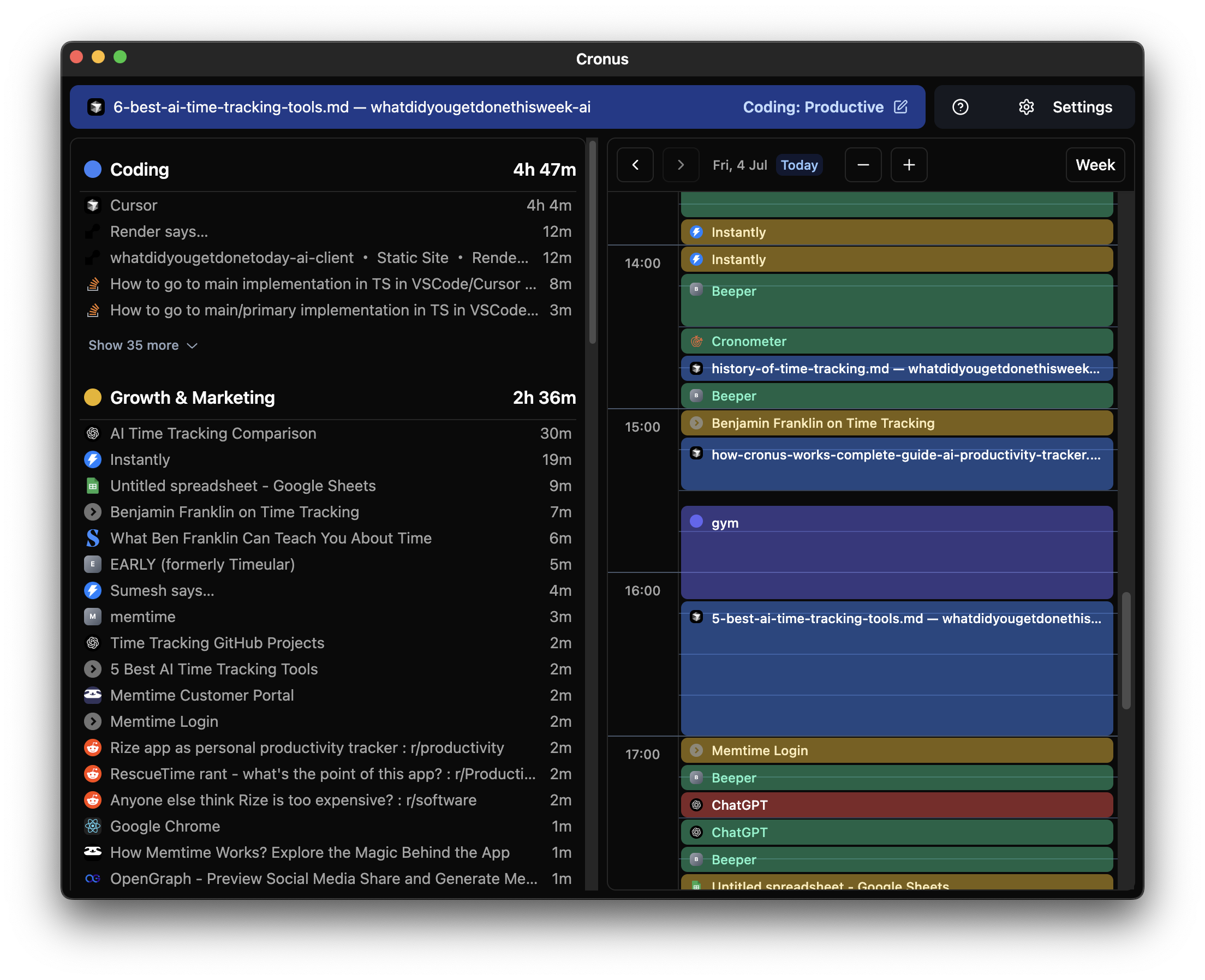
That is what Cronus does. It watches which app and window you are in and works out what the time served, judged against goals you set once. No timer to start, nothing to categorise.
This removes all three failure modes at once. Nothing to interrupt you, nothing to sustain on a bad day, and no reconstruction from memory. It is $6 a month after a 21-day trial, and it never captures your screen — window titles only, with sensitive information redacted on your device.
The trade is honest: some metadata leaves your machine so a model can work out what the activity meant. If that is disqualifying, do it by hand or use something local.
What to actually look at
Total hours is the least useful number in the report. Everyone starts there and learns nothing.
Look at these instead.
Longest unbroken block. The best single proxy for whether real thinking happened. If it is 25 minutes, that explains most of the week on its own.
Number of distinct contexts. High context count with flat hours means depth traded for volume.
Where your best hours went. Most people have two or three genuinely effective hours a day. The question is not how many hours you worked. It is what occupied those.
Share of day that is not project work. Usually 40–60%. Knowing yours makes planning realistic for the first time.
Estimate versus actual. Guess before, compare after. Your personal multiplier is usually 1.5x to 3x.
What to expect
The first week is uncomfortable, and that is the system working.
The total will be lower than the number in your head. The shape will be worse — more scattered, with deep work squeezed into a smaller window than it felt. Your biggest time sink will probably not be the one you would have named.
Most people expect the answer to be distraction. Measured, it is usually fragmentation: fifty small switches, none of which felt like anything.
After the audit
Change one thing. Not five.
The most common useful changes, in order:
- Move one recurring meeting out of your best hours.
- Batch messages into two windows instead of continuous.
- Protect one block a day and treat it as an appointment.
Then measure again in a month and see whether it moved. That second measurement is the part almost nobody does, and it is the only way to know if the change worked.
Sources
Read next
- Time Blocking: Why It Fails — what to do with the numbers once you have them.
- Where Did My Day Go? — the four places the hours actually turn up.
- Seven Time Perception Experiments — smaller tests you can run in a day.
- Time Tracking Spreadsheet — a template, and when to stop using it.
- What Benjamin Franklin Got Right — the first person to do this, and what surprised him.
- What Is Quantified Self? — the wider tradition this sits in.
- r/ADHD versus r/productivity — every self-tracking writeup reports a worse number than expected.
Prefer a guided version? The newsletter below walks you through a five-day audit, one short email a day.
If you would rather do the arithmetic by hand, the free time calculators cover the hours, timesheet and duration maths a manual audit needs.
Find out where your week actually goes
The 5-day time audit: one short email a day, walking you through the experiments in this post. You will end the week with a real answer instead of an impression. Free, no app required, and it ends after five days.