ADHD Symptoms in Women: Why They Get Missed
The picture most people carry of ADHD is a boy who cannot sit still.
That picture is why a lot of women reach their thirties or forties before anyone suggests it. Not because their symptoms were mild. Because their symptoms did not look like the picture.
Written by people who build a time tracker, not clinicians. This is a plain summary of what is documented, not diagnosis or treatment advice. If any of it lands, talk to a doctor.
The gap, in numbers
In the US, about 5.4% of men have an ADHD diagnosis against 3.2% of women. That is a diagnosis rate roughly 69% higher for men.
The age gap matters as much as the rate. Men are typically diagnosed between 11 and 22. Women, on average, between 16 and 28 — and a large group much later than that, in their forties and fifties.
Nothing suggests the underlying condition is that unevenly distributed. What differs is how it presents, and what the criteria were built to catch.
Why the criteria miss it
The presentation is more often inattentive. Women and girls tend to show inattentive symptoms rather than hyperactive ones. Inattention is quiet. It does not disrupt a classroom, so nobody refers it.
The rating scales are skewed. ADHD rating scales were largely developed on boys, and still lean toward externalised, visible behaviour. A scale looking for a child climbing furniture will not flag a child staring out of a window.
The symptoms get read as personality. Inattention becomes "dreamy". Talkativeness becomes "chatty". Emotional intensity becomes "sensitive". Disorganisation becomes "scatty". Each reading is a description, and each one closes off the question.
Masking is rewarded. Girls are, on average, socialised harder toward organisation, agreeableness and not being disruptive. Many develop elaborate compensation systems early. Those systems work, which is exactly why nobody looks closer — and they are expensive to run.
What it actually looks like
Less "cannot sit still". More:
Internal restlessness. Not physical fidgeting but a mind that will not settle. Often invisible to everyone else.
Exhausting compensation. Lists, alarms, rituals, triple-checking. Systems rebuilt every few weeks when the last one stops working. The output looks organised. The cost is hidden.
Time that does not behave. Chronic lateness despite effort, tasks that take three times the estimate, hours vanishing. See time blindness.
Emotional intensity. Reactions that feel out of proportion, especially to criticism or perceived rejection. Often the most impairing part, and often the part read as a character trait. See RSD.
Overwhelm at ordinary loads. A day that others find manageable arriving as too much, then shutting down. See paralysis.
A long history of underachievement relative to ability. Capable of much more than the record shows, without an obvious reason why.
Anxiety or depression that never fully resolves. Frequently diagnosed and treated first, sometimes for years, because it is the more visible layer.
The hormonal part
This is the piece most general articles skip, and it explains a lot of late diagnoses.
Estrogen affects the brain directly. It supports neurotransmitter activity involved in executive function, attention, motivation, verbal memory, sleep and concentration. When estrogen drops, those get harder.
So symptoms can track hormonal change:
- Worse in the days before a period
- Changing sharply during pregnancy and postpartum
- Frequently worst during perimenopause
That last one is why a large group of women reach their forties or fifties, find that coping strategies which worked for decades suddenly stop, and only then get assessed. The condition did not appear. The compensation stopped being enough.
There is active research on adjusting stimulant dosing around the menstrual cycle, which tells you the effect is taken seriously clinically.
Why it is expensive to miss
The compensation is the cost.
Running an elaborate manual system to appear organised takes real capacity, all day, for years. It does not show up on any workload measure. Two people with identical jobs are not doing the same amount of work if one is masking through all of it.
That is the direct route into ADHD burnout, which frequently arrives as a collapse rather than a gradual decline, because the scaffolding holds right up until it does not.
Where a time tracker comes in, honestly
Not much. This is a clinical matter and we build software.
The one place it is relevant: the compensation is invisible, including to you. You cannot see how much of your week goes into holding the system together, because it does not feel like separate work. It feels like what having a job is.
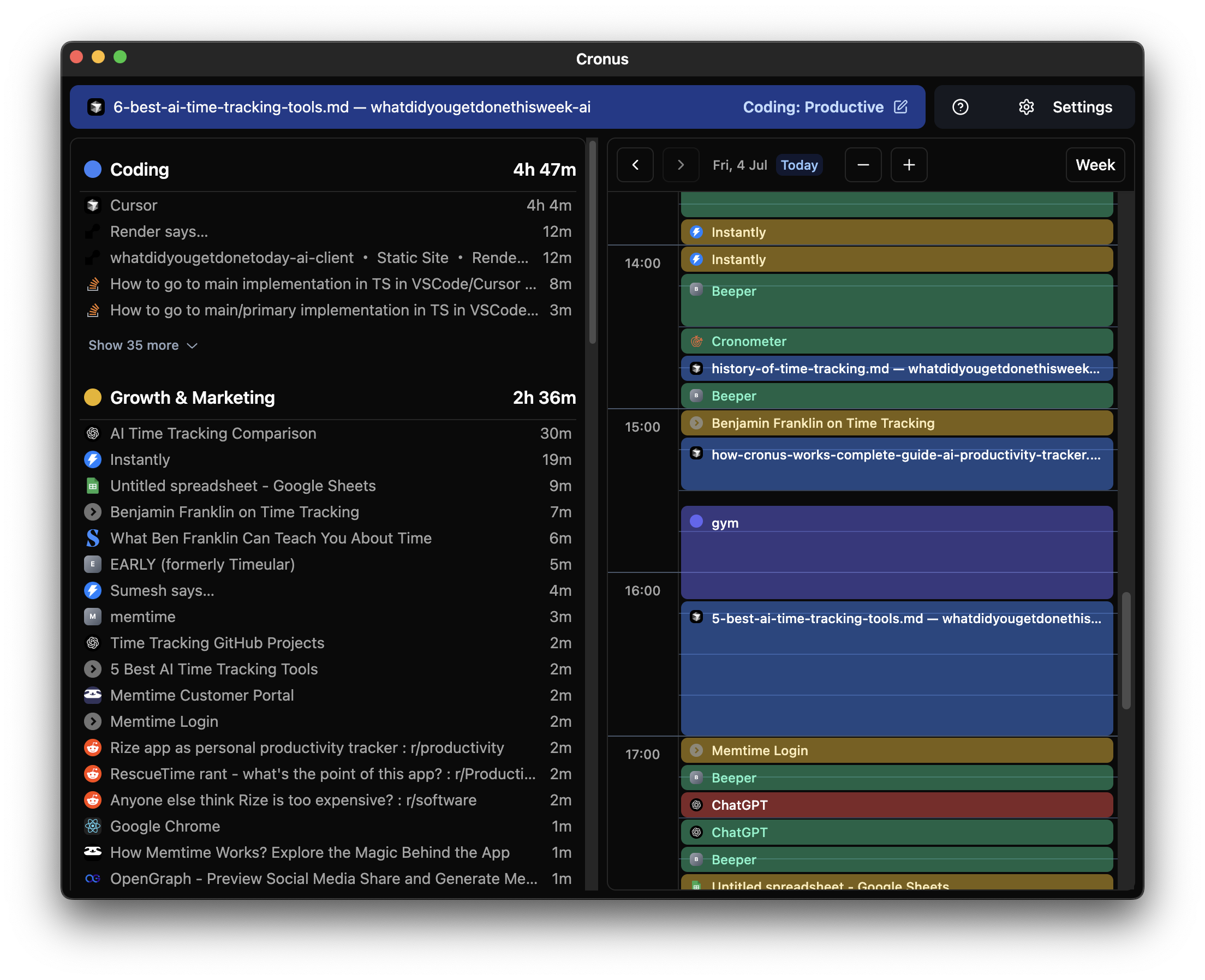
Cronus records where your hours actually go automatically, with no timer and nothing to log, which matters because manual logging is one more system to maintain. Over a few weeks it shows the shape: how fragmented the days are, where the good hours sit, how much goes to admin and rework rather than the work itself.
That is useful for two things. Arranging a week around your actual pattern instead of the one you assume. And having something concrete if you are trying to explain to yourself, or to a doctor, why a normal-looking week is this tiring.
It diagnoses nothing. If this article describes you, the next step is a clinician, not an app.
If you are reading this wondering about yourself
Two things worth holding onto.
Coping well is not evidence against it. The compensation is the symptom pattern, not a refutation of it. "I have a good job, so it cannot be that" is the reasoning that delays most late diagnoses.
A late diagnosis is still worth having. Not to relabel your past, but because the strategies that follow are different from the ones you invented alone, and usually cheaper to run.
Sources
- ADDA: ADHD in Women — signs, symptoms and treatment — diagnosis rates and presentation.
- Cleveland Clinic: ADHD in Women
- ADHD and Sex Hormones in Females: A Systematic Review
- ADHD in women during (peri)menopause: missed diagnoses
- ADDitude: ADHD in women, misunderstood and undertreated
Read next
- ADHD Burnout — what masking costs over years.
- ADHD Time Blindness — the symptom people most often think is a character flaw.
- Rejection Sensitive Dysphoria — and what the evidence for it actually is.
Find out where your week actually goes
The 5-day time audit: one short email a day, walking you through the experiments in this post. You will end the week with a real answer instead of an impression. Free, no app required, and it ends after five days.