11 Best AI Time Tracking Tools in 2026
Do you know how many hours you actually worked last week? Not how many you were at your desk. How many went into the thing you were trying to get done.
Almost nobody can answer that from memory, and the research suggests we are not just vague about it but systematically wrong. That is the gap these tools exist to close.
A lot has changed in this category over the past year. Prices went up and got more complicated, nearly everyone bolted an AI chat interface onto their product, and "AI credits" arrived as a way to meter the one feature you actually wanted. Here is where things stand in August 2026.
If you are still working out what AI time tracking is, how accurate it is and what each type can see, start with the explainer. This page assumes you have decided you want one and are choosing between them.
First: "automatic" and "AI" are not the same thing
This distinction does most of the work in this comparison, so it is worth being clear about up front.
Automatic tracking means the app records what you did without you starting a timer. Nearly everything on this list does this. It is a solved problem and has been for years.
AI categorization means the app works out what that activity meant without you telling it. This is much rarer than the marketing suggests. Most tools labelled "AI-powered" are running a list of known domains, and when they meet something outside that list, they ask you.
The test is simple: open a tool or a site the app has never seen, and see whether it categorizes it correctly or hands you a dropdown.
1. Cronus: genuinely automatic, and the cheapest of the paid tools
Price: $6/mo, after a 21-day free trial
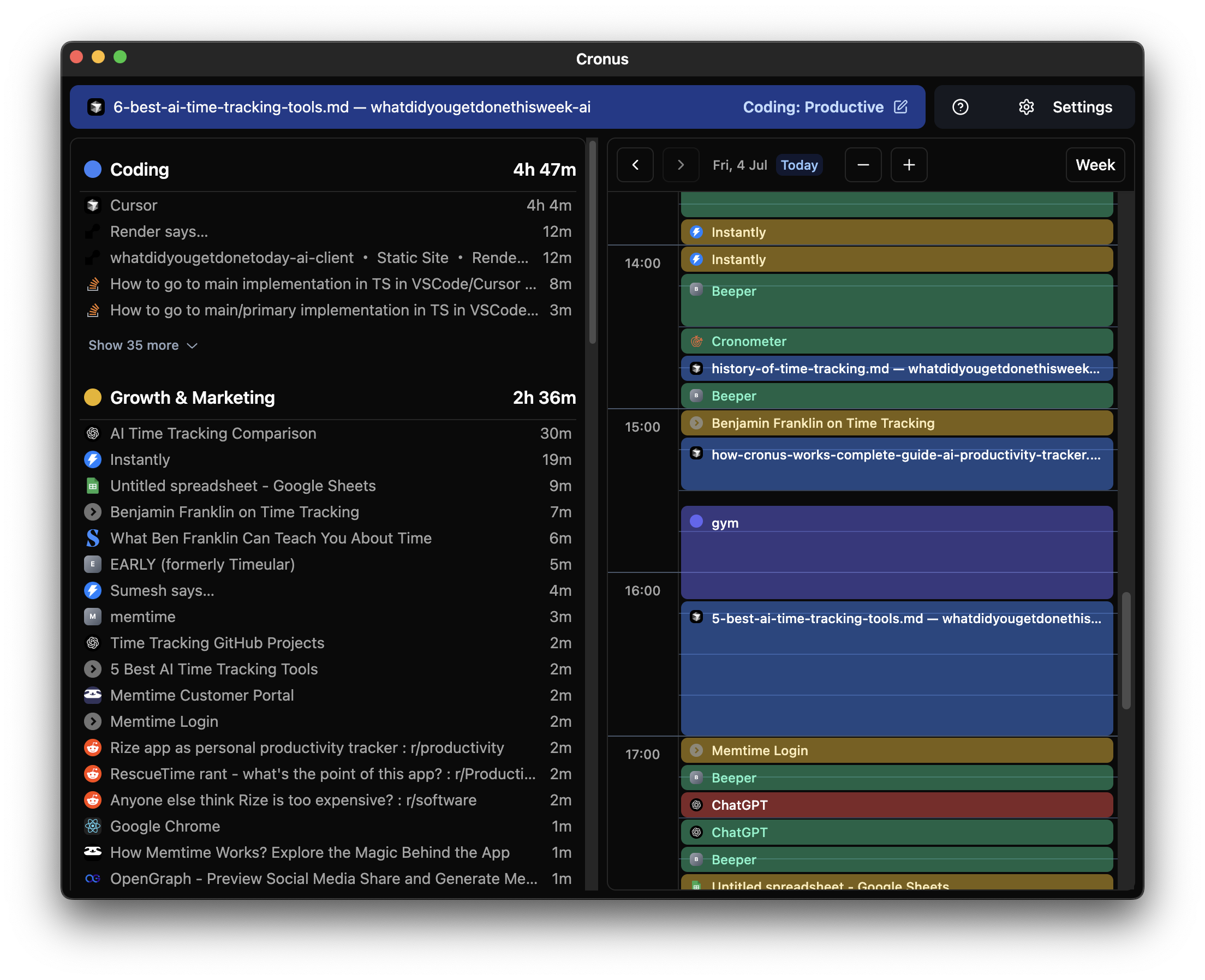
Cronus reads the app you are in, the window title, and the browser URL, and uses an AI model to infer what you are doing from that context. There is no rule list to maintain, so an unfamiliar tool gets categorized correctly the first time it appears.
The bigger difference is that Cronus is goal-aware. You tell it what you are trying to get done, and it judges activity against that. The same YouTube video is research when you are learning a library and a distraction when you are not. Rule-based tools cannot make that distinction because it is not a property of the URL.
What else is worth knowing:
- Ambient, not interrupting. No wall slammed in front of a website, and no alert to dismiss. Two live counters sit in the menu bar, either side of the notch on Macs that have one, showing productive and unproductive time as it accumulates. Information in your eyeline rather than a demand for attention, which is the difference between a tool you keep and one you disable in week two.
- Calendar integration so meetings and offline time land in the timeline automatically.
- AI that runs on your Mac. A small model categorizes on your Mac, so the text on your screen never leaves it. Only metadata (app names, window titles, URLs and categories) syncs to our servers. We are GDPR compliant. You can pause tracking or revoke permission at any time. See our privacy policy.
- $6 a month, after a 21-day free trial. No tiers, and no credit meter on the one feature you came for. The trial only counts days you actually use it.
Where it is not the answer: no invoicing, no client billing reports, no API or webhooks. If you bill hours to clients, look at Timely or Rize Pro.
2. Rize: capable, and considerably overloaded
Price: $12.99 / $28.99 / $49.99 per month, plus custom Enterprise
Rize is the most feature-dense product in this category, and that is its central problem.
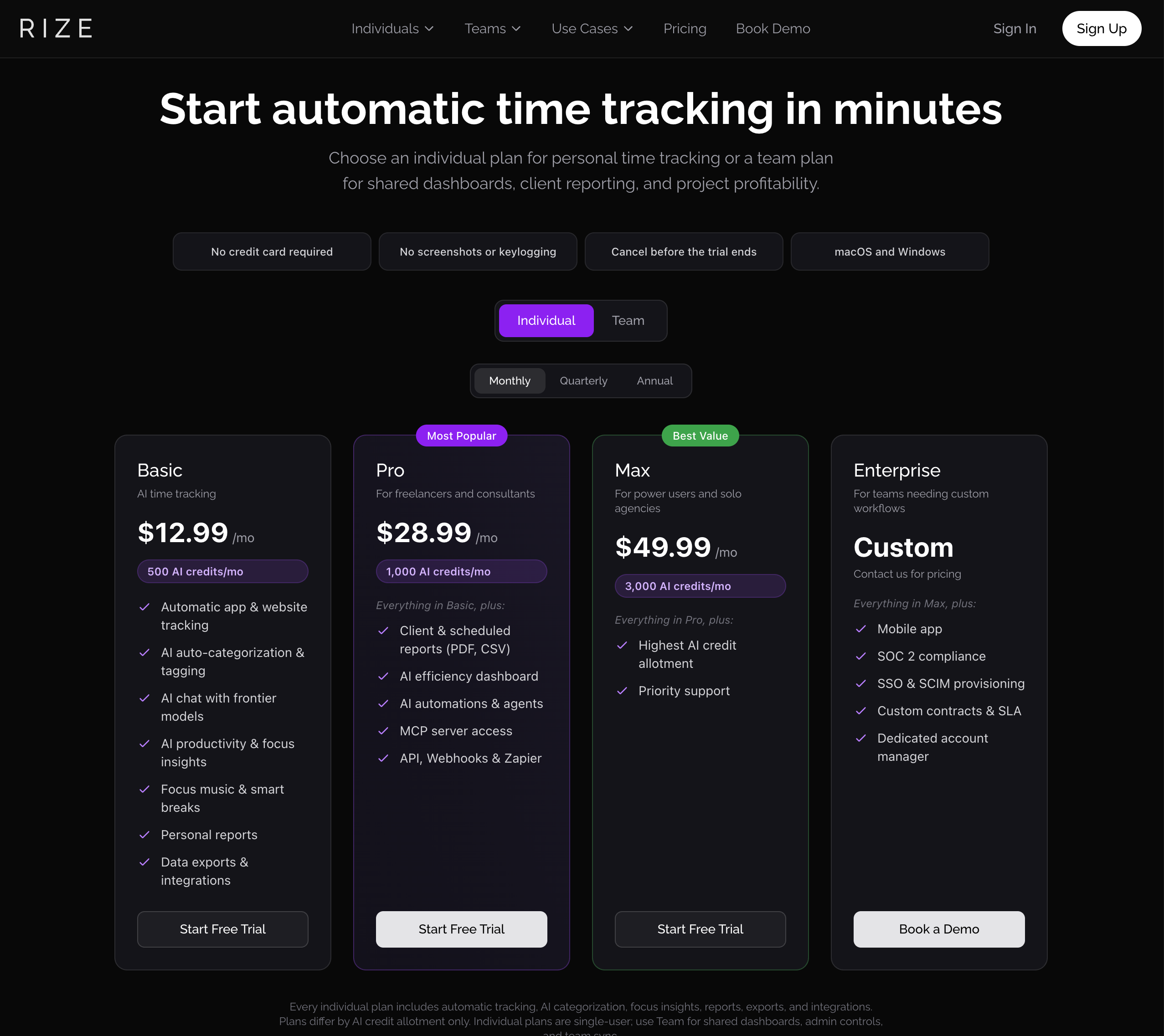
A Basic subscription now includes automatic tracking, AI auto-categorization and tagging, AI chat with frontier models, AI productivity and focus insights, focus music, smart breaks, personal reports, and exports. Pro adds an efficiency dashboard, AI automations and agents, an MCP server, an API, webhooks and Zapier.
Every individual plan is metered by AI credits: 500 a month on Basic, 1,000 on Pro, 3,000 on Max. Their own fine print says plans "differ by AI credit allotment only," which means $49.99/mo buys you more credits and priority support over the $28.99 tier and nothing else.
The categorization is also still substantially rule-driven. When Rize meets something outside its ruleset, it asks you to classify it:
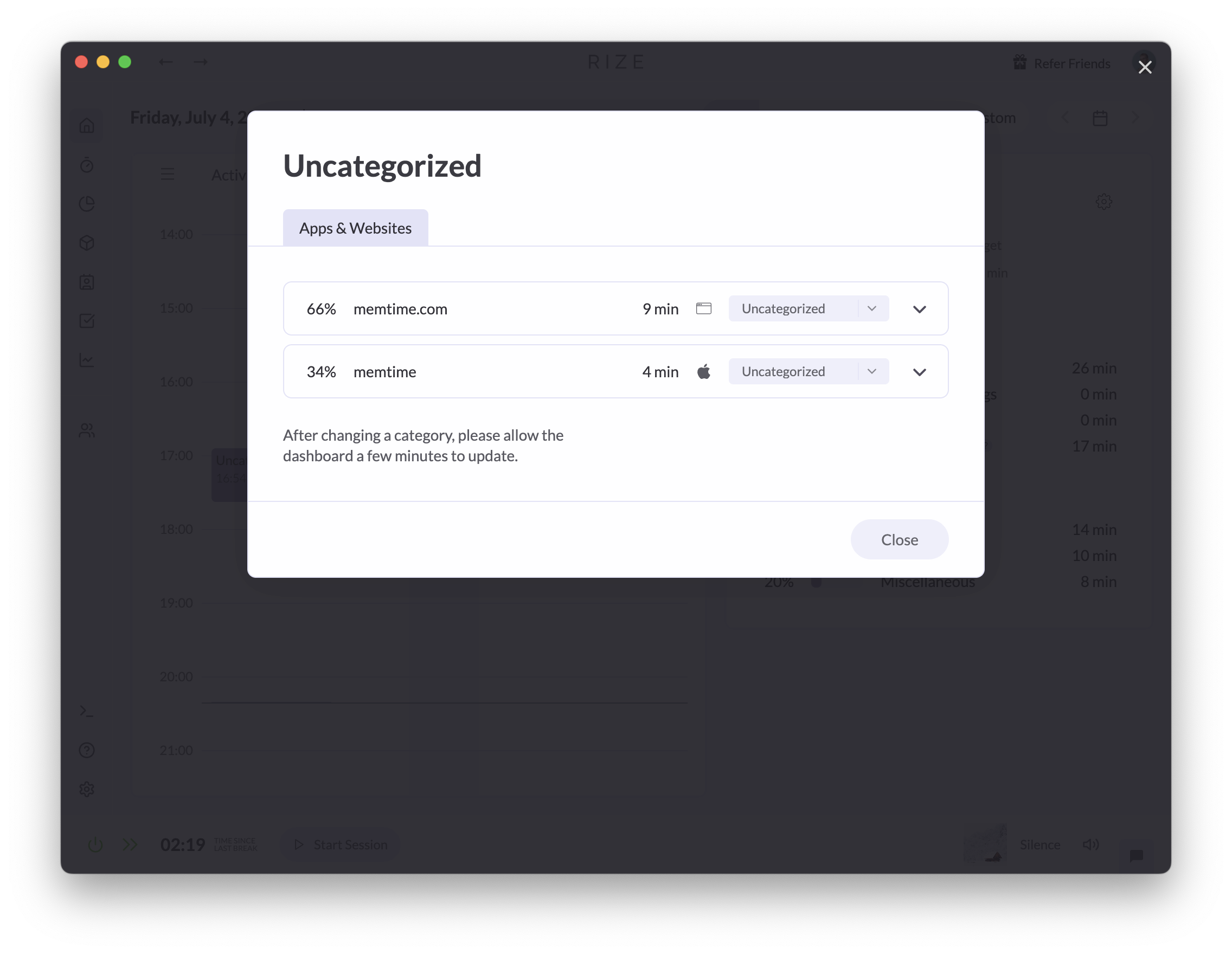
The job here is not complicated: tell me where my time went. Rize asks you to have opinions about credit allotments, focus music and MCP servers first.
Worth saying: it is actively maintained (3.0.26, July 2026), the trial is a genuine 7 days with no card, and if you need the API and client reporting, Pro delivers them.
3. RescueTime: the incumbent, still thorough, still dated
Price: Focus $7/mo annual ($9 monthly), Solo+ $12/mo annual ($15 monthly). A free "Lite" tier exists, and there is a 14-day trial.
RescueTime has been at this longer than anyone and the data collection is genuinely solid. It is also the cheapest credible paid option here, and one of the very few with any free tier at all.
The complaint that keeps recurring is that thorough is not the same as actionable. The dashboard offers a great deal of charting and comparatively little guidance about what to change, and the interface shows its age.
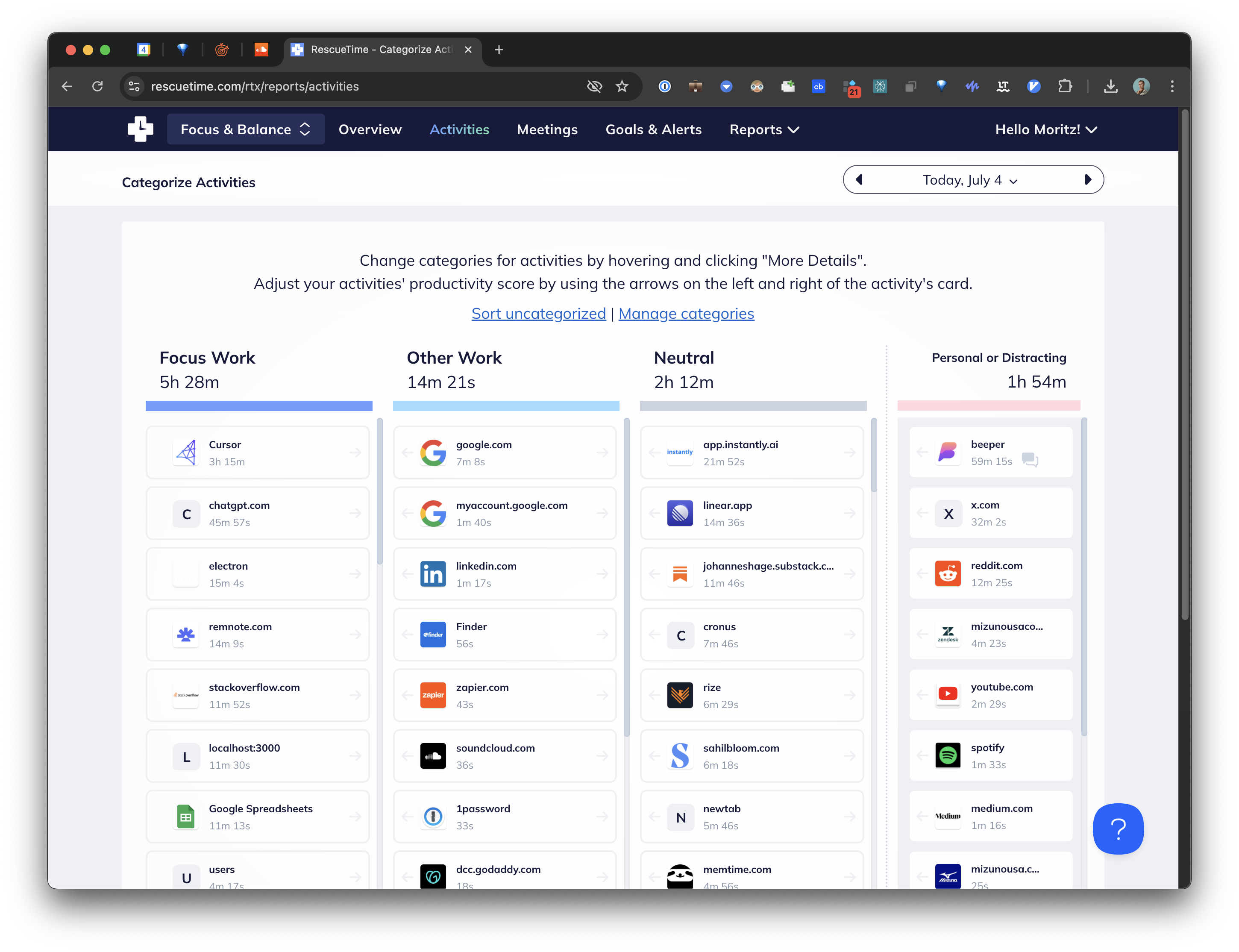
Mobile and desktop data also remain siloed, and the macOS app is closer to a repackaged mobile app than a native one.
4. Timing: the Mac veteran, if your projects are stable
Price: from ~$10/mo · 30-day free trial, no card · macOS only
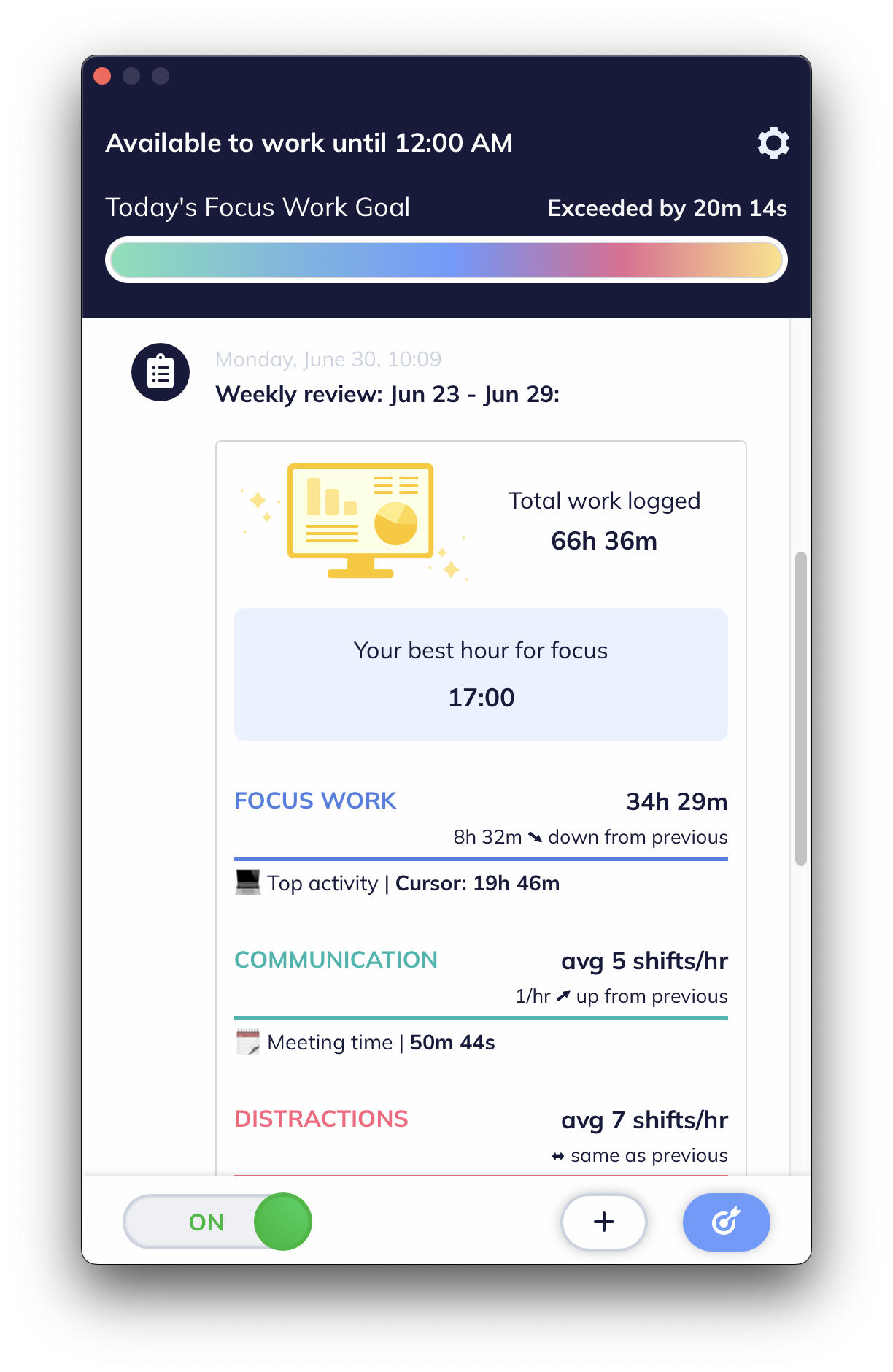
Timing has been doing automatic tracking on the Mac longer than most of this list has existed, and it pulls iPhone and iPad usage from Apple Screen Time into the same timeline on the Mac. If phone calls and tablet reading are invisible hours in your week, it closes that gap without another app.
Data is stored locally, with sync and cloud backup optional rather than required, and the trial is the most generous in the category by a distance.
The catch is how it decides what things mean: projects are assigned through keyword and rule associations you set up and maintain. That is fine when your work maps onto stable projects, and awkward when most of your day happens in the same handful of apps, since a rule engine cannot distinguish this hour in your editor from that one. Reviewers consistently mention both the setup cost and ongoing manual reassignment.
Full head-to-head: Cronus vs Timing.
5. Timely: the best option if you bill clients
Price: from around $11 per user per month
Timely's Memory app records activity in the background and its AI drafts timesheet entries that you approve. For consultancies and agencies, this is the strongest product on the list: the entries become invoices, so a human review step is a feature rather than friction.
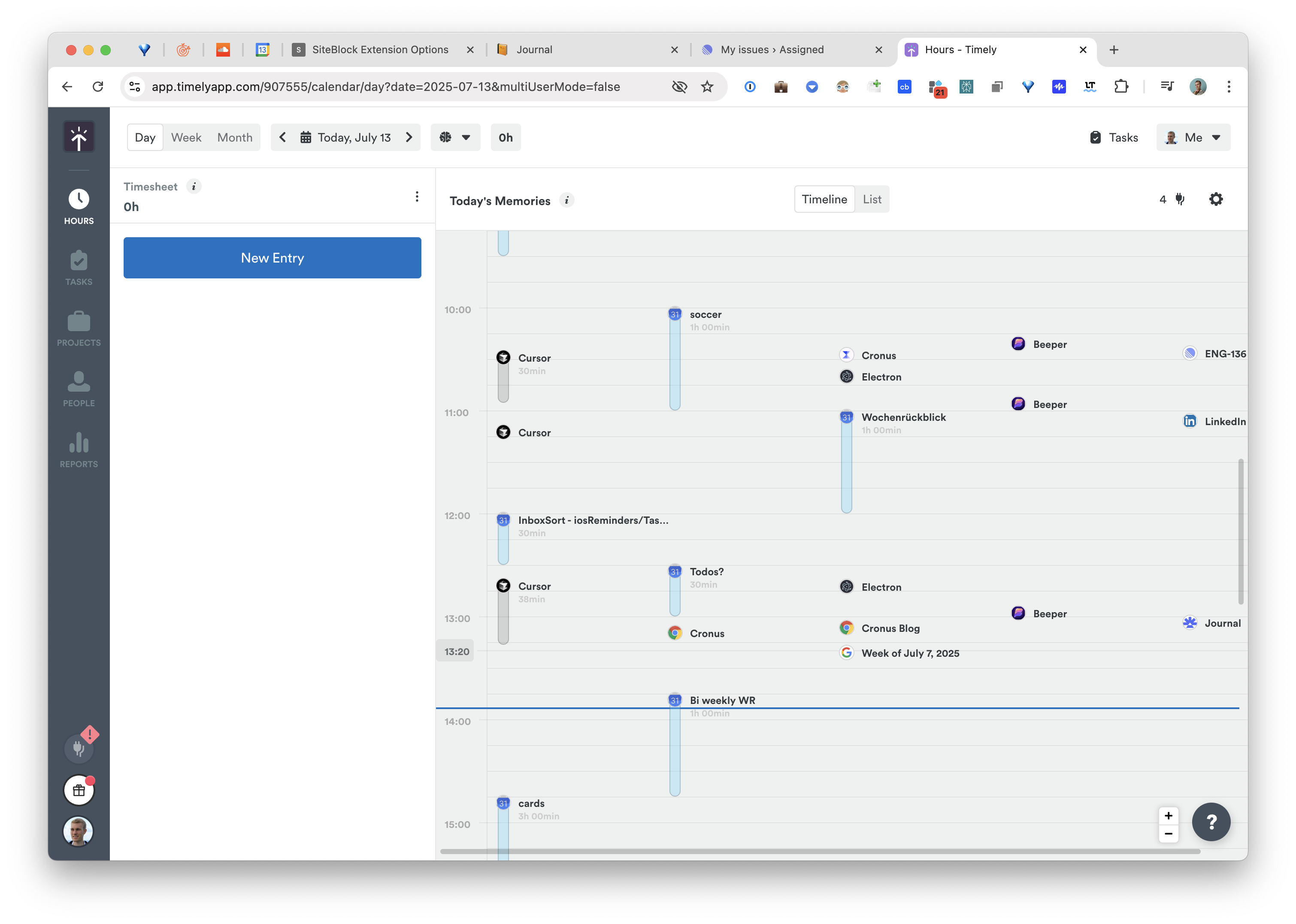
For an individual who just wants to know where the week went, that same review step is a daily chore attached to a tool that promised to remove one. Memory also runs separately from the main interface, which makes the workflow feel more fragmented than it should.
6. Memtime: fully local, no interpretation
Price: from $14/mo annual, $18/mo quarterly, up to $35/mo on Premium. 14-day trial, no free tier.
Memtime captures application activity and window titles entirely on-device. Nothing is processed server-side, which is the strongest local-only guarantee among the paid tools here.
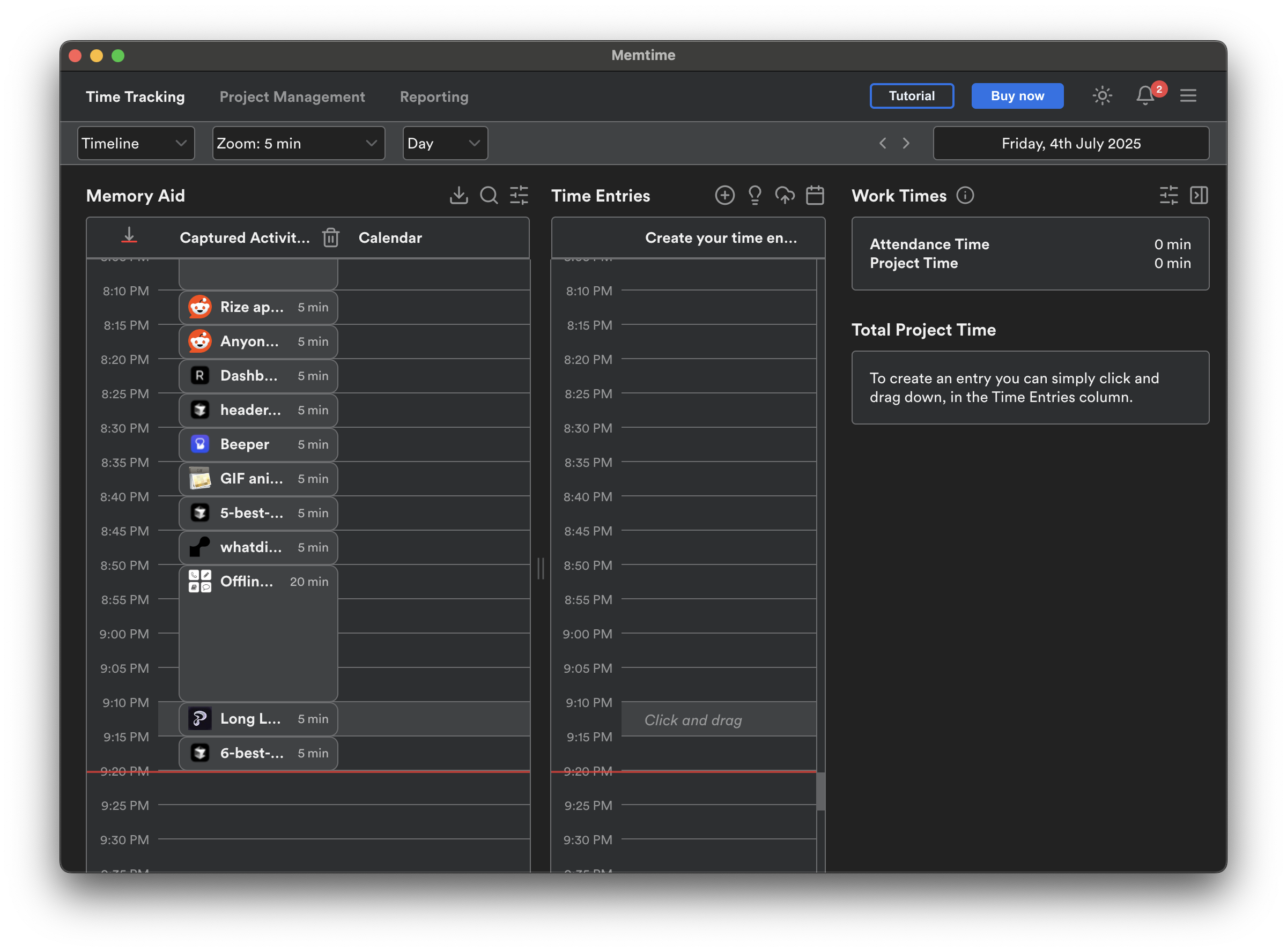
The trade is direct: Memtime does no interpreting. Memtime shows you a complete record of what happened and leaves what it meant to you. Onboarding is also long, and there are recurring complaints online about billing practices and aggressive collections on expired subscriptions, which is worth knowing before you enter a card.
7. Early (formerly Timeular): semi-automatic, with a physical die
Price: paid, with a trial
Early tracks context automatically but stops short of deciding anything: you confirm and categorize what it captured. Its genuinely distinctive feature is an 8-sided Bluetooth cube you flip to switch tasks, which sounds gimmicky and works surprisingly well for people who want a physical ritual rather than a screen.
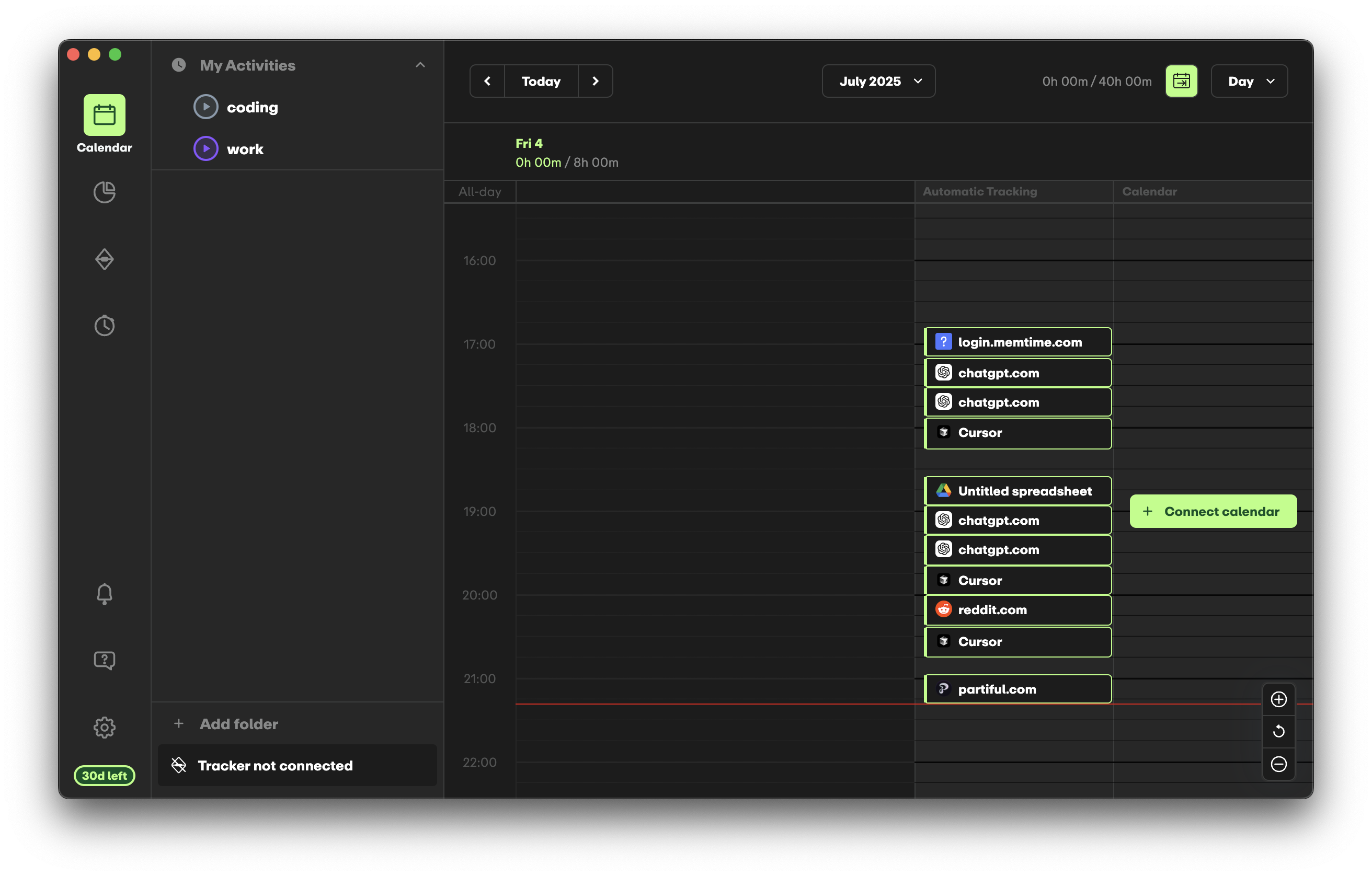
If the flipping appeals to you, nothing else on this list offers it. If you wanted the categorization handled for you, this is not that.
8. ManicTime: on-premise, for organizations that require it
Price: paid, perpetual and subscription options
Founded in Slovenia in 2007, ManicTime's real strength is that you can run it on your own infrastructure, which for some regulated organizations is the only acceptable answer.
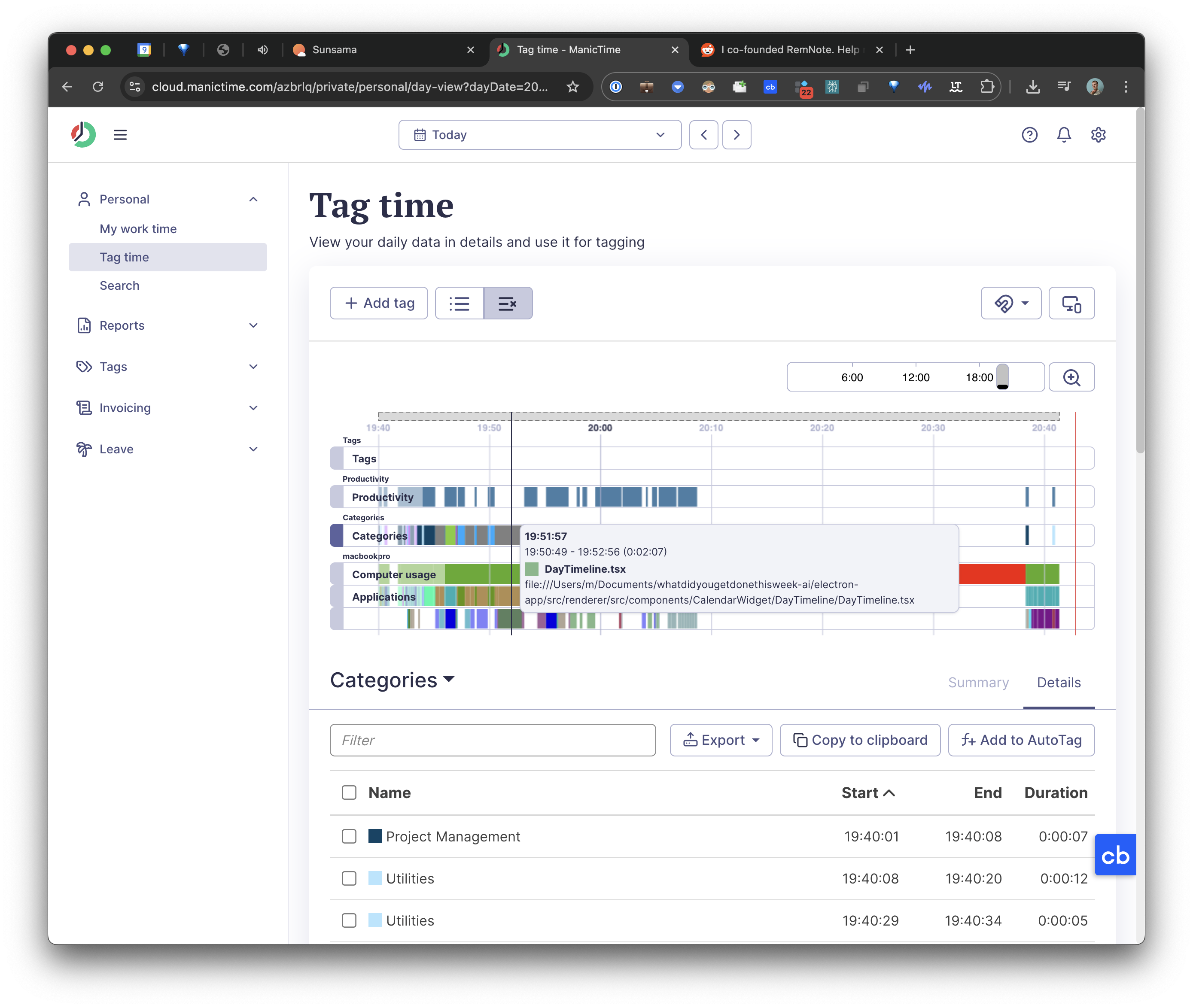
"Automatic" here applies to recording only. Categorization is manual tagging, with no AI assistance, and the interface is of its era.
9. ActivityWatch: free, open-source, entirely yours
Price: free, forever. Open-source and self-hosted.
ActivityWatch is open-source, fully local, and records active applications, window titles, browser activity via extensions, and AFK time. It will run forever without a subscription and answers to nobody.
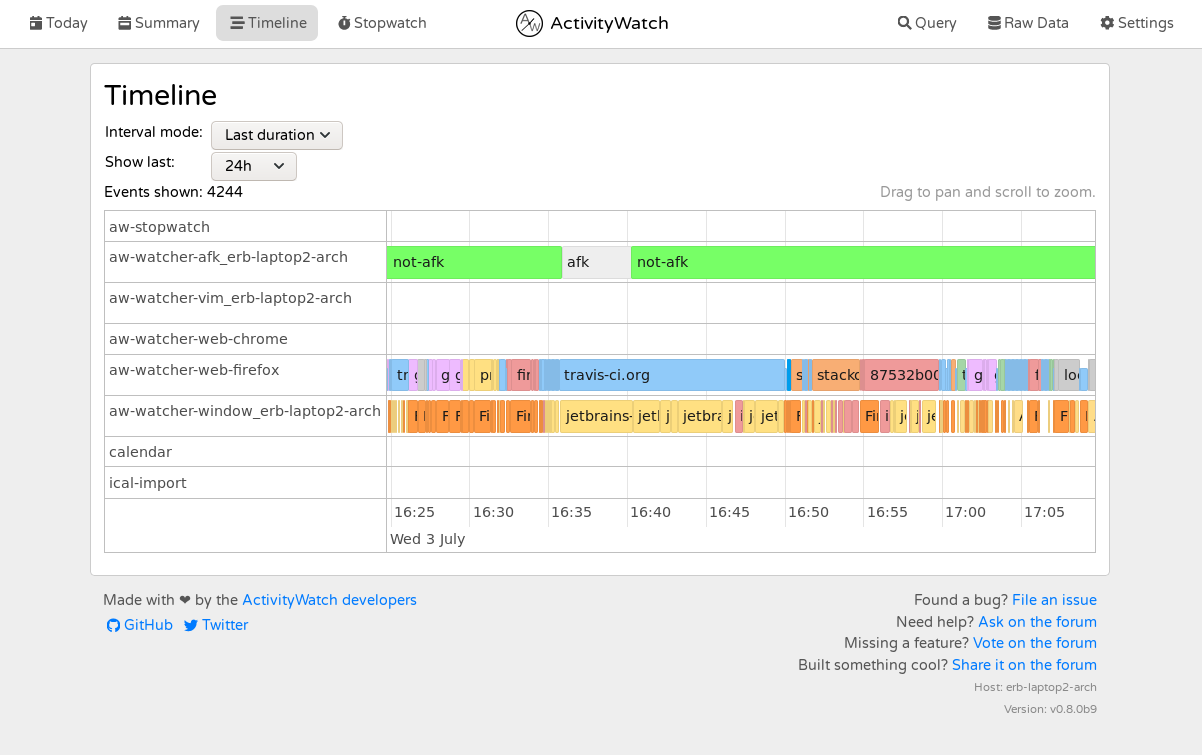
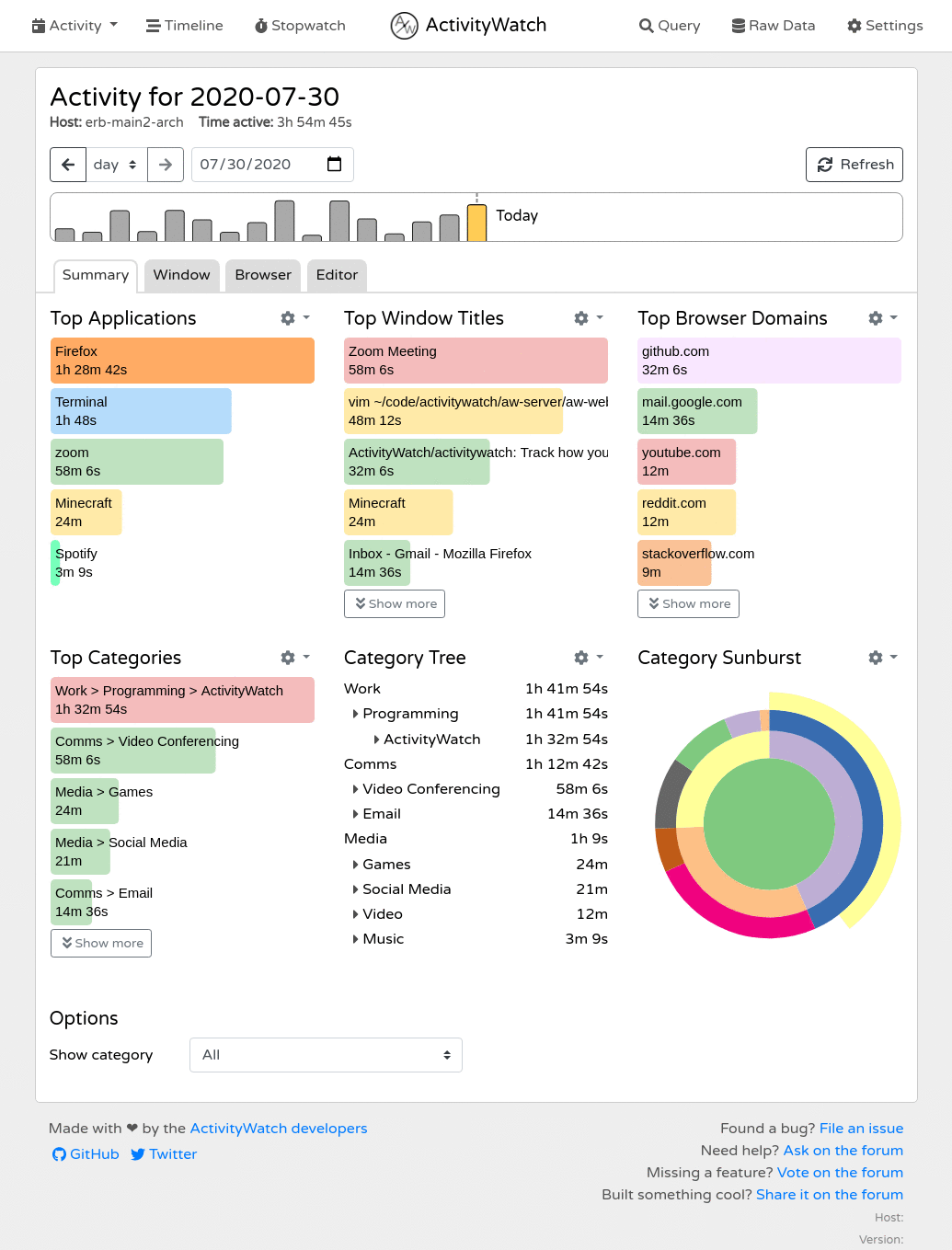
It is also raw. You get events and basic dashboards, not interpretation. Getting real insight means building your own views or accepting a coarse picture. Excellent if that sounds like fun, frustrating if you wanted an answer rather than a dataset.
10. Toggl Track: manual tracking, done well
Price: free tier available, paid plans above it
Toggl is the best manual tracker there is. Reporting and billing are strong, the integrations are everywhere, and its free tier is generous.
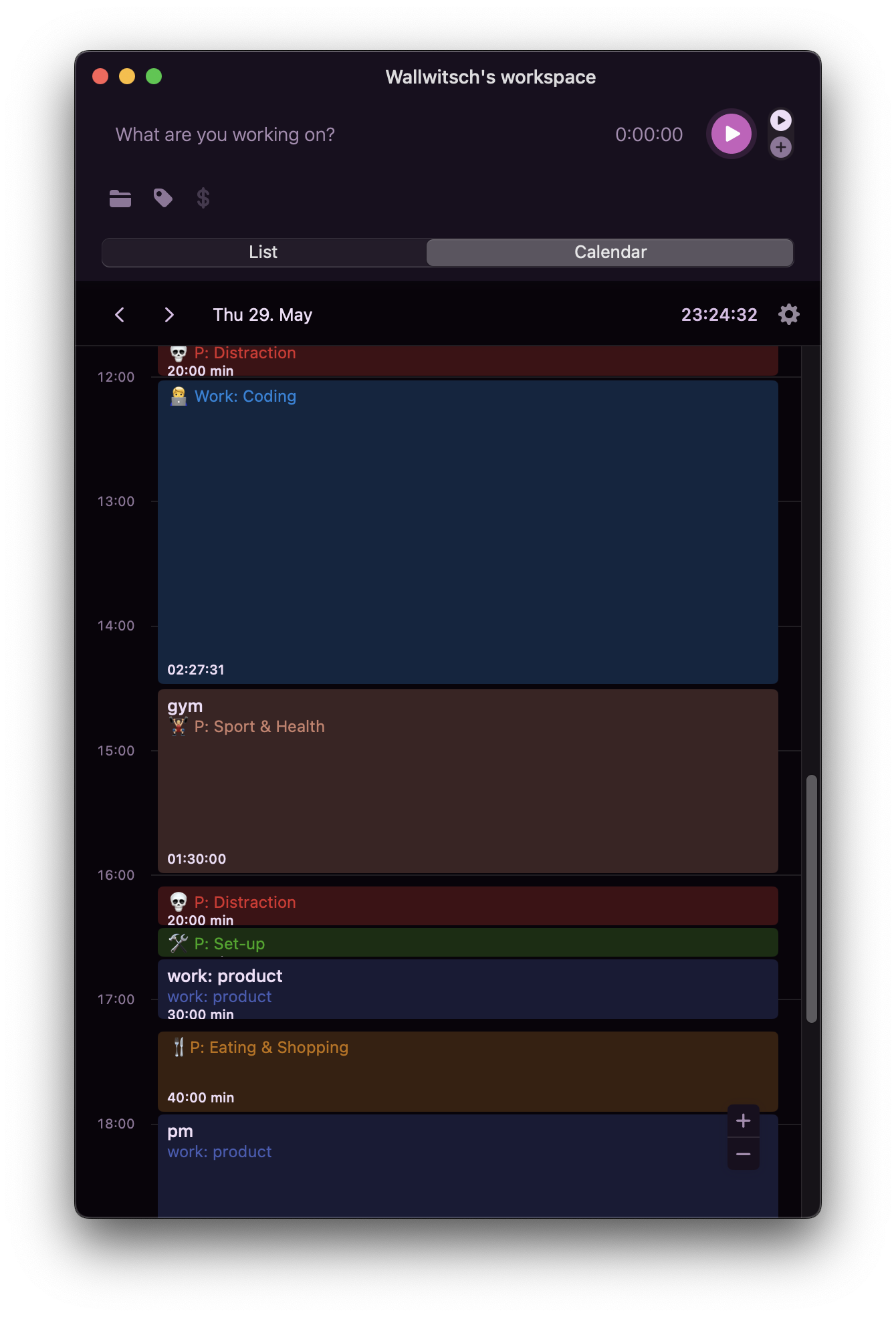
It has added an AI Autotracker that suggests entries from your behaviour and calendar, but the model is still fundamentally that you drive it. The macOS app does show an activity block you can use to reconstruct what you were doing when you forgot to start the timer:
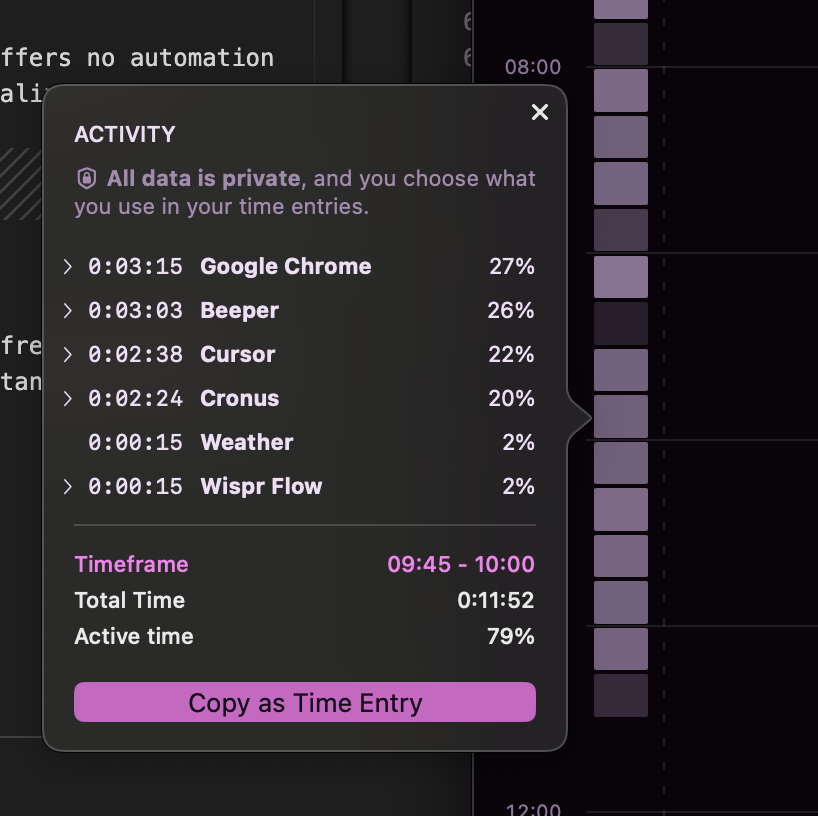
If you already know you will start the timer, Toggl is great. Most people do not.
11. Motion: schedules time, does not measure it
Price: paid, no free tier
Motion belongs on this list because people keep asking about it, and it does not belong in the same category as everything above it.
Motion auto-schedules tasks into your calendar and reshuffles when meetings move. In 2026 it has expanded into project management, AI notes, docs, a meeting scheduler and "AI Employees" agent workflows. It is a large and capable product.
But it points the other way in time. Motion decides how you should spend the hours ahead. It does not tell you where the hours behind you went. If your problem is that you cannot account for last week, Motion cannot help, and if your problem is that you never plan, no tracker on this list will help either. They are complements, not alternatives.
Comparison
| Price | Truly automatic categorization | Metering | Free tier | Screen captured | |
|---|---|---|---|---|---|
| Cronus | $6/mo | Yes, AI on your Mac | No | 21-day trial | No, text read on your Mac |
| Rize | $12.99–$49.99/mo | Partly, rule-assisted | AI credits | No | No |
| RescueTime | $7–$15/mo | Automatic but shallow | No | Lite tier | No |
| Timing | ~$10/mo and up | Keyword rules | No | 30-day trial | No |
| Timely | ~$11/user/mo | AI drafts, you approve | No | No | No |
| Memtime | $14–$35/mo | No, recording only | No | No | No |
| Early | Paid | No, you confirm | No | No | No |
| ManicTime | Paid | No, manual tags | No | Limited | No |
| ActivityWatch | Free | No, raw events | No | Yes, open-source | No |
| Toggl Track | Free tier + paid | No, manual with hints | No | Yes | No |
| Motion | Paid | Not a tracker | No | No | No |
How to actually choose
- You bill clients by project. Timely, or Rize Pro. The approval step is the product.
- You need on-premise or an API. ManicTime for on-premise, Rize Pro or Enterprise for the API.
- Nothing may leave your device. Memtime if you will pay, ActivityWatch if you will tinker. Both leave the interpretation to you.
- You want the cheapest paid incumbent with a long track record. RescueTime.
- You want to know where your time went, with no setup and no rules to maintain. That is exactly what we built Cronus for, and at $6 a month it is the cheapest tool here that categorizes automatically.
Individual comparisons: vs Rize, vs RescueTime, vs Timely, vs Timing.
Download Cronus and find out what last week actually looked like.