Benjamin Franklin on Time Tracking
Dost thou love life? Then do not squander time; for that's the stuff life is made of.
Lost time is never found again.
—Benjamin Franklin

Benjamin Franklin's net worth was an estimated $50 million in today's currency. He was a prolific writer, inventor, and business titan. He was also the first person of his standing to share his time tracking and time blocking system. This system wasn't just about productivity; it was a key part of his lifelong project to achieve "moral perfection" through his 13 Virtues. The schedule was his practical tool for the virtue of Order. In his autobiography (1790) he wrote:
The precept of Order requiring that every part of my business should have its allotted time, one page in my little book contained the following scheme of employment for the twenty-four hours of a natural day:
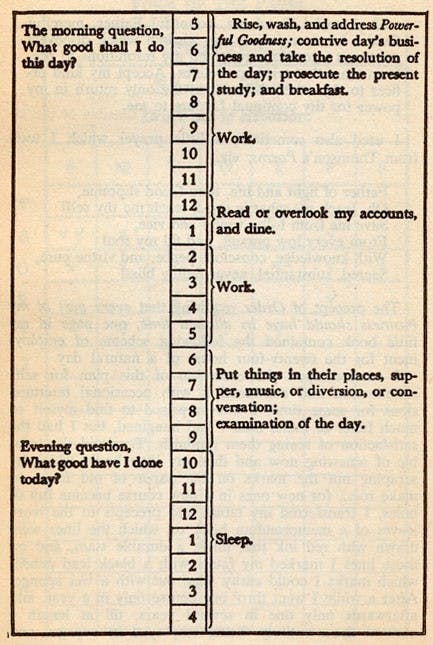
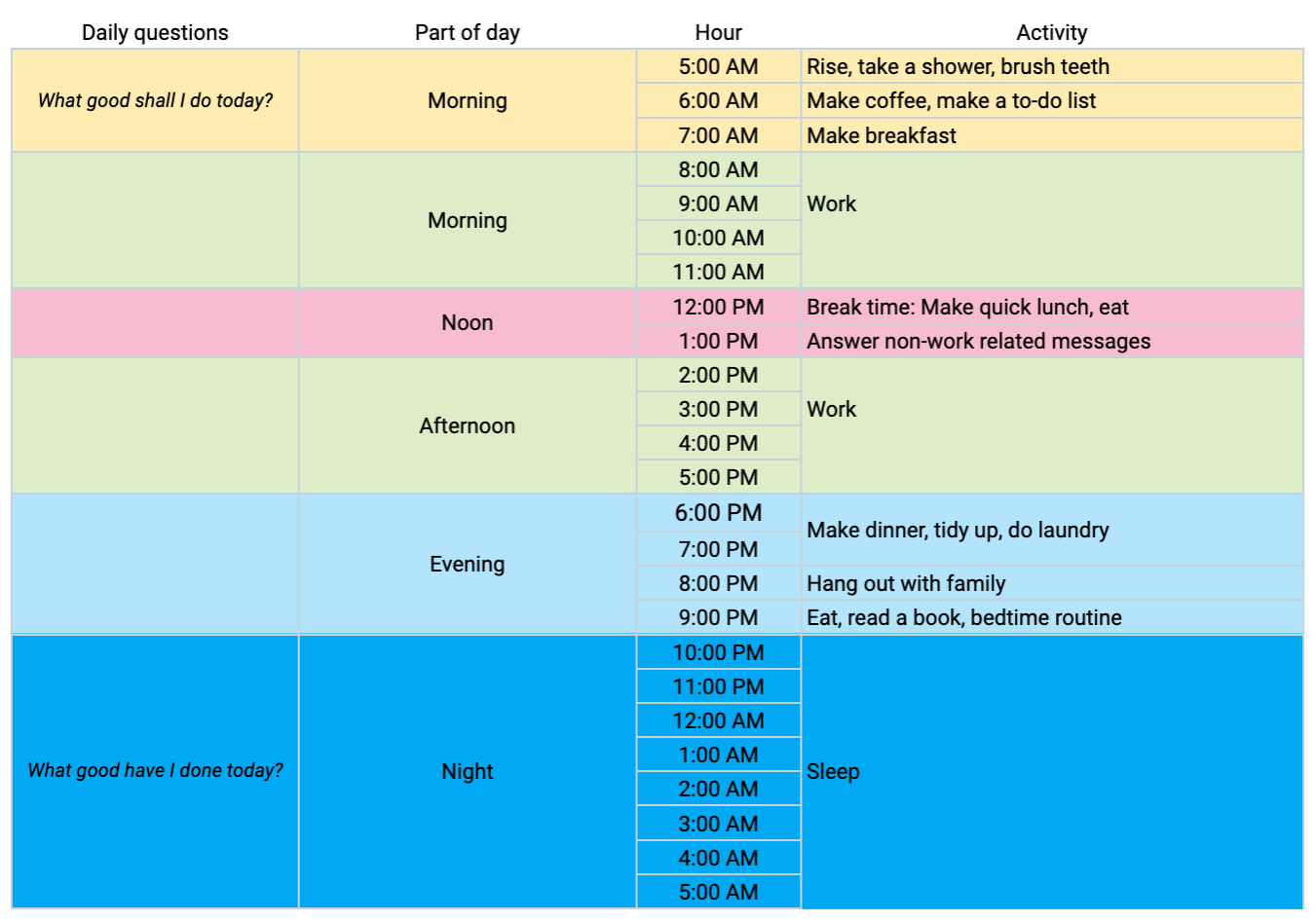
I entered upon the execution of this plan for self-examination, and continued it with occasional intermissions for some time. I was surprised to find myself so much fuller of faults than I had imagined; but I had the satisfaction of seeing them diminish.
From Franklin's "Little Book" to AI Tracking
Franklin's "little book" was his tool for self-examination. This manual tracking revealed a surprising truth: he was "so much fuller of faults than I had imagined." But by diligently tracking, he had the "satisfaction of seeing them diminish."
This is the core principle of improvement: what gets measured gets managed. Do you know how many hours you lose each week to brief distractions on X.com, Reddit, or YouTube? Franklin had to track his "faults" by hand, a laborious process. Today, you don't need to carry a little book to get the same insights. Cronus is the modern equivalent, an AI-powered time tracker that automatically shows you where your day truly goes. It pinpoints distractions and uncovers patterns, giving you the same self-awareness Franklin sought, so you too can diminish your "faults" and reclaim your time.
What we can learn from Franklin's time tracking system
In his autobiography he dedicated time each morning to "prosecute the present study" meaning he decided time to learn and follow his curiosities. How much time do you spend every day doing this? Writing blog posts, reading books, learning new skills, etc. If you want to learn how much time you spend on tasks like this you can use Cronus to track your time using AI. Our ai calendar integration and manual-tracking feature also make it effortless to track how your spend your time when you're away from your computer.
Franklin found the same thing modern science keeps finding
Go back and read that one line again, because it is the most modern sentence in the autobiography:
I was surprised to find myself so much fuller of faults than I had imagined.
Franklin is describing the gap between his estimate of his own conduct and the measured record of it. He expected to be better than he was. The measuring is what told him otherwise, and he found the result surprising despite being the person who lived every one of those days.
Two hundred and thirty-six years later, that gap has been quantified.
In 2025, METR ran a randomized controlled trial on experienced software developers. Using AI tools, they were 19% slower. Asked afterwards, they estimated they had been 20% faster: a roughly forty percentage point error about work they had personally just completed. We wrote about it in full here.
Levels CEO Sam Corcos guessed he spent 20 minutes a day on social media and news. It was over three hours.
Different centuries, different methods, same finding. People are surprised by their own records, and always in the flattering direction. Franklin's response was a little book and daily self-examination, which is why almost nobody replicated it: the discipline required to measure your faults is roughly the discipline that would have prevented them.
That is the one thing that has genuinely changed. The measuring no longer costs the discipline. Cronus keeps the record for you, automatically, with no timers and no book to carry.
The surprise, unfortunately, is still included.