Hyperfixation
Hyperfixation is intense, sustained absorption in one subject or activity, during which most other things stop registering. Meals, messages, sleep, the rest of your to-do list, and above all the passage of time.
It is not a formal diagnosis. You will not find it in the DSM-5. It is a community term, mostly from ADHD and autistic communities, describing something real that clinical language never named well.
That informality is worth knowing, because it means definitions vary. Here is the version that is actually useful, starting with the distinctions that get muddled everywhere else.
Hyperfixation vs hyperfocus vs special interest vs obsession
These four get used interchangeably. They are not the same thing, and one of them matters clinically.
| What it attaches to | How long | How it feels | |
|---|---|---|---|
| Hyperfocus | A task | Hours, one sitting | Absorbed, productive, hard to exit |
| Hyperfixation | A subject or interest | Days to months | Consuming, urgent, crowds out other things |
| Special interest | A subject, often lifelong | Years, sometimes permanent | Joyful, restorative, part of identity |
| OCD obsession | An intrusive thought | Recurring, unwanted | Distressing, anxious, not enjoyed |
Hyperfocus is about a task and a session. You sit down to fix one bug and stand up four hours later. It ends when the task ends. We wrote about it separately in ADHD hyperfocus.
Hyperfixation is about a subject and a stretch of life. For six weeks it is bread, or a band's discography, or medieval sword forging. You think about it in the shower. Then one day it is simply gone, often without warning, and the sourdough starter dies in the fridge.
A special interest is the autistic version, and it is generally not a problem to be solved. The distinction most people miss: special interests tend to be stable, returned to over years, and genuinely regulating. Autistic people frequently describe them as the thing that makes everything else bearable. Treating one as a symptom to be managed is usually a mistake.
An OCD obsession is a different category entirely, and the difference is whether you want it. Hyperfixation feels good, or at least compelling. An OCD obsession is unwanted, distressing, and the compulsions that follow are attempts to relieve anxiety rather than to enjoy anything. If what you are describing is intrusive and unpleasant rather than absorbing, that is worth raising with a doctor, because it responds to specific treatment and time management advice will do nothing for it.
Why it happens
The common framing is that ADHD is a deficit of attention. It is closer to say attention is poorly regulated: hard to direct at will, and hard to withdraw once engaged.
An interest-based nervous system allocates attention to novelty, interest, challenge and urgency, rather than to importance. When something hits those, engagement is not effortful. It is closer to automatic, and the same mechanism that makes starting a boring task feel impossible makes stopping an interesting one feel impossible.
That symmetry is the part people miss. Hyperfixation and task paralysis are the same regulation problem pointed in opposite directions, which is why someone can lose an entire weekend to a new hobby and still not answer an email that takes four minutes. It is not hypocrisy or a willpower failure, and reading it as one causes a great deal of unnecessary shame.
For the autistic version there is a more specific and better-grounded account: monotropism, the theory that autistic attention runs as a single deep channel rather than several shallow ones. Worth reading if this describes you, because it reframes the whole thing as an attention style rather than a defect.
What it costs, and why you cannot feel it
Hyperfixation is not automatically a problem. Plenty of expertise, art and career-defining work comes out of it, and a great deal of writing on this subject is unnecessarily pathologising.
The costs, when they come, are specific:
Time you cannot account for. Not "a bit longer than planned" but whole days with no internal record.
Everything else stops. Bills, replies, laundry, other people. The cost lands on whatever was not the fixation.
Physical neglect. Not eating, not drinking, not sleeping, not moving for long stretches.
The crash. When the fixation ends, the accumulated backlog arrives at once, alongside a flat, depleted feeling. That combination is one of the more reliable routes into burnout.
The reason these accumulate is that hyperfixation is invisible from the inside while it is happening. Time perception depends partly on noticing that time is passing, and the defining feature of the state is that you are not monitoring anything outside the fixation. So there is no moment where you register "this has been five hours".
People are unreliable about this even under normal conditions. In a randomised controlled trial, experienced developers estimated that a tool had made them 20% faster on real tasks from their own repositories. Measured, they were 19% slower: a forty percentage point error about work they had just finished, while concentrating, with no fixation involved. The full study is worth reading. Self-estimates during a hyperfixation are not going to be better than that.
This is why "just set a timer" fails. A timer requires you to have decided, in advance, that this session needed one. Hyperfixation rarely announces itself at the start. It starts as looking something up.
What actually helps
Nothing here is about stopping hyperfixating. That is neither achievable nor obviously desirable.
Use external interrupts, not internal ones. Anything relying on you noticing something is relying on the exact faculty that is offline. A person, an alarm across the room, a scheduled call. Something in the world, not in your head.
Make the interrupt require movement. A dismissible notification loses to a fixation every time, because dismissing costs nothing. An alarm you have to stand up to silence works, because the standing up breaks the state.
Set up the environment before you start, not during. Water, food within reach, and, if it applies, medication taken. During is too late; there is no during.
Let it run when the cost is low. A Saturday with nothing scheduled is what hyperfixation is for. The problem is a Tuesday with a deadline, and you can separate them.
Ride it deliberately when it lines up with real work. If the fixation happens to be aimed at something that matters, that is the most productive state available. The skill is recognising it, not suppressing it.
Expect the ending and plan for the backlog. Fixations end. Knowing the crash is coming makes it a phase rather than evidence of failure.
Seeing the time you cannot see
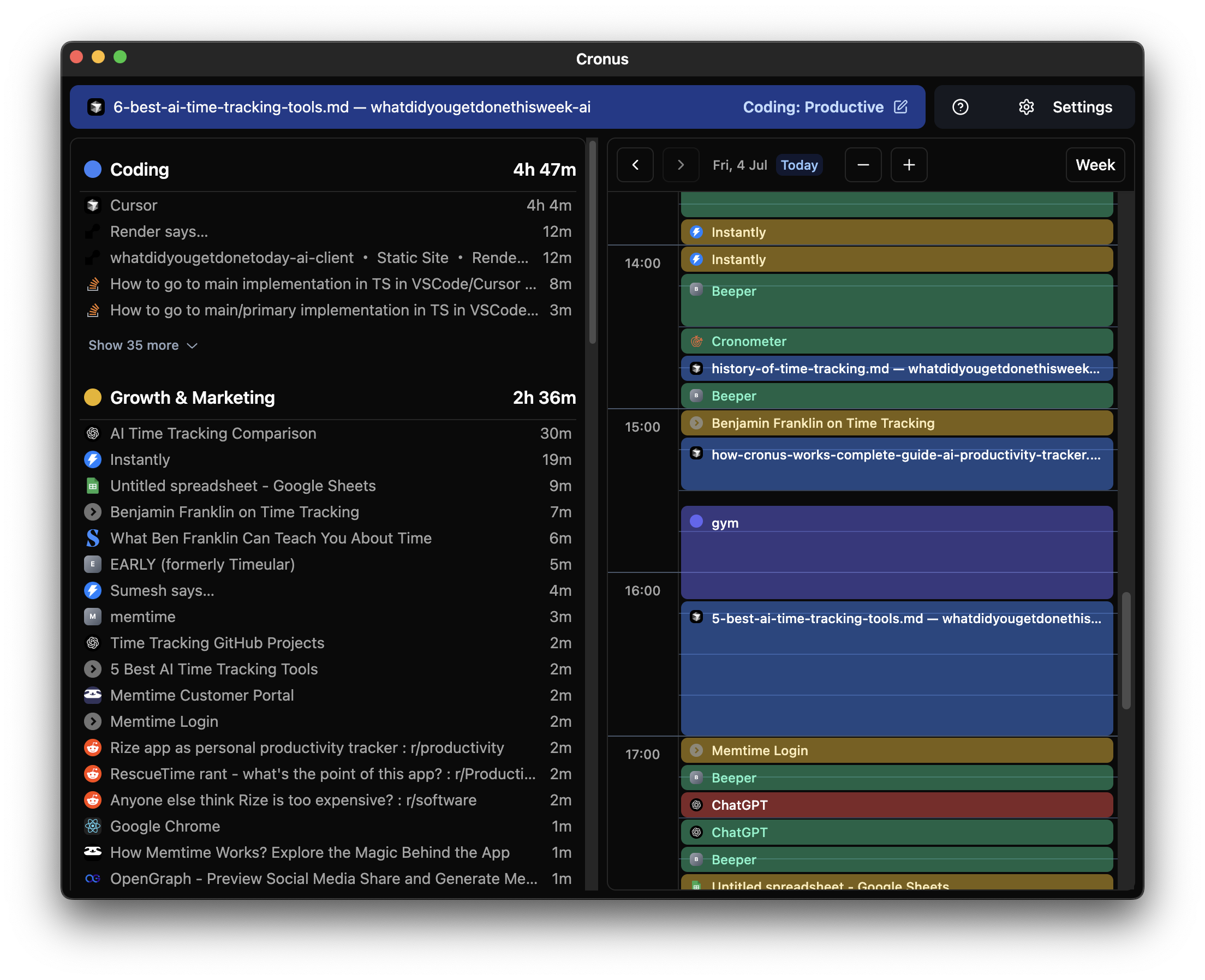
The one thing that genuinely helps and that you cannot do from the inside is knowing afterwards how long it actually was.
Manual tracking is useless here, and for an obvious reason: it needs you to log at the moment you switch, and the entire phenomenon is the absence of switching. A tracker you have to remember will record everything except a hyperfixation.
Cronus records it automatically on your Mac. No timer to start, nothing to log, so a six-hour stretch shows up as a six-hour stretch rather than as a gap you would have described as "a couple of hours".
What that changes, honestly, is not much on the day. It changes the week. "I lost Tuesday afternoon" becomes a number, and a number is something you can plan around, warn people about, or decide you are fine with. The dread of not knowing where the time went is usually worse than the finding.
$6 a month after a 21-day trial. It never captures your screen: window titles only, with sensitive information redacted on your device before anything is sent.
Two honest limits. It will not interrupt you: nudges do not beat a fixation, and we are not going to claim otherwise. And if you are prone to feeling bad about your own time use, a daily dashboard can become another stick. Look weekly.
When to talk to someone
Most hyperfixation is a personality feature with logistics attached. Some of it is worth clinical attention:
- If the content is intrusive and unwanted rather than absorbing, that pattern points toward OCD, which has specific effective treatment.
- If it consistently costs you sleep, food or medication to a degree that is affecting your health.
- If it is new and out of character, particularly alongside reduced need for sleep or elevated mood, which is worth ruling out properly.
- If the crashes afterwards involve persistent low mood rather than ordinary depletion.
None of that is a reason to stop having intense interests. It is a reason to have a professional look at a specific pattern.
Read next
- Monotropism — the autistic account of single-channel attention, and the best explanation of this that exists.
- ADHD Hyperfocus — the task-level version, and how to exit it.
- ADHD Paralysis — the same regulation problem, pointed the other way.
Sources: Murray, Lesser & Lawson (2005), Attention, monotropism and the diagnostic criteria for autism, Autism 9(2) · ADDA: ADHD and Hyperfixation · Healthline: Special Interest vs Hyperfixation