Time Tracking Spreadsheet: A Template, and When to Stop Using It
Spreadsheets are a genuinely good way to track time. They are free, you own the data, and you can shape them however you like.
They are also the wrong tool for one specific job, and it is worth knowing which.
The template
Six columns. Resist adding more.
| Date | Start | End | Duration | Category | What |
|---|---|---|---|---|---|
| 2026-08-10 | 09:15 | 10:40 | 1:25 | Deep work | Migration |
| 2026-08-10 | 10:40 | 11:05 | 0:25 | Messages | Slack, email |
Duration should be a formula, not typed: =End - Start, formatted as duration. Typing it invites rounding, and rounding is where honesty leaks out.
Category should be a dropdown with five or six options. Five or six, not twenty. Fine-grained categories are the single most common reason people abandon a tracking spreadsheet — every entry becomes a decision.
Good starting set: Deep work, Meetings, Messages, Admin, Breaks, Other.
What is free text and should stay short. Three words.
Two pivots worth adding
Once you have a week of rows, two summaries do most of the work:
- Hours by category, by day. Shows the shape of a week at a glance.
- Longest single entry, by day. This is the most useful number in the sheet and almost nobody computes it. It tells you whether real thinking happened.
Where spreadsheets genuinely win
Billing. If hours become an invoice, a human has to stand behind each line. A spreadsheet is auditable, editable, and defensible. Automatic tools are worse at this.
Ownership. Nothing leaves your machine. No account, no subscription, no third party.
Odd requirements. Custom rates, unusual categories, a specific export format for a client. A spreadsheet bends; a product does not.
Non-computer work. Meetings, calls, workshops, physical work. No automatic tracker sees these well.
If any of those describe you, the spreadsheet is the correct answer and you can stop reading.
Where it fails
There is one job spreadsheets are bad at: finding out where your time actually goes.
Three reasons, and they are structural rather than fixable with a better template.
You have to remember to fill it in. At the moment of switching, which is when you have least to spare. Miss a few and the day has holes.
It collapses on the days that matter. Chaotic days are the ones worth seeing and the ones you will not log. So the sheet over-represents your calm weeks and quietly flatters you.
It records what you meant to do. Filling in a row after the fact means reconstructing, and reconstruction is smoother and more purposeful than the actual day. Fragmentation disappears, because it was never encoded.
That last one matters most. The fifty small context switches in a day are exactly what a manual log cannot capture, and they are usually the answer to where the week went.
The test
Fill in your spreadsheet honestly for one week, then ask:
Does the total match the hours you were at your desk?
For most people it does not. There is an hour or two a day missing, and the missing time is not evenly distributed — it is concentrated in the messy afternoons.
That gap is the thing you were trying to measure.
When to switch
Switch when the question changes.
Keep the spreadsheet if you are billing, if you need custom logic, if the data must stay local, or if much of your work happens away from a computer.
Use something automatic if you are tracking for your own benefit and you want to know where the hours really go, including the ones you would not have logged.
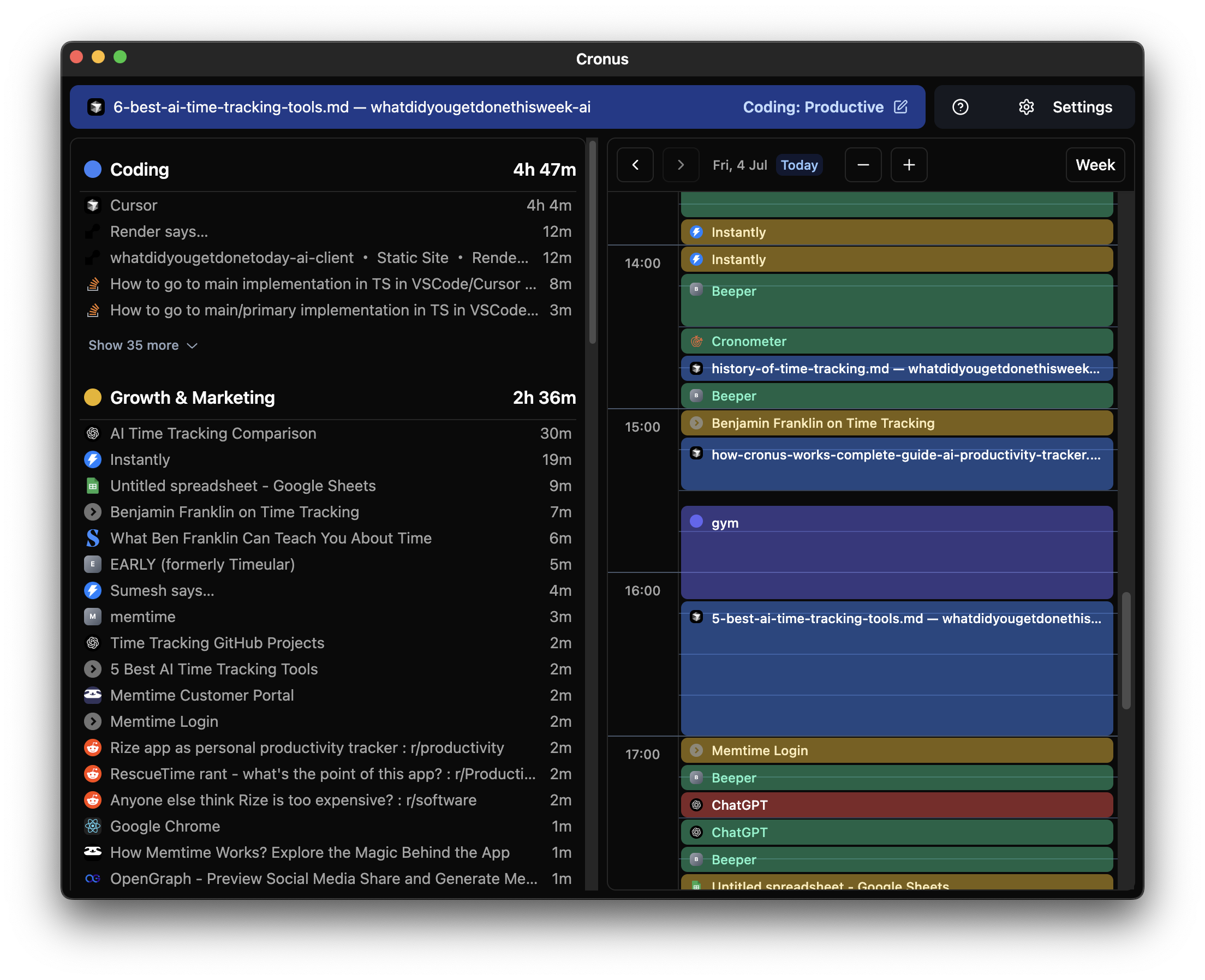
Cronus records what you were in and works out what the time served, judged against goals you set once. No rows to fill, nothing to remember at a switch, and the chaotic days produce a complete record rather than a gap. $6 a month after a 21-day trial, and it never captures your screen.
It is worse than a spreadsheet at billing, has no custom rates, and cannot see the meeting you took away from your desk. Those are real limitations, not marketing hedges.
A reasonable hybrid
Plenty of people run both, and it is not silly:
- Automatic tracking for the picture of where time actually goes
- A spreadsheet for the small number of hours that turn into an invoice
The first is a measurement problem. The second is an accounting problem. They have different requirements and there is no rule saying one tool has to do both.
Read next
- How to Do a Time Audit — the method, manual or automatic.
- Free and Open-Source Time Trackers — if the appeal was not paying for anything.
- Time Blocking: Why It Fails — what to do with the numbers once you have them.