Where Did My Day Go? How to Actually Find Out
It is six in the evening. You were at your desk from nine. You did not slack off, you barely stopped, and you cannot name three things you finished.
This is one of the most common experiences in knowledge work and one of the least examined. The hours went somewhere. Here is where, and how to find out for your own days rather than taking anyone's word for it.
First: your memory of today is not evidence
Before the explanations, the thing that makes this hard.
You cannot answer this question by thinking about it, and the reason is not that you have a bad memory. It is that everyone's estimate is wrong in the same direction.
In 2025, METR ran a randomized controlled trial on sixteen experienced developers doing real work from their own backlogs. They estimated afterwards that AI tools had made them 20% faster. They were 19% slower. A roughly forty percentage point error about work they had just personally done, and the estimate barely moved even after living through it.
To find out what actually happened, the researchers had to record screens and manually review 143 hours of video. That is what ground truth costs when self-report is the alternative.
Every conclusion you reach by reflecting on your day is produced by the same faculty that was off by forty points. So the honest answer to "where did my day go" begins with: you do not know, and reflecting harder will not tell you.
That said, when people do measure, the hours turn up in four fairly predictable places.
1. Fragmentation, which is invisible by construction
The single biggest one, and the hardest to see.
Fifty context switches in a day do not feel like anything. Each one costs a few seconds of literal switching and then a much longer re-entry, during which you are working but not yet at depth. None of that registers as an event, so none of it is in your memory of the day.
What you remember is "I worked on the migration this morning." What happened was eleven interleaved fragments of migration work with re-entry cost each time.
This is why the day feels full and the output feels thin. Both are accurate.
The number that reveals it: your longest unbroken block. Not total hours. If your longest stretch on one thing was 22 minutes, that explains the whole day on its own.
2. The work that expanded to fill the space
Some of the day went to tasks that genuinely took that long. But a good share went to tasks that grew because there was room.
Parkinson's law is not a joke about bureaucracy, it is a description of what attention does with slack. The task that could have taken forty minutes takes ninety, with more polish, more iterations, more second-guessing, none of which felt like waste at the time.
This has got more pronounced with AI in the loop. METR's 2026 survey found technical workers reporting a median 3x speedup while reporting only 1.4x to 2x more value delivered, and the researchers point to one mechanism: people drift toward tasks that AI does quickly, whether or not those tasks are worth doing. You did not lose the saved time. You spent it doing more, smaller, faster things.
3. Coordination that does not look like work
Slack, email, standup, the quick call, the thread you got pulled into, the doc you reviewed.
Individually all legitimate. Collectively frequently half the day. And they are systematically under-remembered, because none of them is a thing you did, they are things that happened around what you were doing.
The tell: if you cannot account for a chunk of the afternoon at all, this is usually where it went.
4. Genuine distraction, which is smaller than you think
Everyone assumes this is the main answer. In practice, for most people who feel like their day disappeared, it is the smallest of the four.
The guilt-shaped explanation ("I wasted time on Twitter") is emotionally available in a way the other three are not, so it gets the blame. Measurement usually exonerates you here and indicts the fragmentation instead.
That is not permission, it is a diagnosis. If you fix the wrong one you get nothing.
How to actually find out
Three options, in ascending order of how well they work.
Reconstruct it (free, unreliable)
Before checking anything, write down what you did in each hour. Then check against your calendar, sent messages, editor history and browser history.
Most people account for about half the day, mornings better than afternoons. The reconstruction also comes out smoother and more purposeful than the day was, with the fragmentation edited out.
Worth doing once, precisely to see how large the gap is. Not worth relying on.
Log it manually (accurate, unsustainable)
Start a timer, stop a timer, tag it. Genuinely accurate when you do it.
You will not do it. The logging is itself an interruption, it needs an action at the exact moment your attention is moving elsewhere, and it fails hardest on chaotic days, so your record ends up biased toward your calmest weeks. That bias is worse than no record, because it looks like data.
Measure it automatically (accurate, sustainable)
Have something else keep the record, then read it.
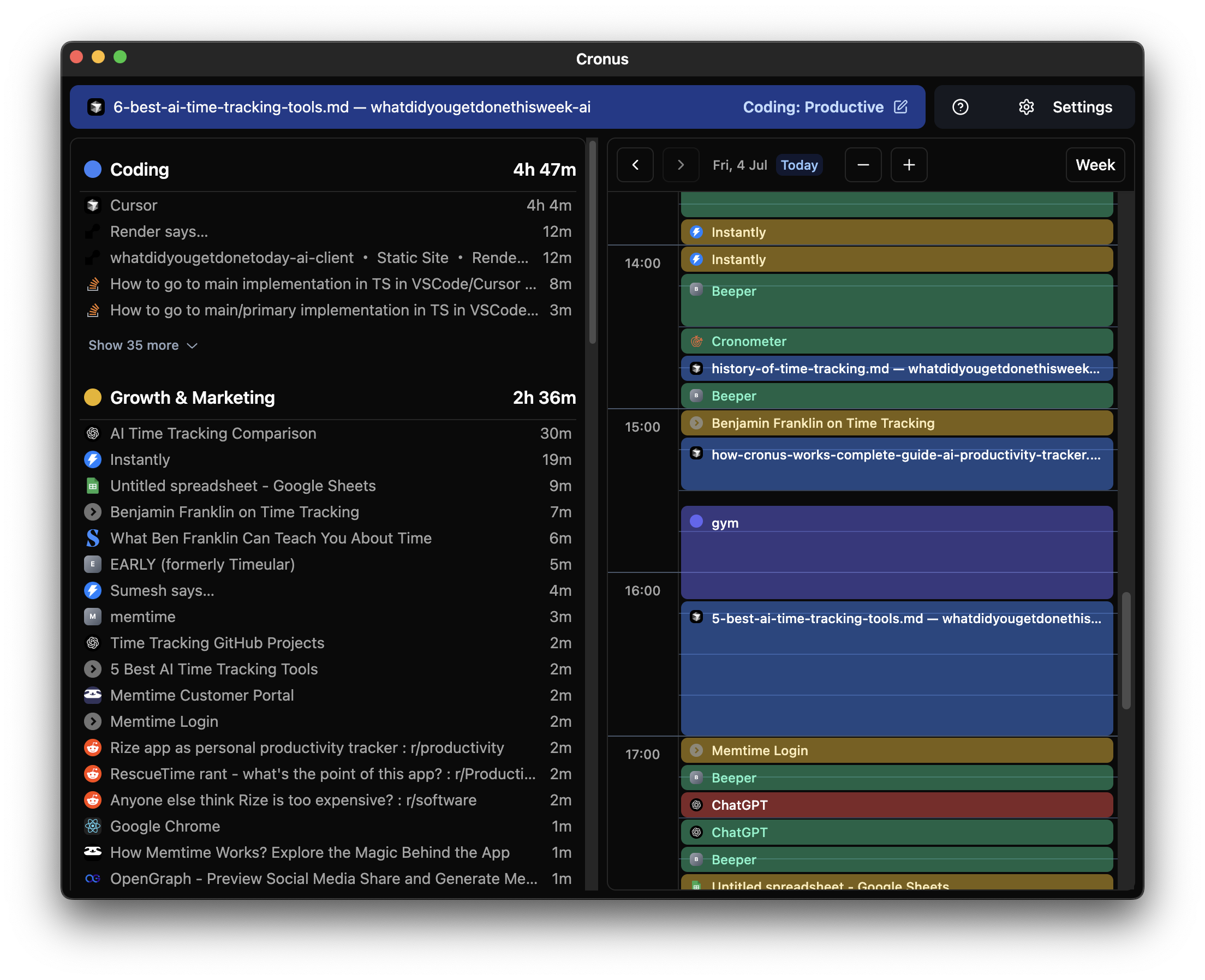
That is what we built Cronus to do. It watches which app and window you are in, and an AI model works out what the activity was in service of, judged against goals you set once. No timers, nothing to log. The chaotic hours show up rather than quietly disappearing, which is the whole point, because those are the ones you cannot reconstruct.
The numbers to look at
When you do have a record, most people look at the wrong thing. Total hours is the least informative number available.
Look at these instead:
- Longest unbroken block. The best single proxy for whether real thinking happened.
- Number of distinct contexts. High, with flat hours, means depth got traded for volume.
- When your best hours are, and what is in them. Most people have two or three genuinely good hours a day. The question is not how many hours you worked, it is what occupied those.
- Share of the day in your top activity. Concentration is almost always what you actually wanted.
What to expect
The first week is usually unpleasant, and you should treat that as the system working rather than failing.
The total will be lower than the number in your head. The shape will be worse: more scattered, with deep work compressed into a much smaller window than it felt like. Your biggest time sink will probably not be the one you would have named.
That gap is the entire value. You cannot fix a forty-point error you cannot see, and the one thing we know for certain is that thinking harder about it does not close it.
Cronus is $6 a month after a 21-day trial. Find out where today actually went.
Read next
- Time Blindness: Why You Lose Hours, and How to Get Them Back — why your sense of elapsed time is unreliable in the first place.
- Developers Thought AI Made Them 20% Faster. It Made Them 19% Slower. — the full METR result.
- ADHD and Time Tracking — if the standard advice has never worked for you.
- How to Do a Time Audit — the method for finding out.
- How to Beat Distractions at Work — once you know which of the four it is.
- What We Learned from Elon Musk and 5 CEOs — people who measured, and what it changed.
- Where Did the Time AI Saved You Go? — the same question, one level up.
Or start without installing anything: the newsletter below is a five-day audit of your own time, one short email a day.
All of the free time calculators mentioned across this site are collected on one page: free time calculators.
Find out where your week actually goes
The 5-day time audit: one short email a day, walking you through the experiments in this post. You will end the week with a real answer instead of an impression. Free, no app required, and it ends after five days.