Updated August 2026
AI time tracking, explained by people who build one
AI time tracking records what you worked on without a timer, then uses a model to work out what each stretch of activity was actually for. The recording part is not new. The interpretation is, and it is the only part where the “AI” label means anything.
We make one of these tools, so weigh this accordingly. What follows is the version we would want to read before buying: the three architectures, what each one can see, how accurate any of it is, and where the whole category is oversold.
What does the AI actually do?
Can AI track time across multiple apps?
Is it free?
The three architectures, and what each can see
This is the distinction that matters most and the one marketing pages skip. “AI time tracking” describes at least three quite different things, with very different privacy consequences.
| Approach | How it records | What it can see | Examples |
|---|---|---|---|
| Screenshots | Periodic captures of your screen, read by a model | Everything on screen: messages, banking, health, other people on calls | Hubstaff, Time Doctor, most employee monitoring |
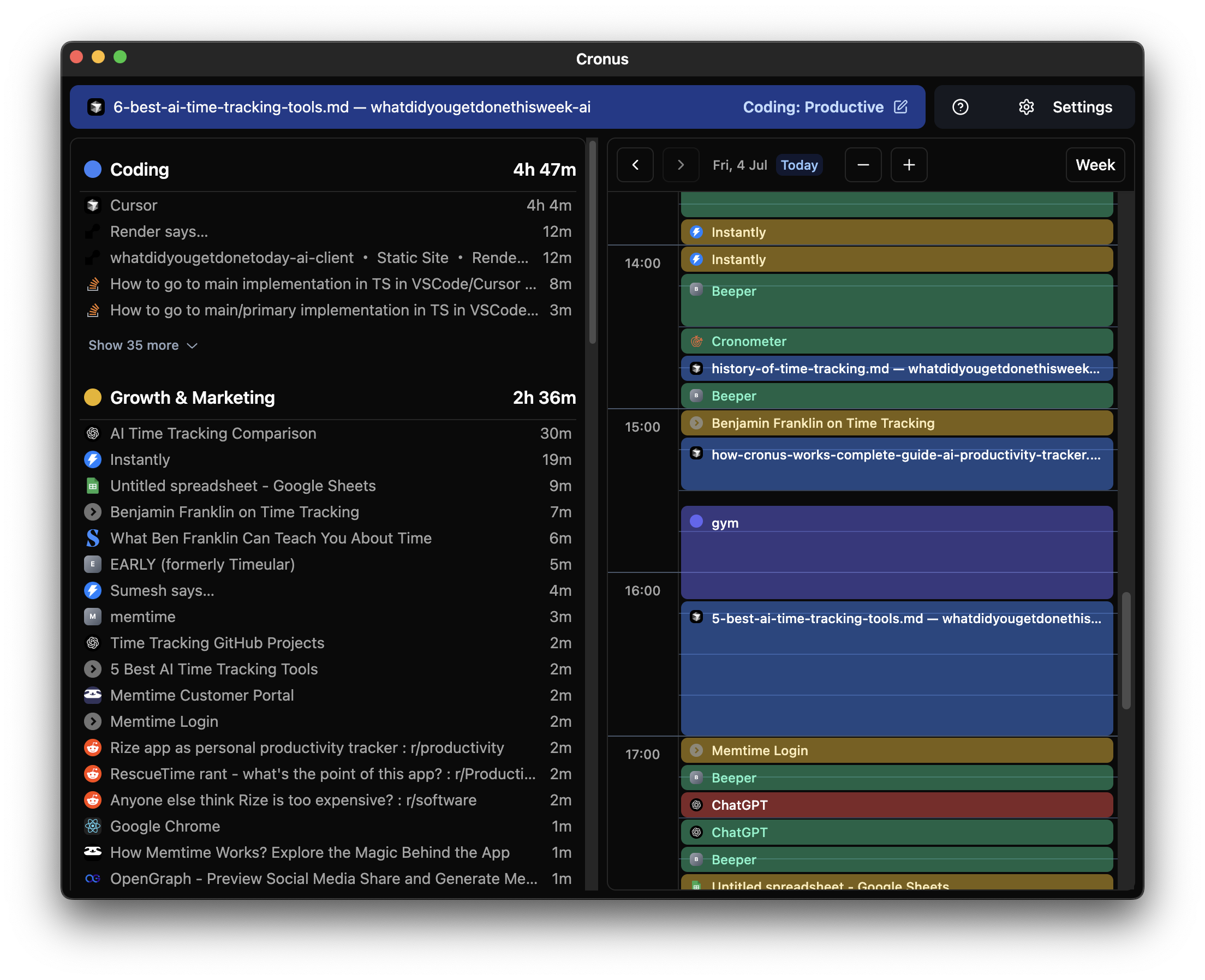
| Window metadata | App name and window title only, no pixels | App names and document/tab titles, which can still contain client names | Cronus, Rize, Timing, RescueTime |
| Calendar and integrations | Meetings, commits, tickets, documents you touched | Only what the connected services already know | Reclaim, Motion, some Timely setups |
The gap between rows one and two is enormous and rarely made obvious. A screenshot tool sees your bank balance, your messages and whoever is on your video call. A metadata tool sees that Chrome was open and what the tab was called. Both get described as “AI time tracking”.
Cronus is in the second row. We never capture your screen: we read the application name and window title, redact sensitive information on your device before anything is sent, and categorise server-side. That last part is a real trade-off and we would rather state it than bury it. If your requirement is that nothing leaves the machine, the honest answer is Memtime or ActivityWatch, not us.
How accurate is it?
Split the question, because the two halves have very different answers.
The recording is essentially exact. Which app was in front, which window was focused, for how many seconds. There is no estimation involved.
The interpretation is not. A model deciding whether a documentation page was research or procrastination is making a judgement, and it will be wrong sometimes. Any vendor quoting a single accuracy percentage is quoting a number from their own benchmark on their own definition of correct.
The relevant comparison is not against perfection, though. It is against the alternative, which is you remembering. In a randomised controlled trial, experienced developers estimated that a tool had made them 20% faster on real tasks from their own repositories. Measured, they were 19% slower: a forty percentage point error about work they had just finished. We wrote that study up in full. An imperfect record beats a confident memory by a wide margin.
What the tools cost, and what they see
| Tool | Price | Records | Platforms | Screenshots |
|---|---|---|---|---|
| Cronus | $6/mo | Window metadata | macOS (Windows in progress) | No |
| Rize | $12.99–$49.99/mo | Window metadata | macOS, Windows | No |
| Timely | ~$11/user/mo | Metadata + integrations | Mac, Windows, web | No |
| RescueTime | ~$12/mo | Window metadata | Mac, Windows, Linux, mobile | No |
| Timing | from ~$10/mo | Window metadata | macOS only | No |
| Memtime | from ~$14/mo | Window metadata, fully local | Mac, Windows, Linux | No |
| ActivityWatch | Free | Window metadata, fully local | Mac, Windows, Linux | No |
| Hubstaff | from ~$7/user/mo | Screenshots (optional) | Mac, Windows, Linux, mobile | Yes |
Longer reviews of each are in the 2026 roundup.
Where the category is oversold
It will not make you productive. It produces a record. Acting on the record is a separate and much harder problem, and no tool has solved it.
Automatic categorisation is not defensible. If your hours become an invoice or a legal bill, you need a human approving each line. That rules us out for legal billing and makes Timely, with its approve-the-draft flow, the better fit for consultants.
“AI” often means rules. A good deal of what is marketed as AI categorisation is a lookup table mapping domains to categories, which is why those tools keep asking you to classify things they have not seen before.
It is a poor surveillance tool, and that is deliberate. If you are looking for something to monitor staff, we are the wrong product and this is the wrong site.
Who it actually suits
People who have abandoned timers. If you have tried three manual trackers and stopped using all three, the problem is not which one. Every manual tool needs an action at the moment you switch tasks, which is exactly when you have nothing spare. This is worth reading before you buy a fourth.
People whose days are fragmented. The more contexts you pass through, the less your memory of the day is worth, and the more a record is worth.
People who suspect the week is not going where they think. Usually correct, and usually not in the way expected: the culprit is normally meetings and switching rather than anything that feels like slacking.
21 days free, then $6 a month
No timers to start. The trial counts only the days you actually use it, and Cronus never captures your screen.
Related: what each tool can actually see, the best automatic trackers for Mac, and the free options.