The ADHD Tax
The ADHD tax is the money you lose specifically to having ADHD.
Not the cost of treatment. The surcharge on ordinary life: the late fee on a bill you had the money for, the subscription you have not used since March, the third phone charger this year, the produce that liquefied in the drawer, the flight rebooked because you read the date wrong.
It is not carelessness and it is not a moral failing. It is a predictable, structural cost of unreliable working memory and executive function, and treating it as a character problem is exactly why people keep paying it.
What it is made of
Late fees and interest. Bills with the money sitting available. This is the largest and most avoidable category.
Unused subscriptions. Cancelling requires noticing, deciding, and completing a multi-step flow that is designed to be tedious. Companies rely on that.
Replacing things you own. Buying a second one because finding the first is harder than ordering another.
Food waste. Bought with real intent, forgotten, thrown away.
Impulse purchases. Interest-driven attention plus poor future-consequence weighting, and online shopping engineered against you.
Premiums for lateness. Express shipping, last-minute flights, the taxi because you missed the train.
Avoidance costs. The unopened letter that becomes a fine. The dentist you did not book that becomes a root canal. This is the most expensive category by a distance and the least visible, because the cost arrives months later attached to something that looks unrelated.
Underearning. Not invoicing, not chasing invoices, not asking for the raise. Rarely counted and often the biggest number of all.
Roughly what it costs
There is no rigorous figure and anyone quoting a precise one is guessing. Community surveys and personal-finance write-ups tend to land somewhere in the hundreds to low thousands of dollars a year, which is consistent with what the categories above would produce.
The more useful exercise is your own number, and it takes twenty minutes:
- Bank statements, twelve months.
- Add up late fees, interest, overdraft charges.
- Add subscriptions you did not knowingly use.
- Add duplicate purchases and obvious impulse buys you regret.
- Add express shipping and last-minute travel premiums.
That total is your annual ADHD tax, and it is usually larger than expected. It is also the number that makes the fixes below worth the effort.
Do this once, without judgement. The point is a figure to reduce, not evidence against yourself.
Fixing it, in order of return
The principle throughout: automate, do not remember. Every fix that relies on you noticing something will fail eventually, and it will fail on your worst month.
Autopay everything. The single highest-return change available. Minimum payments at least, on every card and bill. This removes almost the entire late-fee category in one afternoon.
Set up a bills account. One account that money lands in and only bills leave from. Removes the decision layer entirely.
Audit subscriptions once, hard. Bank statement, twelve months, cancel everything you cannot justify. Then use a virtual card for future trials so an unnoticed renewal cannot recur. Monarch, Copilot and Rocket Money will find them for you if the manual version will not happen.
Buy multiples of small things you lose. Chargers, keys, scissors, nail clippers. Cheaper than the time and money spent replacing them one at a time, and it eliminates a whole category of frustration.
Put a "do it now" rule on anything under two minutes. Especially post and email. The two-minute task that gets deferred is the one that becomes a fine.
Make finances visible. A widget, a whiteboard, anything you cannot avoid seeing. Out of sight is genuinely out of mind, and money is no exception.
Get someone else to do the avoidant things. A bookkeeper for a freelancer, or a friend on a call while you open the post. Body doubling works on admin better than on anything else.
Ask for the fee to be waived. Genuinely: first-time late fees are frequently reversed if you call and ask. Most people never do.
The largest line is time
The financial version gets all the attention because it appears on a statement. The bigger cost usually does not.
The hours lost to looking for things, redoing work, sorting out consequences, and rebuilding after switching are not on any statement, and for anyone whose time has a market rate they will exceed every fee in the list above.
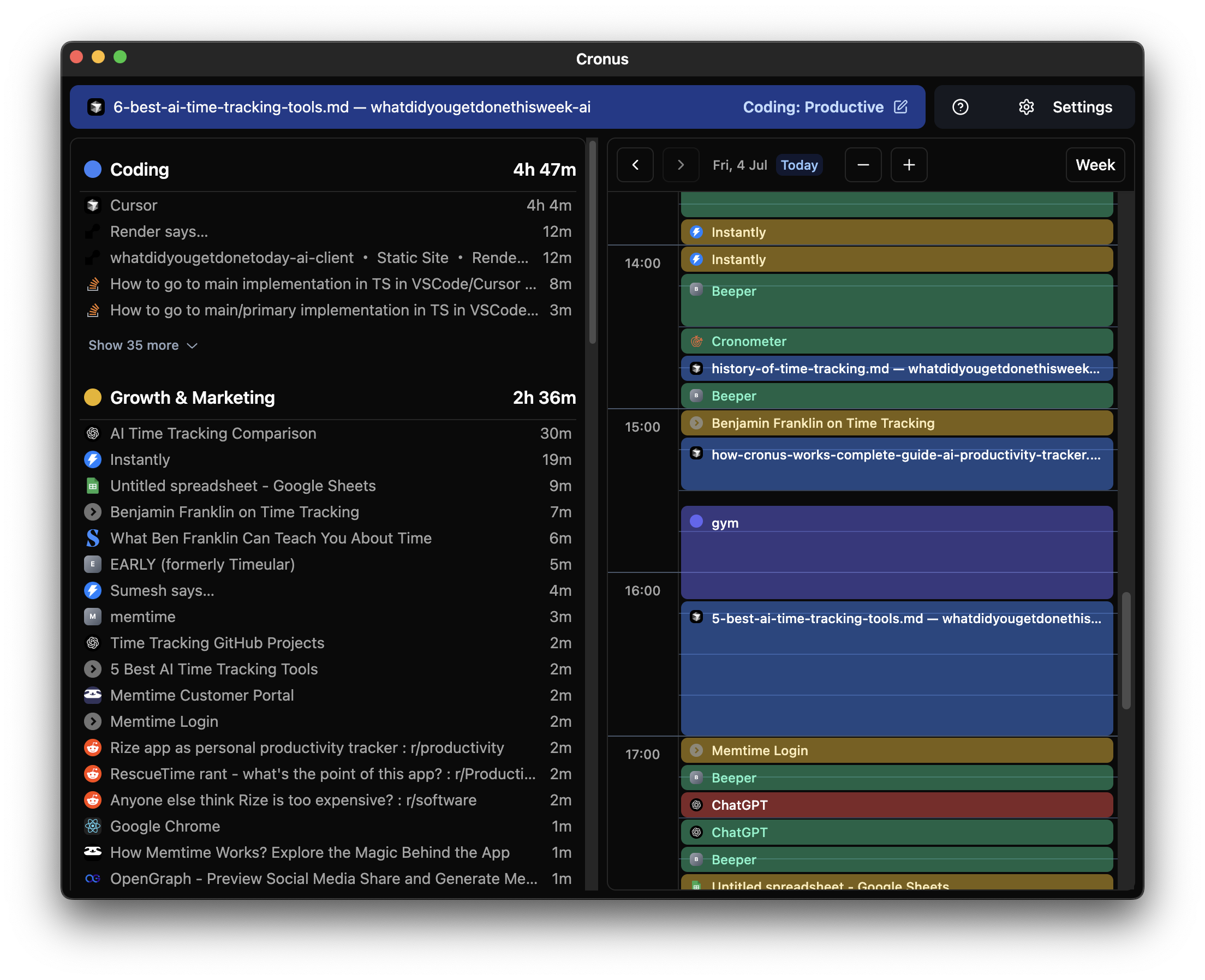
Cronus records where your time actually goes on your Mac, automatically, with no timer and nothing to log. That last part matters here, since admin and rework are exactly the work nobody starts a timer for.
The finding that changes behaviour is usually how much of the week goes to admin and rework rather than to the work you are paid for. Once that is a number, hiring a bookkeeper or paying for the annual plan stops being an indulgence and becomes arithmetic.
$6 a month after a 21-day trial, and it never captures your screen: window titles only, with sensitive information redacted on your device before anything is sent.
What it will not do: it will not pay a bill, remind you of anything, or see anything off the laptop. For reminders, use location-based alerts, which are free and better at that job.
The part that matters most
The ADHD tax is a design problem, not a discipline problem.
Every fix above works by removing the need to remember, notice or decide. None works by trying harder, because trying harder is precisely the resource that is unreliable, and building a system that depends on it is building a system that fails on your worst week.
And do not spend the effort on shame. It costs a great deal and reduces nothing. Set up autopay instead.
Read next
- ADHD and Object Permanence — why the letter stays unopened.
- ADHD Paralysis — the avoidance that produces the expensive category.
- Body Doubling — the most effective admin tool there is.