Best Jobs for ADHD
Almost every article on this subject gives you the same list: paramedic, chef, journalist, entrepreneur, teacher, sales, trades.
The lists are not useless, and they are the wrong level of detail. Two software jobs can differ more from each other than a software job differs from a nursing job, and the thing that decides whether you thrive is not the industry.
What follows is the features that actually predict it. Then the job names, because you probably came here for those.
The features that matter
Novelty and variety. Attention runs on interest and novelty rather than repetition. A job where every day is structurally identical will feel like pushing uphill by month four, however well it suited you at the start.
Genuine urgency, not manufactured. Deadlines that are real and external are the most reliable ADHD performance enhancer there is. Jobs with natural deadlines — shifts, broadcasts, patients, service tickets — supply the activation that self-imposed deadlines never quite generate.
Visible, short feedback loops. Finishing something matters enormously. Work where the result is visible today beats work where it lands in eighteen months, because the loop is what sustains engagement.
Autonomy over how, structure over what. This combination is the sweet spot and it is oddly rare. Being told the outcome and left to find the route works well. Being told the outcome and the route works badly, and being told neither works worst of all.
Interest alignment. Larger than anything else on this list. An ADHD brain will do astonishing amounts of demanding work on something genuinely interesting and almost nothing on something dull. Choosing for interest is not indulgent, it is the main lever.
Low admin burden, or admin someone else does. Expenses, timesheets, compliance forms, CRM hygiene. This is where careers quietly fail. Someone brilliant at the actual job gets managed out over paperwork.
Movement allowed. Sitting still for eight hours is a tax you pay before doing any work.
Tolerable sensory environment. Open-plan offices are among the worst environments available, and this is rarely factored into a career decision.
The features that predict trouble
- Long projects with no interim milestones. Multi-year work with nothing visible for months.
- Heavy unsupported administration. Especially where the admin is the compliance requirement rather than the work.
- Rigid time policing. Jobs where being nine minutes late matters more than what you produce.
- Sustained low stimulation. Monitoring roles where almost nothing happens are far harder than high-pressure ones.
- Constant social performance. Client-facing all day is expensive if you mask, and the cost is invisible to everyone including you.
- Everything depending on your memory. Roles with no external systems, where dropping one detail is a serious failure.
So, the job names
With the caveat that the specific role matters more than the category.
High urgency, high variety: emergency medicine, paramedic, nursing, veterinary, firefighting, air traffic control. Real deadlines, real feedback, no two days alike. The cost is shift work, which is hard on sleep, and sleep is upstream of every ADHD symptom.
Creative and production: design, video, journalism, marketing, copywriting, music. Interest-driven, deadline-driven, visible output. The trouble arrives as freelance admin and invoicing rather than as the work.
Trades and hands-on: electrician, carpenter, plumber, mechanic, chef. Movement, variety, a finished thing at the end of the day, and low tolerance for sitting still is an asset rather than a problem. Chef work is genuinely high-stimulation, and genuinely brutal on hours.
Technology: software, DevOps, security, data. Deep-focus work aligned with interest, high autonomy, and usually flexible about how and when. The failure mode is long roadmap-driven projects with no visible completion, so the team matters more than the company.
Sales and business development: commission is immediate feedback, targets are real deadlines, days vary, and CRM admin is the thing that ends careers.
Teaching and training: performance, variety, constant feedback, real urgency. Marking and administration are the load-bearing risk.
Entrepreneurship: high autonomy, high novelty, total interest alignment. Also completely unstructured, which is the single hardest environment for executive function, and it removes every external deadline. It suits some people extraordinarily well and is not the default answer it is often presented as.
Two things worth more than picking the right title
You can reshape a job more than you think. Most people change career when what they needed was to change the shape of the one they have — trading a meeting-heavy role for a delivery-heavy one, negotiating admin support, moving from open-plan, or shifting to a team with shorter cycles. That is a far smaller move than retraining.
The first two years of anything are misleading. Novelty makes almost any job engaging at the start. If your pattern is loving a job for eighteen months and then finding it unbearable, that is not evidence the job was wrong — it is evidence you need built-in variety, which you can sometimes negotiate.
Working out which features you actually need
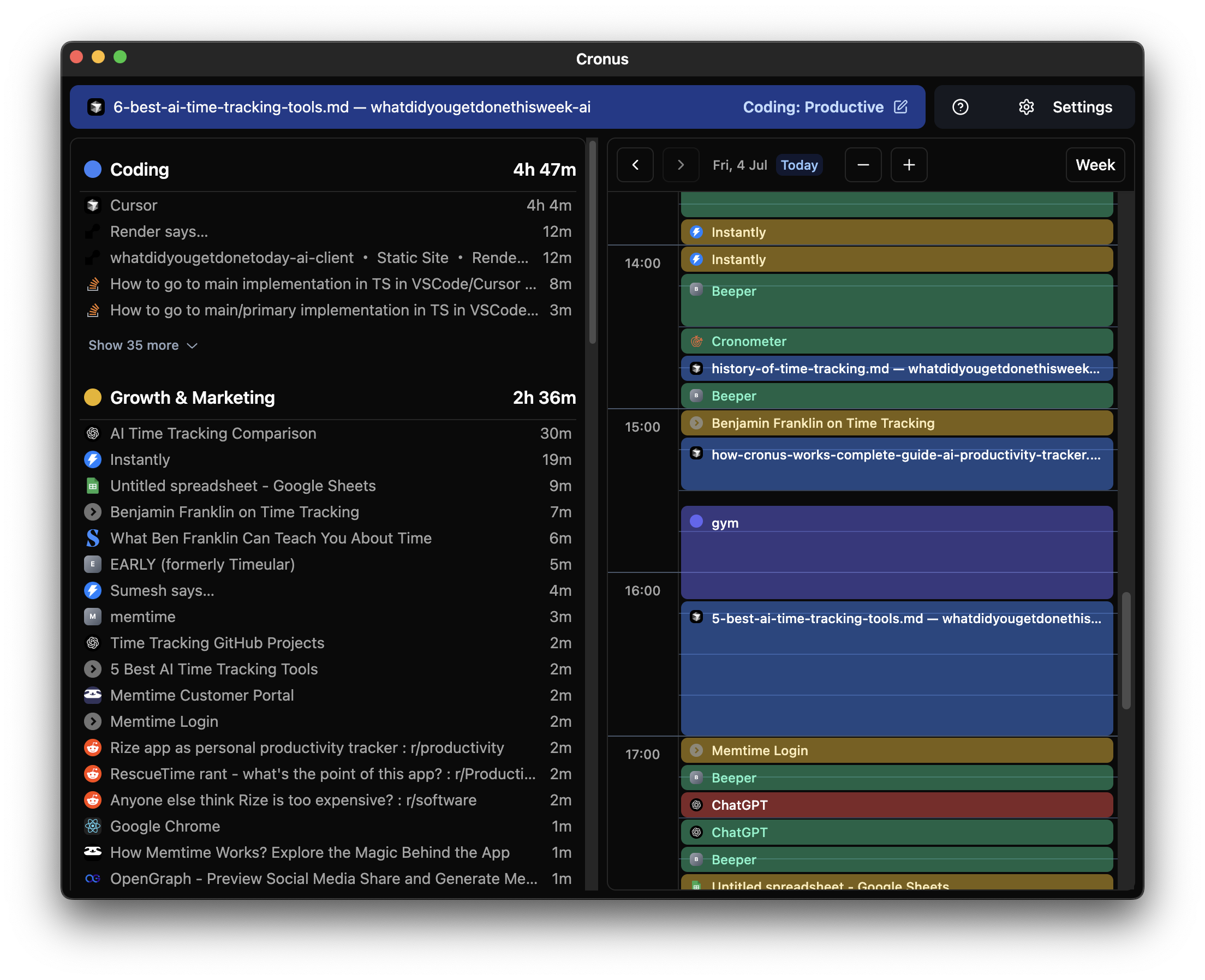
The list above is only useful if you know which items apply to you, and most people are guessing.
The honest way to find out is to look at what your current work actually does to you. Which days you sustain focus and which you do not, whether meeting-heavy days destroy the ones after them, how long you genuinely last on different kinds of task, and where the good hours fall.
Cronus records that automatically on your Mac, with no timer and nothing to log. A few weeks of it turns "I think I need more variety" into something specific enough to act on — and specific is what you need when you are negotiating a role change or deciding whether to move at all.
$6 a month after a 21-day trial, and it never captures your screen: window titles only, redacted on your device.
Obvious limit: it only sees desk work. For a paramedic or an electrician it will tell you almost nothing, and the features above matter just as much in those jobs.
And do not hand this to an employer. Bring a conclusion, never a log. More on that here.
One caution about career advice
Nobody writing a list of ADHD-friendly jobs knows your finances, your location, your qualifications or your responsibilities. Advice to retrain into a trade is free to give and expensive to take.
Start with reshaping what you have. Change careers when the evidence is strong, not when an article suggests it.
Read next
- ADHD Accommodations at Work — how to reshape the job you have.
- Neurodivergent Burnout — what a badly matched job produces eventually.
- Monotropism — why environment matters more than task.