Time Blocking: Why It Fails, and the Step Everyone Skips
Time blocking is simple. You put every task in your calendar as an appointment, then do the thing the calendar says.
It works well. It also gets abandoned by most people who try it, usually inside two weeks.
The reason is not discipline. It is that the first version of your calendar is built on a guess about how long things take, and that guess is badly wrong.
How it is supposed to work
- List what needs doing.
- Estimate how long each takes.
- Put them in the calendar as blocks.
- Follow the calendar.
Step 2 is where it breaks.
Why the first attempt fails
You underestimate everything. Most people run 1.5x to 3x over on non-routine work. So a day planned to the minute is already impossible by 11am.
You plan the work and forget the rest. Blocks get drawn for tasks. Days also contain messages, interruptions, decisions, context switching and recovery. None of that is in the calendar, so it eats the blocks instead.
One overrun destroys the day. Back-to-back blocks have no slack. The 10am running twenty minutes late pushes everything, and by lunchtime the plan is fiction.
Then you stop looking at it. A calendar you have already fallen behind is unpleasant to open. So you stop, and time blocking has "not worked".
Notice none of that is about willpower. The plan was wrong before the day started.
The step everyone skips
Measure first. Block second.
You cannot schedule your capacity until you know your capacity, and you do not currently know it. Not roughly.
That is not a criticism. Self-assessment of time is unreliable for everyone. In a 2025 randomised trial, experienced developers estimated AI tools had made them 20% faster on real work. They were 19% slower — an error of about forty percentage points on work they had just finished. Researchers had to review 143 hours of screen recordings to establish what actually happened.
If that is the error on a simple question, your estimate of "the report takes two hours" is not a foundation to build a calendar on.
So spend a week or two measuring before you plan anything.
What to measure
Four numbers. They are the ones that decide whether a calendar survives contact with a real week.
Your longest unbroken block. Usually far shorter than people assume. If it is 40 minutes, a two-hour block is not a plan, it is a wish.
Your real multiplier. Estimate before, record after, for two weeks. You will find a stable ratio. Then estimate as badly as you always do, and multiply.
How much of the day is not tasks. Messages, meetings, admin, switching. Frequently 40–60%. Whatever it is for you, that share cannot be blocked for project work.
When your good hours are. Most people have two or three genuinely effective hours. Where they sit is stable and personal, and it is the single most useful thing to learn.
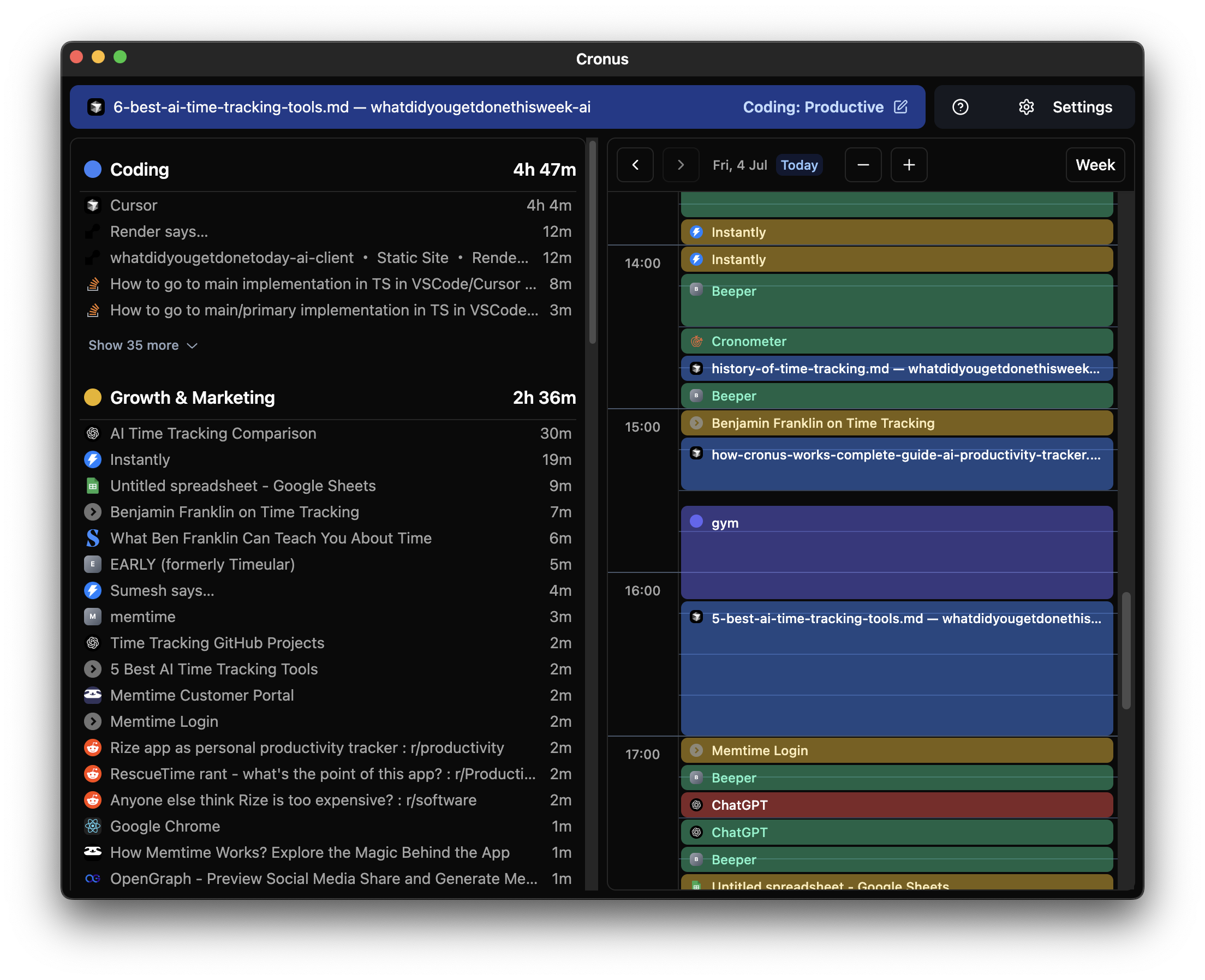
You can gather this by hand with a timer and a notebook. Most people do not, because logging is a chore that collapses in exactly the messy weeks that would be most informative.
Cronus does it automatically: it records what you were in and works out what the time served, with no timer to start. After two weeks you have the four numbers rather than four guesses. It is $6 a month after a 21-day trial, and it never captures your screen.
Time blocking that survives
Once you have real numbers, the method changes shape.
Block your best hours first, for one thing. Protect the two or three good hours before anything else gets scheduled. Everything else fits around them.
Block half the day, not all of it. If 40–60% of a day is not project work, planning 100% guarantees failure. Leave it genuinely empty rather than optimistically full.
Use your multiplier. Estimate, then multiply. Every time.
Make blocks match your real attention span. If your longest stretch is 45 minutes, use 45-minute blocks. Fighting your actual pattern loses.
Leave gaps at transitions. Switching costs time that never appears on any plan. Ten minutes between blocks is not slack, it is the cost of changing task.
Theme days if you can. Fewer switches beats better switches. One kind of work per day outperforms four kinds well-arranged.
When it is the wrong tool
Worth saying plainly, because it is oversold.
If you cannot start tasks, time blocking will not fix that. A block in the calendar does not solve initiation. See ADHD paralysis.
If your day is genuinely reactive — support, ops, anything interrupt-driven — blocking most of it is fighting the job. Block one or two protected slots and leave the rest.
If your schedule is not yours, blocking mostly produces a calendar you feel guilty about. Fix the meeting load first.
The short version
Time blocking is not a discipline technique. It is a scheduling technique, and scheduling requires accurate inputs.
Measure for two weeks. Learn your longest block, your multiplier, your non-task share, and where your good hours are. Then build a calendar around those, not around what you would like to be true.
Almost everyone skips the measuring and blames themselves when the calendar fails.
Sources
Read next
- Where Did My Day Go? — where the unplanned half of the day goes.
- 15-Minute Increments for Productivity — a smaller-grained version of the same idea.
- ADHD Time Blindness — why the estimates are wrong in the first place.
- Welcome to Cronus — what we built, briefly.