ADHD Time Blindness: Why You Lose Hours, and How to Get Them Back
You sit down to do one thing. You look up and it is two in the afternoon. You could not honestly say where the last five hours went, and the thing you sat down to do is not done.
Most people file this under laziness or bad discipline. It is neither. It has a name, time blindness, and it describes a real and well-studied gap between how long things feel and how long they take.
It is not exclusive to ADHD. Everyone's sense of elapsed time is unreliable, which is why this post is worth reading either way. But it is markedly more pronounced with ADHD, where temporal processing differences are well documented, and most of the research quoted below comes from that literature.
This post is about what is actually going on, why the usual advice fails, and what works instead.
What time blindness actually is
Time blindness is the reduced ability to sense the passage of time and to judge how much of it has gone by. In the ADHD literature it shows up as differences across three domains: motor timing, perceptual timing and temporal foresight, spanning intervals from milliseconds to years.
It shows up in ordinary ways:
- Losing hours to something absorbing without noticing any of them pass
- "Five more minutes" reliably becoming an hour
- Being late despite leaving what felt like plenty of time
- No sense of whether a task will take twenty minutes or three hours
- Deadlines that feel abstract until they are suddenly imminent
If any of that reads as a description of your week, you are not unusual. It is a normal feature of how human attention works, and it is more pronounced for some people than others.
Your internal clock is not a clock
The core of it is this: you do not have a clock. You have an attention meter, and you read it as if it were a clock.
Time in the mind runs on how much your attention is occupied. When you are absorbed, very little gets encoded as elapsed duration, so an hour reads as twenty minutes. When you are bored or waiting, everything gets encoded, and ten minutes reads as forty.
You can demonstrate this to yourself in two minutes, and it is worth doing because reading about it changes nothing:
Sit somewhere without a clock and estimate two minutes. No counting. Then do it again while absorbed in something. Then again while waiting for a build or a page to load.
Almost everyone undershoots badly when engaged and overshoots when waiting. That is the whole mechanism, and everything else in this post follows from it.
ADHD and time: two different abilities, and only one of them fails
Here is the part that is genuinely useful, and that most writing on this subject misses.
Research on time perception distinguishes between estimating an interval and reproducing one. Estimating is "how long do you think that took?" Reproducing is "tell me when two minutes have passed."
These come apart. In the temporal-processing literature, particularly work on ADHD, a specific pattern turns up: reproduction is impaired while estimation is often intact.
Which is to say: you may be perfectly able to say a meeting took about an hour. What you cannot do is track the hour while you are inside it.
That distinction explains a lot of otherwise confusing behaviour. It is why someone can be genuinely good at planning and still late every time. It is why "just keep an eye on the clock" fails: keeping an eye on the clock is the exact ability that is not working. And it is why "five more minutes" ends in two hours, without any intent to break the promise.
Why the standard time management advice fails
Almost all time management advice assumes you can feel time passing. Once you know that assumption is wrong, the failures stop being mysterious.
"Just check the clock." Requires you to remember to check, at intervals, while absorbed. The absorption is what suppressed your sense of time in the first place. You will check, then not check again for two hours.
"Use a timer." Better, because it is external. But a timer only covers work you remembered to start a timer for, which is not the work that eats your day. Nobody sets a timer before "quickly looking something up."
"Log your time in 15-minute blocks." This is the advice that looks most rigorous and fails hardest. It asks you to interrupt yourself all day, and to write down what you did from memory. Both of those are the impaired faculty. And it collapses precisely on the chaotic days, so your record is quietly biased toward your calmest weeks.
"Be more disciplined." Discipline is not the missing ingredient. You are not failing to act on information you have. You do not have the information.
What actually helps
Three things, in rough order of how much they matter.
1. Make time external
If your internal sense of duration is unreliable, the fix is to stop relying on it. Put time outside your head where it does not depend on you noticing.
An analogue clock in your eyeline works better than a digital one, because you read elapsed time as a shape rather than a number you have to compare against a remembered number. Some people use a visual countdown timer for the same reason.
The general principle: anything that shows time passing without requiring you to check is worth more than anything that requires a check.
This is also the reason Cronus puts its counters in the menu bar rather than sending notifications. A number you have to open an app to see is a check. A number sitting beside the clock is not.
2. Measure automatically, not manually
The only reliable way to know where your hours went is to have something else keep the record.
This is not a productivity preference, it follows directly from the mechanism. Self-logging asks the impaired faculty to do the measuring. Automatic tracking does not ask you for anything, which means it also works on the days you are least capable of maintaining a system, and those are exactly the days worth seeing.
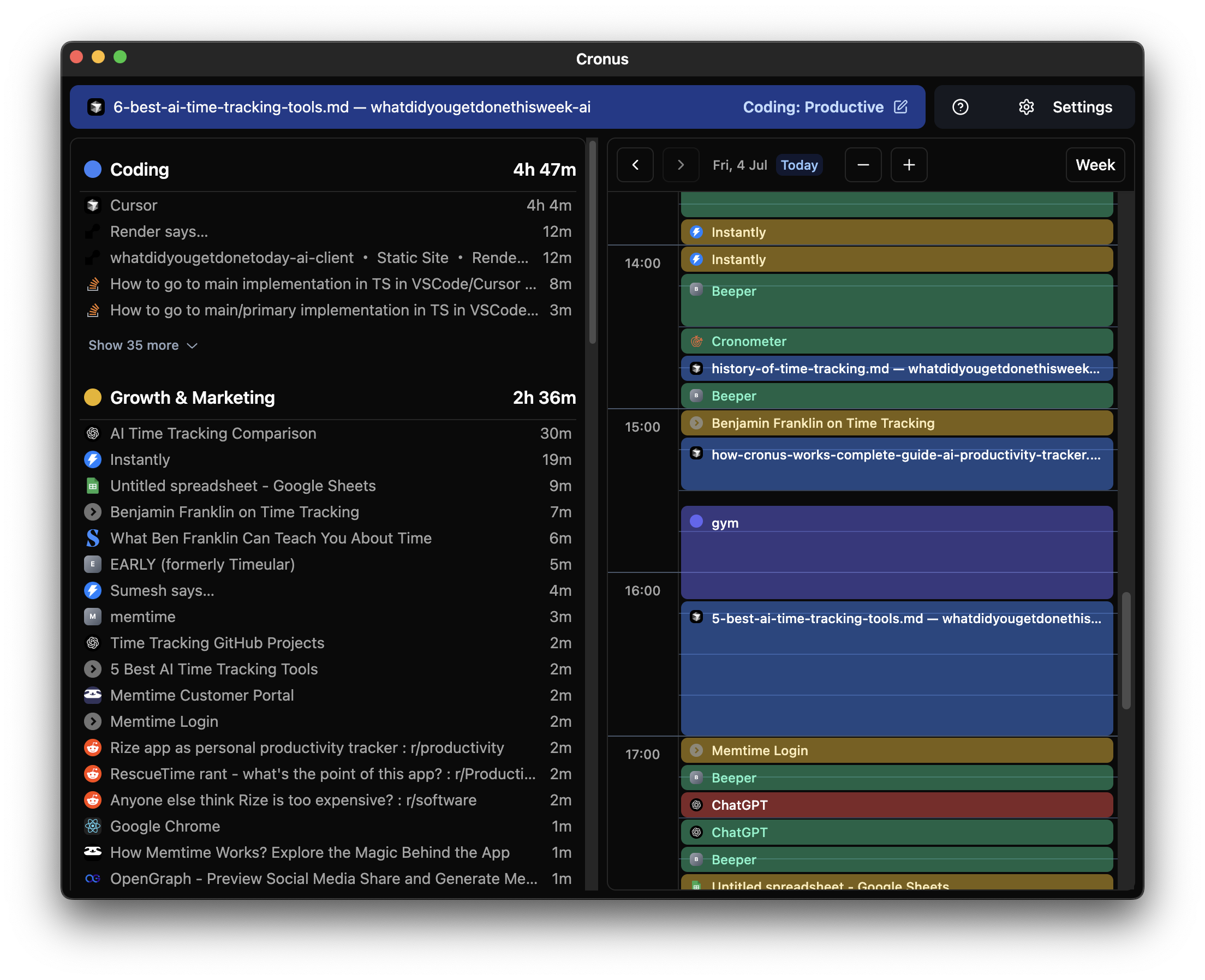
This is what we built Cronus for. It watches which app and window you are in, works out what the activity was in service of, and keeps the record. No timer to start, nothing to log, nothing to remember. Then the question "where did the morning go" has an answer that does not depend on your memory of it.
Expect the first week to be uncomfortable. The numbers are usually worse than the ones in your head, and the shape of the day is more fragmented than it feels. That gap is the point.
3. Get interrupted at the right moment
The useful moment is not Sunday evening looking at a chart. It is twenty minutes into something you did not intend to be doing, while you can still change it.
That is why Cronus does not block, and why it does not send you an alert to dismiss.
Instead it draws two live counters into the menu bar — either side of the notch on Macs that have one — showing productive and unproductive time as they accumulate. It is the same principle as the analogue clock above: information already in your field of view, requiring no check. A blocker makes a decision for you in advance using information it does not have, and gets uninstalled the first time it is wrong. An alert gets dismissed. A number that is simply always there does neither.
What to stop doing
Stop trusting your estimate of how long things take. Log estimates against actuals for two weeks and you will find your personal multiplier. Most people run between 1.5x and 3x on anything non-routine. Then just multiply.
Stop treating lost hours as a moral failure. It is a perceptual gap, and you would not describe needing glasses as a character flaw. The framing matters because guilt makes people abandon systems, and abandoning the system is the actual failure mode.
Stop building systems that require the broken faculty. Any method whose first step is "notice the time" is going to fail. Judge a tool by what it asks of you on your worst day.
The honest summary
You cannot fix time blindness by trying harder to feel time. The sense is not there to be sharpened, and the harder you concentrate, the more absorbed you become, and the less time you perceive.
What you can do is stop relying on it. Put the clock outside your head. Let something else keep the record. Get told what is happening while it is still happening.
Cronus is $6 a month after a 21-day trial, and it does the measuring so you do not have to notice.
Read next
- ADHD and Time Tracking: Why Manual Trackers Fail You Specifically — the same mechanism, and why every popular method asks for the ability that is hardest.
- Where Did My Day Go? — the four places the hours actually turn up.
- Seven Time Perception Experiments You Can Run on Yourself — measure your own distortion in under a week.
- Why Am I Always Late? — the most common consequence.
- ADHD Symptoms in Women — if this went unnamed for a long time.
If you would rather start without installing anything, the newsletter below walks you through a five-day audit of your own time, one short email a day.
Find out where your week actually goes
The 5-day time audit: one short email a day, walking you through the experiments in this post. You will end the week with a real answer instead of an impression. Free, no app required, and it ends after five days.