Seven Time Perception Experiments You Can Run on Yourself
Reading that human time perception is unreliable does not change anything. Watching your own estimate miss by 40% does.
These are seven experiments you can run on yourself. Most take under a week. None require equipment beyond a timer and, for a few of them, something that records where your hours actually went, since the whole point is comparing belief against measurement.
They are ordered roughly by how uncomfortable the results tend to be.
1. The estimate-first test
Time required: one minute now, five minutes in a week.
Before you look at any data, write down your answers:
- How many hours did you work last week?
- How many of those were focused, uninterrupted work?
- What was your single longest unbroken block?
- Which app or site took the most time?
- What percentage of the week went to your most important project?
Seal it. Then measure a week and compare.
What usually happens: total hours come out close, because you know your schedule. Everything else misses badly. Focused hours are typically overestimated by a lot, longest block is overestimated dramatically, and the biggest time sink is almost never the one people name.
This asymmetry is the finding. You know your calendar. You do not know your attention.
2. The two-minute test
Time required: two minutes.
Sit somewhere without a clock and estimate two minutes. No counting. Just stop when it feels right.
Do it again while doing something absorbing. Then again while waiting for something.
What usually happens: engaged, you undershoot badly, sometimes calling ninety seconds two minutes. Waiting, you overshoot. The clock in your head is not a clock, it is a function of how occupied your attention is.
Everything else on this list follows from that one fact.
3. The task estimation log
Time required: two weeks, thirty seconds per task.
Before each task, write your estimate. After, write the actual. Nothing else.
What usually happens: you find your personal multiplier, and it is stable. Most people run between 1.5x and 3x on anything non-routine. Once you know yours, planning improves immediately, because you can multiply.
Note the shape of the error too: estimates are usually right about the work and wrong about everything around it. The coding took forty minutes as predicted. The setup, the interruption, the context switch back, and the review took ninety more.
4. The interruption count
Time required: one day.
Tally every context switch. Every Slack check, every tab change away from the task, every "quick look" at something.
Do not try to reduce them. Just count.
What usually happens: the number shocks people. Fifty to a hundred in a working day is ordinary. Worse, the act of counting reveals how many are self-initiated rather than external, which is the uncomfortable part: most interruptions are not interruptions, they are escapes.
A caution: counting changes the behaviour, so day one is not a clean baseline. That is a real limitation of this experiment and the reason for the next one.
5. The recall test
Time required: five minutes on a Friday.
Before looking at anything, reconstruct your week hour by hour. Write what you did in each block from memory. Then compare against a record.
What usually happens: you can account for maybe half. The mornings come back reasonably. Afternoons dissolve. Whole hours are simply missing, and the reconstruction tends to be smoother and more purposeful than the week actually was, with the fragmentation edited out.
This is the experiment that most directly demonstrates the forty-point self-report gap on yourself. It needs an independent record, which is the one thing here you cannot do from memory by definition.
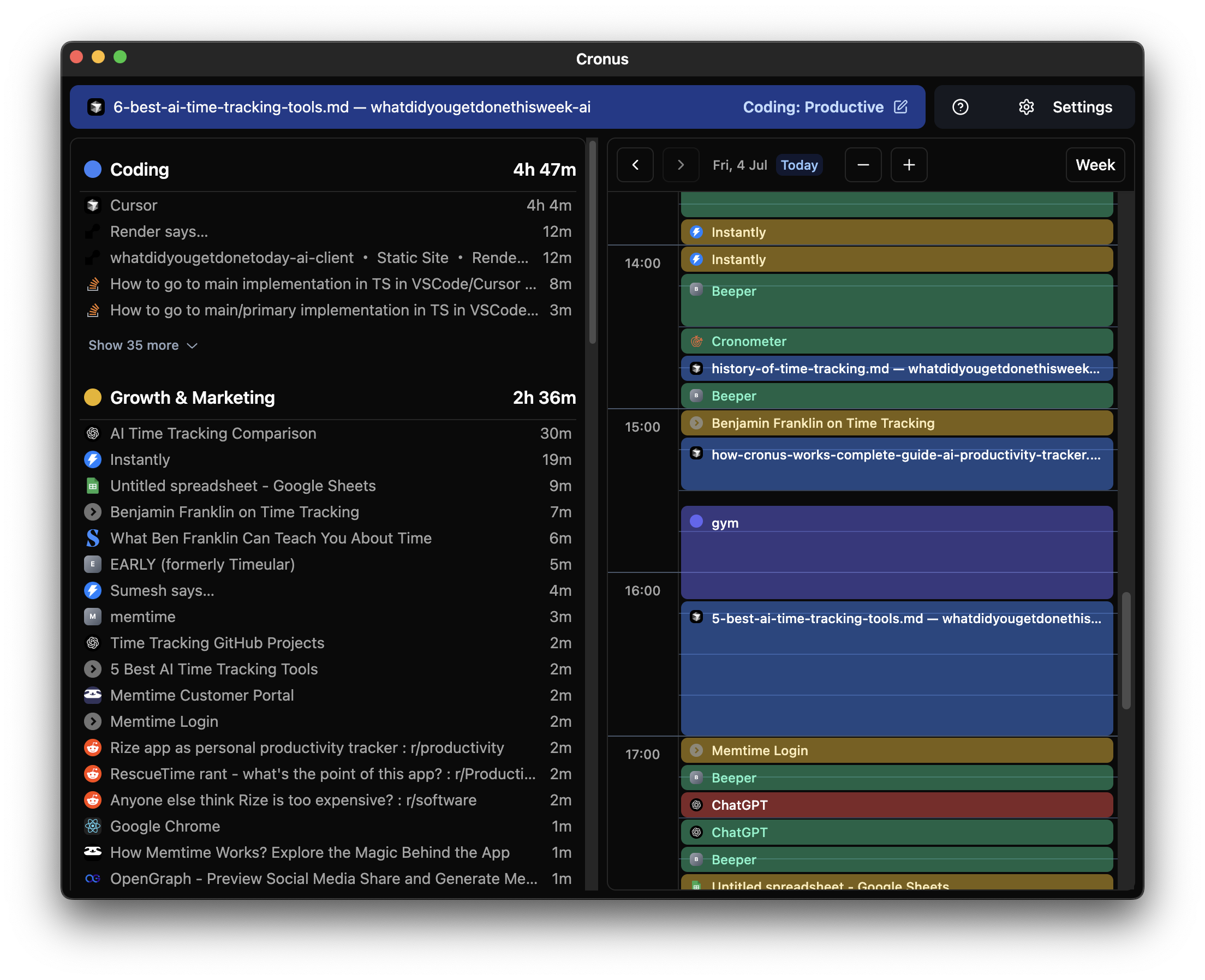
We built Cronus for exactly this comparison. It records where your hours went and what they meant, automatically, so there is something to check your reconstruction against. It is $6 a month after a 21-day trial, and there is no timer to remember to start, which matters because the weeks worth examining are the ones where you would have forgotten.
6. The novelty ratio
Time required: four weeks.
At the end of each week, sort your hours into two buckets:
- Distinguishable: work at the edge of your ability, first times, things that required you to change.
- Template: work you have done many times before, in the familiar way.
What usually happens: the template bucket is far larger than expected, and it grows quietly over months as you get better at your job. Competence converts distinguishable hours into template hours, which is what being good at something means, and it is also why the years compress.
The tension is real and there is no clean resolution. But you cannot manage the ratio without seeing it.
7. The prospective-retrospective split
Time required: one week, ten seconds a day.
Each evening, rate the day on two scales, without looking at yesterday's answers:
- While living it, did today feel fast or slow?
- Looking back, does today feel long or short?
What usually happens: they invert. Busy fragmented days feel fast in the moment and short in retrospect, which is the worst combination and also the most common. Deeply focused days feel fast while you are in them and long afterwards. Days of waiting feel slow throughout and vanish entirely.
The lesson is that "the day flew by" is ambiguous and the two meanings point in opposite directions. One means you were absorbed. The other means nothing was stored. It is worth learning to tell them apart on yourself, because only one of them is a problem.
What to do with the results
Run three or four of these and a pattern emerges that is consistent across almost everyone:
- Your estimate of total time is decent.
- Your estimate of focused time is far too high.
- Your estimate of fragmentation is far too low.
- Your memory of a week is smoother and more purposeful than the week was.
Every one of those errors runs in the flattering direction, which is why introspection alone will never correct them. You are not going to think your way to a less flattering account of your own week.
That is the entire argument for measuring rather than reflecting, and it is why the useful measurement has to be automatic. A method requiring discipline fails precisely in the weeks that discipline is short, which are the weeks worth examining.
Try Cronus. Run experiment one this week, and check it against what actually happened.
Find out where your week actually goes
The 5-day time audit: one short email a day, walking you through the experiments in this post. You will end the week with a real answer instead of an impression. Free, no app required, and it ends after five days.