Monotropism
Monotropism is the idea that autistic attention runs as one deep channel rather than several shallow ones.
A monotropic mind pulls most of its available processing into a small number of interests at a time, intensely. A polytropic mind spreads attention more thinly across more things at once. Neither is a malfunction. They are different allocation strategies, with different strengths and different costs.
The theory was developed by autistic researchers — Dinah Murray, Mike Lesser and Wendy Lawson — and set out in Attention, monotropism and the diagnostic criteria for autism (Autism, 2005). What made it unusual for its time is that it explained the diagnostic features of autism without positing a deficit anywhere. It is one of very few theories of autism authored substantially by autistic people, which is part of why it has been taken up so widely in autistic communities.
The attention tunnel
Murray's image for it is a tunnel.
Attention is a tunnel that goes deep but has walls. Inside the tunnel, processing is rich, detailed and fast. Outside it, things are not merely deprioritised — they are genuinely not perceived. Not ignored. Not registered.
Her example is Archimedes, who worked out the principle of buoyancy in the bath and then ran through the streets of Syracuse without noticing he had no clothes on. The nakedness was not a decision. It was outside the tunnel.
Once you have that image, a long list of apparently unrelated autistic traits stops looking like a list.
What one idea explains
Why transitions are hard. Changing task is not a matter of turning your head. It means dismantling a tunnel and building another one, which is expensive, and the expense is real rather than attitudinal. This is the mechanism behind autistic inertia: both the difficulty starting and the difficulty stopping, which are the same phenomenon at two ends.
Why interruptions cost so much more than they appear to. For a polytropic mind, an interruption is a detour. For a monotropic one, it can collapse the tunnel entirely, and rebuilding is not free. The visible cost is two minutes. The actual cost can be the rest of the session.
Why routine and predictability help. A predictable environment means fewer forced tunnel rebuilds. Routine is not rigidity for its own sake; it is protection of a limited resource.
Why intense interests are regulating rather than symptomatic. Deep engagement is the state this attention style is built for. Time in a strong interest is often where an autistic person is most capable and most comfortable, which is why treating special interests as behaviour to be reduced tends to backfire.
Why overwhelm arrives the way it does. Environments demanding many simultaneous shallow channels — open-plan offices, group conversation, noisy rooms with several things happening — are the worst possible fit. The overload is not weakness. It is a mismatch between the demand and the architecture.
Why social interaction is exhausting in a specific way. Typical conversation is many-channelled: words, tone, expression, posture, timing, subtext, all at once. Monotropic attention is not built to run six shallow channels in parallel, so it does it deliberately and effortfully instead of automatically. Notably, the theory predicts that two monotropic people often communicate together with far less friction, which matches what autistic people consistently report and what the double empathy problem describes.
Why time disappears. This is the one most relevant here, and it gets the section below.
Monotropism and time
Time perception depends on some part of you sampling the outside world periodically. Noticing light change, noticing hunger, noticing that the meeting is soon.
Inside an attention tunnel there is no sampling. So there is no accumulating sense of duration, and this is not carelessness — the monitoring process is simply not running.
Two consequences follow, and they explain a lot of what gets labelled as unreliability.
Duration is not registered. Four hours and forty minutes feel similar from the inside, because neither was measured. Asking someone to estimate afterwards asks them to reconstruct from evidence they never collected.
Future events do not stay present. When a whole tunnel is one thing, an appointment at 3pm is outside it and therefore effectively does not exist until something external surfaces it. This is what makes people chronically late despite genuinely caring about being on time, and it is much closer to a perceptual issue than a motivational one.
People are unreliable about elapsed time even without any of this. In a randomised controlled trial, experienced developers estimated a tool had made them 20% faster on real tasks; they were 19% slower, an error of forty percentage points about work they had just completed. We covered the study in full. That is the baseline error for a typical mind that was paying attention. Estimating from inside a tunnel is a harder problem.
What to do with it
The useful move is not to become polytropic. That is not on offer, and the attempt is a decent description of masking.
Work with the tunnel, not against it. Long uninterrupted blocks are worth more to a monotropic mind than to most people, and fragmented calendars cost more. One three-hour block genuinely beats six half-hours, by a wider margin than the arithmetic suggests.
Batch by context. Every change of context is a rebuild. Grouping similar work is not a nicety here; it is the difference between one rebuild and eight.
Budget for transitions explicitly. Put actual time between things. A calendar packed edge to edge is a calendar of unpaid rebuild costs.
Use external anchors for anything outside the tunnel. Alarms that require movement, another person, a calendar that speaks. Anything relying on you noticing is relying on the thing that is switched off.
Ask for the accommodations that map onto this, if you are in a position to. Fewer meetings and larger blocks, warning before changes, written rather than verbal instructions, a quieter space. All of these follow directly from the theory rather than being generic requests. We wrote about how to ask, including why you should never hand over raw tracking data.
Measuring what you cannot sense
If the monitoring process is not running, the honest fix is not to try harder at monitoring. It is to have something else do it.
Manual time tracking is close to the worst possible tool for a monotropic mind. It asks for an action at every transition, which is exactly the moment that costs the most, and it asks you to notice you have switched, which is the thing that is not happening.
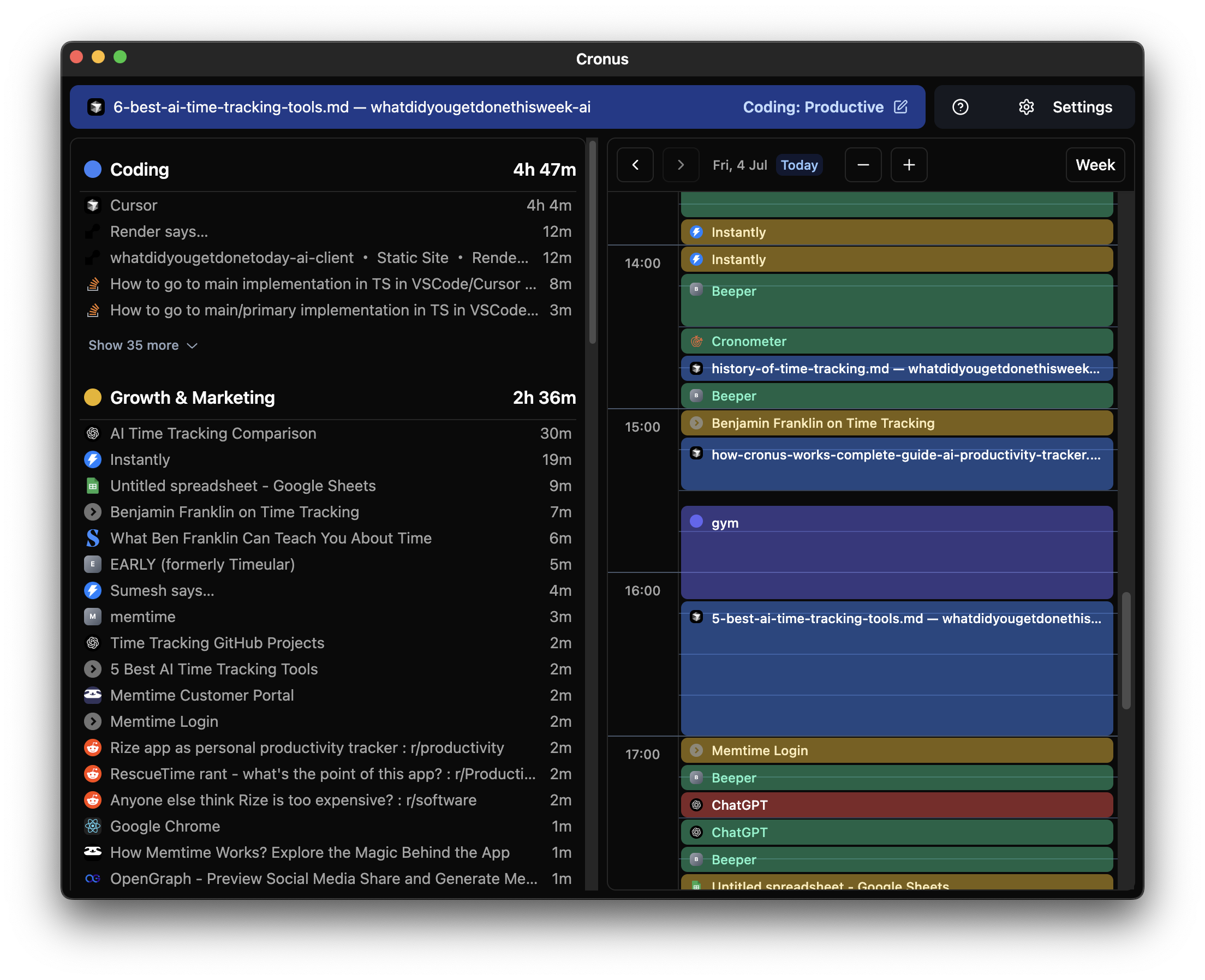
Cronus records automatically on your Mac: no timer, nothing to log, nothing to notice. Afterwards you can see how long the tunnel actually lasted, how many rebuilds a day contained, and which days were fragmented enough to explain why they went badly.
Two things people find useful rather than merely interesting: transitions per day, which is usually far higher than expected and is the number to argue for change with, and the true length of deep sessions, which is usually longer than remembered and reframes a "wasted" day as a productive one that ran long.
$6 a month after a 21-day trial. It never captures your screen: window titles only, redacted on your device before anything is sent.
Where it does not help: it will not interrupt you usefully, it will not make transitions cheaper, and it is a record rather than a treatment. If you want everything to stay on your own machine, ActivityWatch is the better answer.
The honest status of the theory
Monotropism is a well-regarded explanatory framework, not settled fact. It has been influential in autistic communities and increasingly in professional practice, and a self-report questionnaire has been developed to measure monotropic traits. It has considerably less experimental literature behind it than older cognitive theories of autism, and it competes with accounts like weak central coherence and predictive coding, some of which it partly overlaps.
What it has going for it is parsimony and fit: one mechanism accounting for a wide spread of traits, described in terms autistic people recognise from the inside. That is a genuine strength, and it is not the same as proof. Treat it as a lens that explains a lot, not a diagnosis.
Read next
- Autistic Inertia — the starting and stopping problem, in detail.
- Hyperfixation — the ADHD-adjacent cousin, and how they differ.
- What ADHD Communities Say About Time — the same territory, in people's own words.
Sources: Murray, Lesser & Lawson (2005), Autism 9(2) · monotropism.org · National Autistic Society: What is monotropism? · Reframing Autism