ADHD Burnout: Why It Is Not the Same as Regular Burnout
You held it together for months. You met the deadlines, answered the messages, showed up, performed being fine. Then something small went wrong and you could not do any of it any more — not the work, not the washing up, not replying to a friend.
That is not ordinary burnout with an ADHD label attached. The mechanism is different, and the standard advice is aimed at the other thing.
Written by people who build a time tracker, not clinicians. About patterns and practical consequence, not diagnosis or treatment.
The difference that matters
Conventional burnout is usually described as the result of chronic workload: too much, for too long, with too little control or recovery. Reduce the load, restore the recovery, and it improves.
ADHD burnout typically has a second engine running underneath, and it is the more expensive one: the cost of appearing to function normally.
The work is not just the work. It is also:
- Rebuilding a system every few weeks because the last one stopped working
- Double-checking things other people do not check, because you have been burned
- Compensating for a time sense that does not report accurately
- Managing the emotional aftermath of being late, forgetting, or being read as careless
- Masking: producing a calm, organised, on-top-of-it version of yourself, all day
None of that appears on any workload measure. Two people can have identical jobs and identical hours, and one is doing substantially more work, none of it visible, including to themselves.
Which is why "reduce your workload" often does not help. The load that broke you was not the workload.
The cycle
It tends to run in a recognisable shape.
1. Compensation. Things are going well because you have built scaffolding — systems, reminders, effort — and are running it all manually. It is working. It is also expensive.
2. Escalation. Because it is working, more arrives. A project, a promotion, a person to manage. The scaffolding stretches.
3. Erosion. The maintenance stops fitting. Recovery gets used up first, because it is the only compressible thing. Sleep goes, then exercise, then anything not urgent.
4. Collapse. Something small tips it and the whole structure goes at once. Not a gradual decline — a cliff. Executive function drops out, and tasks that were easy last month become impossible.
5. Shame. The collapse looks, from outside and often from inside, like a sudden character failure. That reading makes recovery slower and the next cycle more likely.
The cliff shape is the part people miss. Burnout is often described as gradual, so you wait for a gradual warning that does not come.
Why you cannot feel it coming
Three reasons, and they compound.
Masking hides it from you too. Performing fine is practice at believing you are fine. The signal is being suppressed at the source.
The compensation cost is invisible. You do not experience the extra work as extra. It is just what doing your job feels like, so it never shows up on any mental ledger.
Your read on your own hours is not reliable. Time blindness means the week's shape is not accurately perceived while you are in it. And this is not an ADHD-only limitation: in a 2025 randomized trial, experienced developers were 19% slower with AI tools while estimating they had been 20% faster — a roughly forty percentage point error about work they had just finished.
If that is the error on a straightforward question, "am I overdoing it lately?" is not a question introspection can answer.
The signs that show up before you feel them
Here is the useful part. Burnout is preceded by changes in the shape of your weeks, and shape is measurable even when your sense of it is not.
The ones worth watching:
Recovery disappearing first. Not total hours going up — evenings and weekends quietly filling in. The compressible thing gets compressed first.
Fragmentation rising. Your longest unbroken block shrinking week over week is one of the earliest signals. It usually moves before total hours do.
Work drifting later. Real work migrating into the evening because the day is consumed by everything else.
Fewer distinct good hours. Most people have two or three genuinely effective hours a day. When those shrink while the workday lengthens, you are running on compensation.
Weekend bleed. Sunday stops being empty. Rarely deliberate; usually noticed months late.
Every one is invisible day to day and obvious in a record.
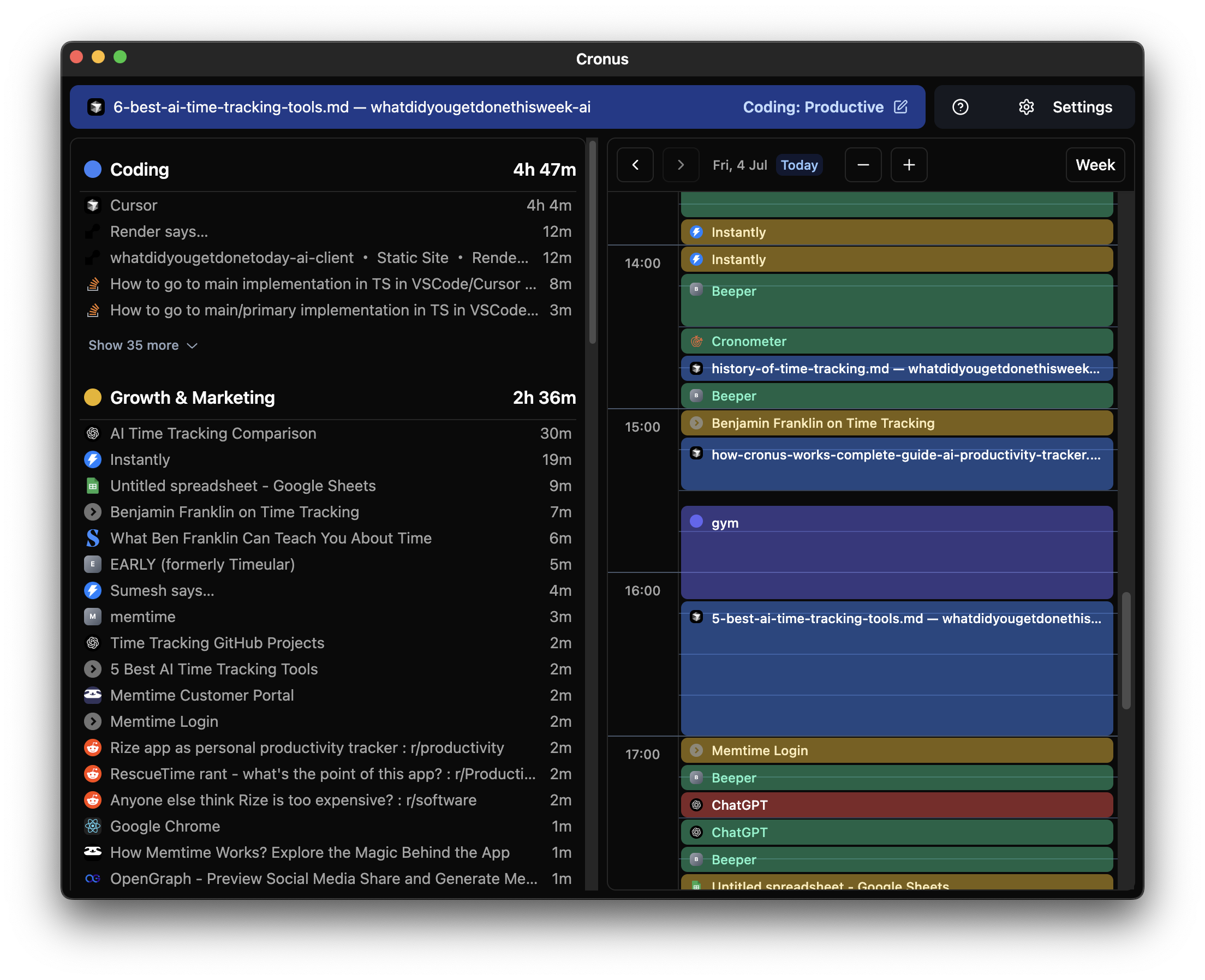
That is where Cronus is genuinely useful for this. It records where your time went automatically, without a timer to start or anything to log, which matters because on the weeks that count you will not be maintaining a logging habit. Over a month or two you can see the trend rather than the day: whether recovery is being eaten, whether your longest block is shrinking, whether work has crept into evenings.
What it is not. It is not a health tool, does not detect burnout, and cannot tell you whether to keep going. It measures the shape of your weeks. Reading that as a warning sign is a judgment you make, ideally with a doctor if things are bad.
What actually helps
Cut the invisible work, not just the visible work. If you cannot reduce hours, reduce the compensation: fewer systems to maintain, fewer things held in your head, automate anything currently done by remembering.
Protect recovery as if it were a deadline. It is the first thing to be compressed and the thing whose loss predicts collapse. It has to be defended, not fitted in.
Reduce masking where it is safe. Sometimes that means disclosing, sometimes just working somewhere you can stop performing for part of the day. This is the single largest hidden cost for many people, and the hardest to change.
Take the cliff seriously. Because the decline is not gradual, "I'll rest when it gets bad" is a plan that arrives too late. The signals above are the earlier warning.
Get the shape of your weeks out of your head. Not for optimisation. So that "I think I have been doing too much lately" becomes a thing you can check.
Recovery is slower than you expect
Worth saying because the expectation causes real harm: ADHD burnout tends to take longer to recover from than the equivalent conventional burnout, partly because the scaffolding that kept you going has also collapsed, and rebuilding it is itself executive-function work — the resource that is depleted.
A weekend does not do it. Neither, usually, does a week.
The most common mistake is returning at the previous intensity as soon as the acute part passes, which reproduces the cycle with less margin.
Read next
- ADHD Paralysis: Why You Freeze — what the collapsed state feels like from inside.
- ADHD Executive Dysfunction, in Plain Language — the functions that go first.
- ADHD Time Blindness — why you cannot assess your own week accurately.
- ADHD and Sleep — where the recovery goes first.
- Accommodations at Work — reducing the load before it collapses.
The newsletter below is a five-day audit of your own time. One short email a day, nothing to log, no app required.
Find out where your week actually goes
The 5-day time audit: one short email a day, walking you through the experiments in this post. You will end the week with a real answer instead of an impression. Free, no app required, and it ends after five days.