Why Am I Always Late? (Even When I Leave Early)
You left twenty minutes earlier than usual. You are still late.
That specific experience is the one worth explaining, because it rules out the obvious answer. If leaving earlier fixed it, you would have fixed it years ago. Something else is going on, and it is not that you do not care.
The short version
Chronic lateness is usually not a planning failure. It is a tracking failure.
You can estimate how long the drive takes. What you cannot reliably do is notice time passing while you are inside it. Those are two different abilities, and only one of them is failing.
So you plan well, then lose the plan in the twenty minutes before leaving.
Why leaving early does not help
Here is the shape of the morning that ends in lateness despite an early start.
You are ready with twenty spare minutes. Twenty minutes is not enough to start anything real, so you fill it: check one email, tidy one thing, look up one fact. Each of those has a natural end you cannot see from the inside.
The email becomes a reply. The reply raises a question. You look it up.
None of that felt like twenty minutes. It felt like four.
The spare time did not act as a buffer. It acted as an invitation. That is why leaving earlier can genuinely make things worse: a bigger buffer is a bigger invitation, and the buffer is consumed by exactly the thing that made you late in the first place.
The two abilities, and which one is broken
Research on time perception separates estimating an interval from reproducing one.
- Estimating: "How long does it take to get to the office?" You are probably fine at this.
- Reproducing: "Tell me when twenty minutes have passed." This is the one that fails.
In the temporal-processing literature, especially work on ADHD, a consistent pattern shows up: reproduction is impaired while estimation is often intact.
That single distinction explains most of chronic lateness:
- You can plan accurately, and still be late, because planning uses the intact ability and execution uses the broken one.
- "Five more minutes" ends two hours later without any intent to break the promise.
- Checking the clock does not help, because remembering to check the clock is the same faculty that is not working.
If you have ADHD, this is likely more pronounced for you, and it has a name: time blindness. But the mechanism is not exclusive to ADHD. Everyone's internal clock is an attention meter rather than a clock.
Your internal clock measures attention, not time
Test it in two minutes, because reading about it changes nothing:
Sit somewhere without a clock and estimate two minutes. No counting. Then do it again while absorbed in something. Then again while waiting for a page to load.
Almost everyone undershoots badly when engaged and overshoots when waiting.
That is the entire mechanism. Time in the mind runs on how occupied your attention is, so the more absorbing the thing, the less time you perceive passing. Which means the activities most likely to make you late are exactly the ones you notice least.
The advice that does not work, and why
"Just leave earlier." Addressed above. Enlarges the gap that gets consumed.
"Set an alarm." Better, because it is external. It fails on the last step: alarms tend to be set for the departure time, at which point you still have to stop, gather things and get out. An alarm at the moment you should already be moving is a notification that you are late.
"Set your clock ten minutes fast." Works for about two weeks, until you internalise the offset and start subtracting it.
"Be more disciplined." You are not failing to act on information. You do not have the information. There is nothing to be disciplined about.
What actually works
1. Set the alarm for the step before
Not "leave at 8:40." Set it for "stop what you are doing at 8:25."
The gap between stopping and leaving is where lateness is manufactured, and it is almost always longer than it feels. If you have ever been fully ready and still left eight minutes late, that gap is your real problem.
2. Make time visible without requiring a check
An analogue clock in your eyeline beats a digital one, because you read elapsed time as a shape rather than comparing two numbers. Visual countdown timers work for the same reason.
The general rule: anything that shows time passing without you having to check is worth more than anything requiring a check. The check is the thing that does not happen.
3. Do not fill the buffer
Give the spare twenty minutes a job that terminates on its own: stand outside, sit in the car, put on music. Anything with an obvious end.
The rule that survives contact with a real morning is narrower: nothing with a screen, and nothing that produces a next step. Email produces a next step. So does "quickly looking something up."
4. Learn your actual multiplier
For two weeks, write down your estimate before a task and the real duration after. You will find a stable personal multiplier, usually between 1.5x and 3x on anything non-routine.
Once you know yours, you stop needing to estimate well. You estimate badly, as always, and multiply.
Measuring the part you cannot see
Everything above depends on knowing where the twenty minutes actually went, and that is the one thing you cannot reconstruct from memory. The absorbing activity is, by definition, the one you noticed least.
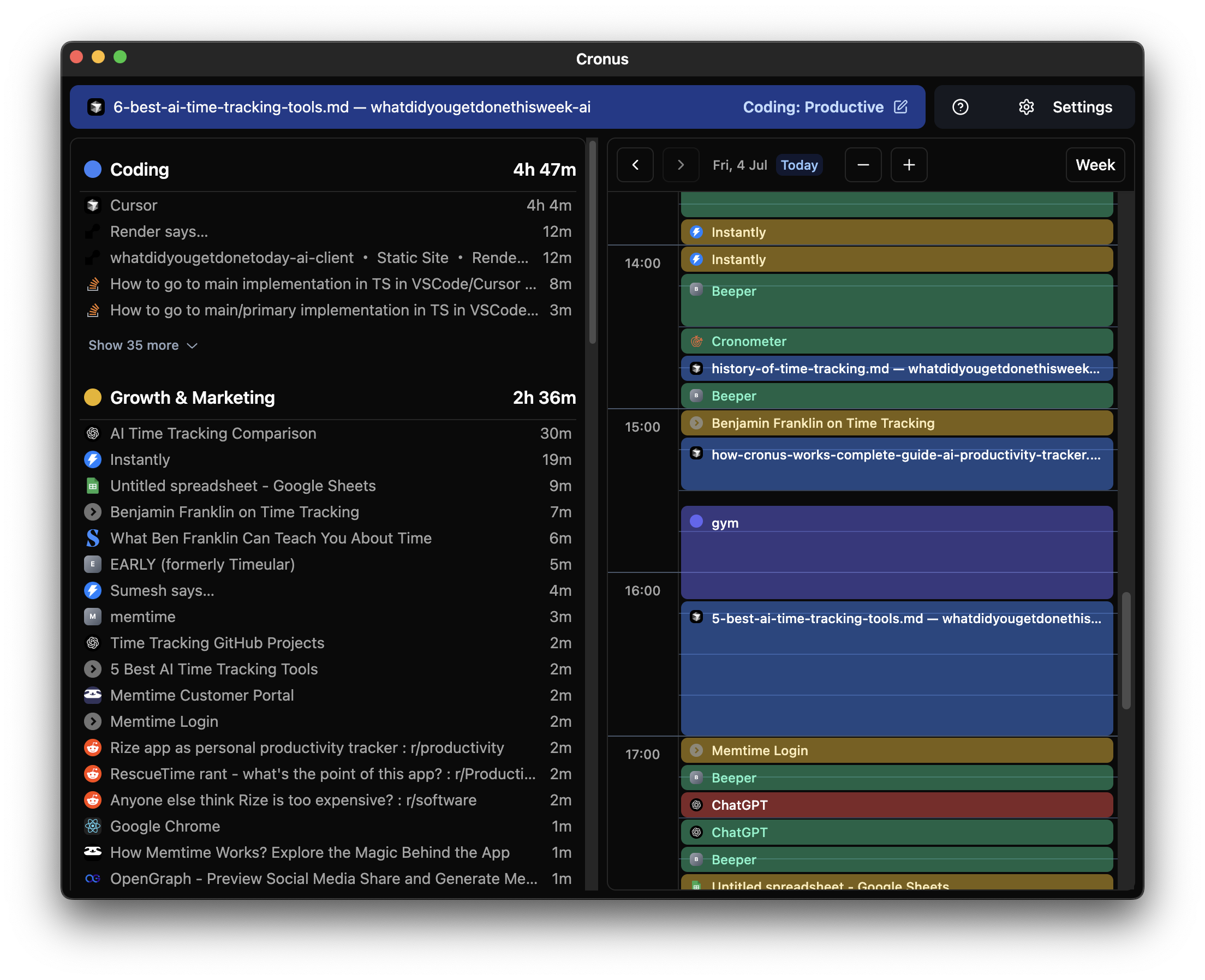
This is what Cronus does. It records which app and window you were in and works out what the time was in service of, automatically. No timer to start, nothing to log. So the morning that ended in lateness has an actual account, rather than "I don't know, I was getting ready."
Most people find the answer is not what they assumed. The story is usually "I was slow getting ready." The record usually says eleven minutes vanished into a single tab.
It is $6 a month after a 21-day free trial, and it never captures your screen.
The part worth saying plainly
Chronic lateness is read by other people as a statement about them: that you did not care enough to be on time. That reading is almost always wrong, and it is the most expensive part of this, far more than the minutes.
You cannot argue your way out of it, because from the outside the evidence looks damning and consistent.
What you can do is stop trying to solve it with effort, which has not worked and will not, and start solving it with external structure: alarms for the step before, time made visible, buffers that cannot be spent, and a record of where the minutes actually go.
Read next
- ADHD Time Blindness: Why You Lose Hours, and How to Get Them Back — the underlying mechanism in depth.
- ADHD and Time Tracking: Why Manual Trackers Fail You Specifically — if every app you have tried has failed the same way.
- Where Did My Day Go? — the same problem at the scale of a whole day.
- ADHD and Relationships — the part that costs most.
- ADHD and Sleep — if the mornings are the hard bit.
Want to find out where the twenty minutes go? The newsletter below is a five-day audit of your own time, one short email a day.
Find out where your week actually goes
The 5-day time audit: one short email a day, walking you through the experiments in this post. You will end the week with a real answer instead of an impression. Free, no app required, and it ends after five days.