Autistic Inertia: Why Starting and Stopping Are Both Hard
You cannot begin the thing. Hours pass.
Then once you do begin, you cannot stop, even to eat.
Both of those are the same phenomenon. It is usually called autistic inertia, and the two-directional part is what most descriptions get wrong.
Written by people who build a time tracker, not clinicians. About the pattern and what helps, not diagnosis.
What it is
Inertia is difficulty changing state.
Not difficulty doing things. Difficulty switching between doing and not doing, in either direction.
The physics metaphor is apt, which is why the name stuck. A body at rest stays at rest. A body in motion stays in motion. Both need force applied to change.
That is why "just start" misses. It treats the problem as motivation, when it is transition.
Why it is not procrastination
Procrastination usually involves preferring something else. You avoid the tax return by watching television. There is a swap.
Inertia often has no swap. You are not doing the appealing alternative. You are frequently doing nothing at all, and not enjoying it.
Two other differences worth noting:
- Procrastination is generally about aversive tasks. Inertia applies to things you actively want to do.
- Procrastination does not usually make it hard to stop. Inertia does.
If you have ever been unable to start something you were looking forward to, that is the distinction in one experience.
The three transitions that cost most
Starting from rest. The classic version. Everything is ready, nothing happens.
Stopping once going. Missing meals, working past the point of usefulness, not going to bed. Close relative of hyperfocus.
Switching between two active things. Often the hardest and least discussed. Moving from one task straight into another can cost more than starting cold.
What helps
Transitions are the target. Not motivation.
Reduce the size of the transition. Do not go from nothing to the task. Go to the chair, then the document, then one sentence. Each step is small enough to be crossable.
Use external cues. An alarm across the room. A person arriving. A scheduled call. Anything that applies force from outside, because generating it internally is the part that is hard.
Keep a runway. Leaving something half-finished, mid-sentence, gives the next session a start point. Restarting from an obvious next action is far cheaper than restarting from a blank page.
Plan the stops as well as the starts. If stopping is hard, an unplanned stop will not happen. Put a hard boundary after the session: a call, a meal with someone else, a place you have to be.
Batch similar work. Switching between two different kinds of task is expensive. Three similar tasks in a row cost less than three different ones.
Do not schedule back-to-back. Leave gaps around transitions. The gap is not slack, it is the cost of changing state.
Inertia and ADHD
Inertia is discussed most in autistic communities, and plenty of ADHD people recognise it. There is overlap in the surface pattern, and the language differs by community.
If it looks more like "I cannot start this specific task", ADHD paralysis covers the same ground with a different vocabulary. Useful to read both and take whichever framing fits.
The measurement problem
Inertia is close to invisible in memory.
Nothing happens during it. There are no events to recall. So the two hours before you started leave no trace, and the six hours after you started feel like two.
That produces confident, wrong accounts of your own week in both directions.
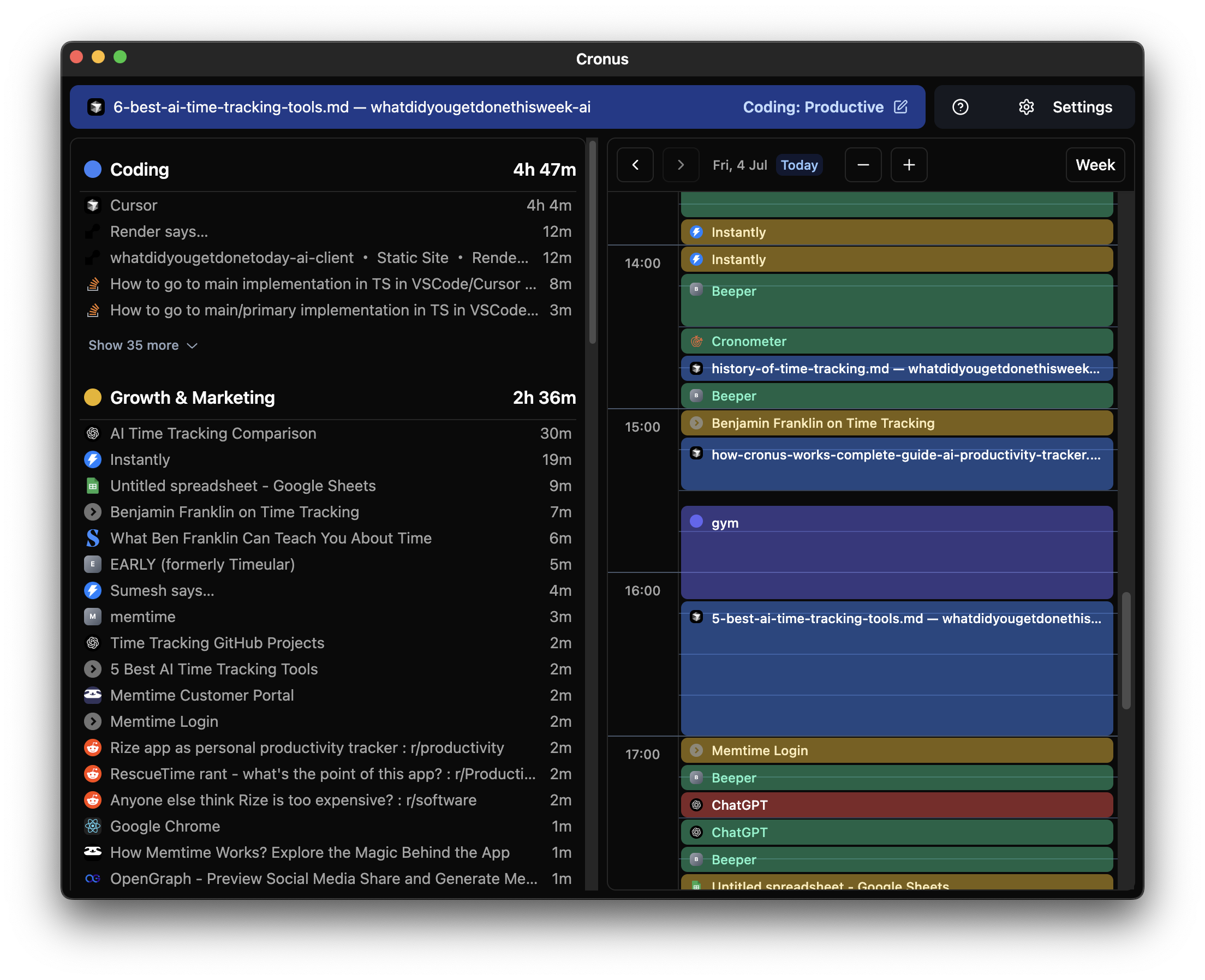
Cronus records what you were doing automatically, so the gaps and the long stretches both show up as themselves. Over a few weeks you can see the real shape: how long transitions actually take, when they are worst, and what tends to precede a stuck stretch.
That is the useful input for arranging a week around inertia rather than fighting it.
It will not get you moving. Nothing in an app applies external force well. A person, a scheduled call, or a hard boundary will do more.
The reframe
Inertia is not a motivation problem, so motivational advice does not touch it.
Design for transitions. Make them smaller, put the force outside your own head, and plan the stops with as much care as the starts.
Read next
- ADHD Paralysis — the same shape, different vocabulary.
- ADHD Hyperfocus — the not-stopping side in depth.
- ADHD Executive Dysfunction — where task initiation sits among the rest.
Find out where your week actually goes
The 5-day time audit: one short email a day, walking you through the experiments in this post. You will end the week with a real answer instead of an impression. Free, no app required, and it ends after five days.