ADHD Accommodations at Work: What to Ask For, and How to Ask
Most articles on this subject list accommodations an employer could provide. That is not usually the hard part. The hard part is working out which ones would actually help you, and then asking for them without feeling like you are confessing to something.
This is practical guidance, not legal or medical advice. Protections and processes vary by country and employer; if you need to know your rights, ask a qualified adviser rather than a time tracking company.
Start with the mismatch, not the diagnosis
The most useful reframe: an accommodation is not a favour or a concession. It is removing a mismatch between how a job is arranged and how you work, in service of the same output.
Which means the conversation goes better when it is about the arrangement rather than about you. "I do my best analytical work before 11am, so I would like to move our standup to the afternoon" is a scheduling request. "I have ADHD and mornings are hard" invites a different, more personal conversation you may not want to be having.
Both can be true. Only one of them is about the work.
The accommodations that actually help
Ordered roughly by how much difference they make relative to how hard they are to get.
Scheduling
- No meetings before a set time, protecting your genuinely good hours for work rather than coordination
- Meeting-free blocks, ideally the same days each week so they become structural rather than negotiated
- Flexible start time, which removes a daily source of stress that has nothing to do with your output
- Advance notice of schedule changes, since unexpected reshuffles cost more than the meeting itself
Scheduling accommodations are usually the highest-value and the easiest to obtain, because they cost the employer almost nothing.
Communication
- Written follow-ups after verbal decisions. Not because you were not listening. Because working memory is a real constraint and reconstructing a meeting from memory is unreliable.
- One channel for what matters, so that important things do not arrive across four apps.
- Deadlines stated explicitly, rather than "when you get a chance", which is not a date and is quietly stressful.
Environment
- Noise-cancelling headphones, or explicit permission to use them
- A quieter or lower-traffic seat
- Remote or hybrid days for deep work
- Permission to keep the camera off in large meetings, which is more restful than it sounds
Task structure
- Large projects broken into checkpoints with dates. Sequencing is often the bottleneck; someone else supplying the sequence removes it.
- One priority at a time, explicitly ranked. "All of these are urgent" is not a prioritisation your manager has done.
- Written instructions for complex or recurring tasks, so you are not re-deriving a process each time.
What most lists get wrong
Two things.
They optimise for the employer's convenience. Many published lists focus on what is cheap and easy to grant, which is not the same as what helps you.
They skip the invisible work. The exhausting part of many ADHD workdays is not the job. It is the compensation: the systems, the double-checking, the masking. Accommodations that reduce compensation are worth more than accommodations that reduce workload, and almost nobody frames it that way.
If you can only ask for one thing, ask for the one that removes maintenance, not the one that removes tasks.
How to actually ask
Ask for something specific. "I would like to move our 1:1 to the afternoon" is actionable. "I need more flexibility" is not, and puts the work of interpreting you onto someone else.
Lead with the outcome. "This would mean my morning block goes to the migration rather than to standups." Managers grant things that come with a stated benefit far more readily.
Start with one. A single specific request is much more likely to succeed than a list, and it establishes that these requests are reasonable and low-cost.
Decide separately whether to disclose. You can request a schedule change without a diagnosis. Formal accommodations under a legal framework generally require disclosure and documentation, informal ones usually do not, and that is a genuine choice with real trade-offs. Getting advice on it is reasonable.
Put it in writing afterwards. A short message confirming what was agreed protects both sides and means it survives a manager change.
Where evidence helps, and where it does not
Accommodation conversations go better with specifics, and specifics about your own patterns are hard to produce from memory. "I think I focus better in the mornings" is a hunch. "My longest uninterrupted block is almost always between 9 and 11, and on days with a 10am meeting it drops by about two thirds" is a scheduling argument.
That is the difference between asking to be trusted and showing your working.
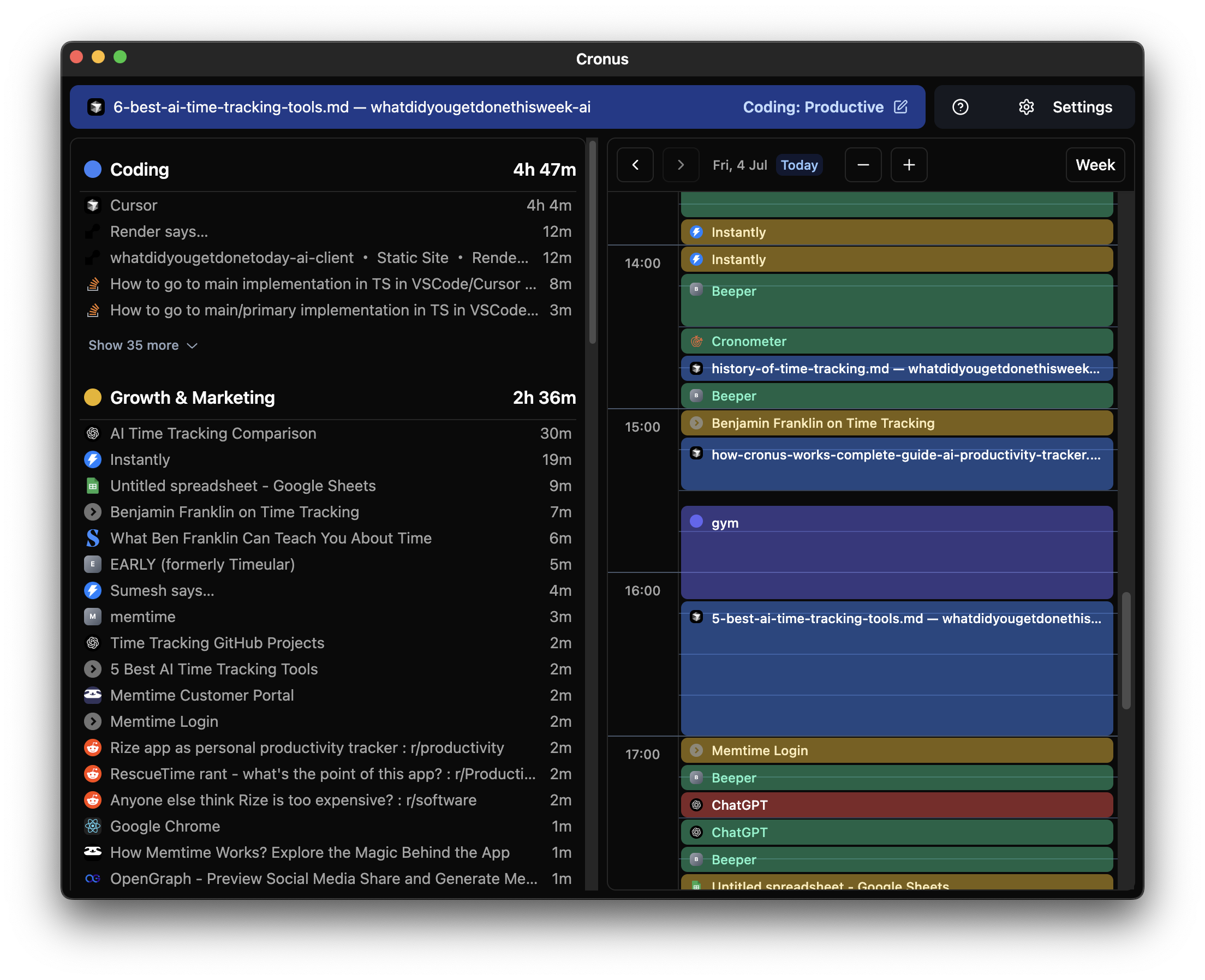
Cronus records where your time goes automatically, with no timer to start, so after a few weeks you have your own numbers: when your good hours are, what fragments them, and how much a badly placed meeting actually costs. It is $6 a month after a 21-day trial, and it never captures your screen — which matters here, because a tool that screenshots you is not one you want anywhere near a conversation with your employer.
Two important cautions.
This data is yours. Do not hand raw tracking data to an employer, and be wary of any employer-provided monitoring framed as an accommodation. The useful thing is a conclusion you drew — "my focused hours are in the morning" — not a log of your activity. There is a large difference between bringing evidence to a conversation and submitting to surveillance.
Do not over-prepare. Most accommodation requests are granted or refused on their reasonableness and cost, not on the strength of your dossier. Bring one specific number if it helps you feel steady. You are not building a case.
If the answer is no
It happens, and it is not always about you. Budgets, precedent, a manager who lacks the authority.
Useful next steps: ask what would be possible, request a trial period rather than a permanent change (much easier to say yes to), go via HR or occupational health if there is a formal process, and write down what was asked and what was said.
And if a workplace consistently refuses low-cost adjustments that would let you do your job, that is information about the workplace.
Read next
- ADHD Burnout — what happens when compensation runs unchecked for long enough.
- ADHD Executive Dysfunction, in Plain Language — useful for explaining the mismatch precisely.
- Where Did My Day Go? — finding out where your good hours actually are.
Find out where your week actually goes
The 5-day time audit: one short email a day, walking you through the experiments in this post. You will end the week with a real answer instead of an impression. Free, no app required, and it ends after five days.