The Flowtime Technique
Pomodoro has one design flaw that ruins it for a lot of people: it interrupts you when the work is going well.
Flowtime is the fix. You work until you naturally stop, then write down what you worked on and how long it took. No fixed intervals, no alarm cutting through a good stretch.
How it works
- Pick one task and note the start time.
- Work until you genuinely want to stop.
- Note the end time, take a break, note that too.
- Repeat.
That is all of it. The output is a simple log:
| Task | Start | End | Worked | Break |
|---|---|---|---|---|
| Migration | 09:12 | 10:34 | 1:22 | 0:12 |
| 10:46 | 11:03 | 0:17 | 0:05 |
What it fixes
Pomodoro cuts you off mid-flow. Twenty-five minutes is arbitrary. If you are deep in something at minute 24, the timer is an interruption you either obey and resent or ignore and stop trusting. Flowtime never interrupts.
It matches your real attention span instead of a fixed number. Some people sustain 90 minutes on a good task and 20 on a bad one. Pomodoro forces both into the same box; Flowtime records the difference.
It produces data. This is the underrated part. After two weeks you know your actual working intervals, which task types you sustain, when your good stretches happen and how often you are interrupted. Pomodoro produces a count of tomatoes, which tells you very little.
What it does not fix
Starting. Flowtime has no ignition mechanism at all, which is the one thing Pomodoro is genuinely good at. "Just 25 minutes" lowers the barrier to beginning; "work until you stop" does not.
If your problem is not being able to start, use Pomodoro to begin and Flowtime to measure. They are not really competitors.
Stopping. If you tend not to notice that four hours have gone, an approach whose only rule is "stop when you want to" will not help. See hyperfocus.
The logging. And this is the real problem.
The catch nobody mentions
Flowtime asks you to write down a start time, an end time, a break, and a label, every single time you switch.
That is more logging than Pomodoro, not less, and it arrives at the exact moment your attention is moving to something else. It works beautifully for about a week.
Then a chaotic day comes and you log nothing. The following week is patchy. Within a month you have a log that covers your calm days and none of your bad ones, which is worse than no log at all, because it looks like data and quietly flatters you.
That is not a discipline failure. Every manual method fails this way, and it fails hardest exactly when the record would have been most useful.
The version that survives
Keep the philosophy, drop the clerical work.
The valuable idea in Flowtime is that your natural working intervals are data, and fixed intervals throw that data away. You do not need to be the one writing it down.
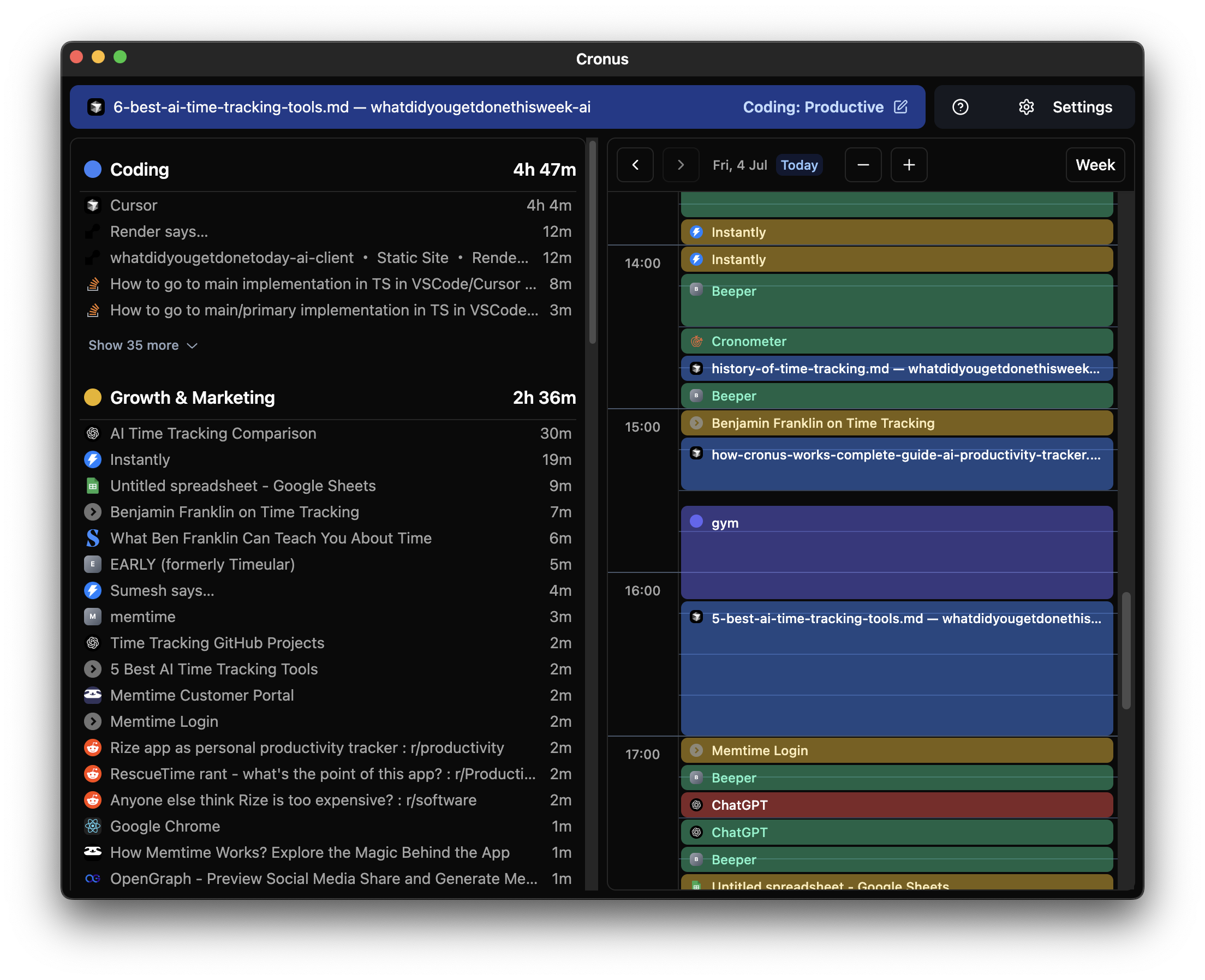
Cronus records the same thing automatically: what you were on, for how long, where the breaks fell, judged against goals you set once. No start time to note, no label to choose, nothing to remember at the switch. So the messy days produce a complete record instead of a gap.
You still get the Flowtime output — your real intervals, your sustainable stretch, when your good hours are — without the part that collapses.
$6 a month after a 21-day trial, and it never captures your screen.
If you would rather do it by hand, that is completely reasonable, and the honest advice is: use coarse labels, log at the end of a block rather than mid-task, and expect the record to have holes. Three good days of data beats two weeks of increasingly fictional data.
Which to use
- You cannot start → Pomodoro, for ignition.
- You get interrupted mid-flow by your own timer → Flowtime.
- You want the Flowtime insight without the logging → automatic tracking.
- You bill clients → neither. You need a timesheet tool, covered here.
Read next
- How to Do a Time Audit — the bigger version of what Flowtime produces.
- Time Blocking: Why It Fails — planning against your real intervals once you know them.
- ADHD and Time Tracking — why every manual method fails the same way.