ADHD Paralysis: Why You Freeze, and What Actually Gets You Moving
You know exactly what you need to do. You know how to do it. You may even want to do it. And you sit there, for two hours, not doing it.
Then at 2am you are suddenly gripped by the need to reorganise your entire life.
If that is familiar, you are describing ADHD paralysis, and the single most useful thing to understand about it is that it is not procrastination, not laziness, and not a motivation problem. Those framings are why the standard advice does not work on it.
This is a post about the mechanism and about what to do, written by people who build a time tracker. It is not medical advice and nothing here diagnoses anything.
What is actually happening
Paralysis is not an absence of will. It is a traffic jam in the step between deciding and starting.
Between "I should answer that email" and actually opening the email, a set of things has to happen: recall what the email needs, sequence the steps, estimate the effort, hold that plan in mind, and initiate the first physical action. That whole chain runs on executive function, and in ADHD it runs less reliably.
When it jams, the experience from the inside is not "I do not want to." It is closer to reaching for something and finding your hand does not move.
Which is why being told to try harder lands so badly. There is no motivational lever to pull. The intent is already there.
The three kinds, because they need different fixes
People use "ADHD paralysis" for three fairly distinct states. Telling them apart matters, because what unsticks one does nothing for another.
1. Task paralysis
You have one specific task and cannot begin it. Usually the task is vague, aversive, or larger in your head than in reality.
The tell: you can describe the task in a sentence but not name its first physical action.
2. Choice paralysis
Too many possible things, all roughly equal, so you select none. This is the 2am "fix my whole life" state: everything feels equally urgent, so nothing is.
The tell: you are not stuck on a task, you are cycling between tasks.
3. Overwhelm shutdown
The load is high enough that the system stops rather than triaging. Often follows a long stretch of masking or a day with too many decisions.
The tell: you cannot think about any of it, and thinking about it makes it worse.
Same appearance from the outside. Three different causes.
Why the usual advice fails
"Just start." The instruction is to perform the exact function that is not working. This is like telling someone with a stuck door to open it.
"Break it into smaller steps." Genuinely good advice that requires the sequencing ability which is also impaired. When you are already frozen, being asked to plan is one more thing you cannot start.
"Make a to-do list." Lists help with choice paralysis and often make task paralysis worse, because now you can see all of it at once.
"Remove distractions." Distraction is not what is holding you. You were not distracted, you were stationary.
"Reward yourself when you finish." The reward is on the far side of the thing you cannot start.
Notice they all assume the bottleneck is wanting to. It is not.
What actually helps
Ordered by how reliably they work, not by how sensible they sound.
1. Shrink to a physical first action
Not "write the report." "Open the document." Not "clean the kitchen." "Pick up one mug."
The rule that survives contact with a real freeze: the first step must be something your body can do without your brain sequencing anything. Physical, specific, and small enough to be faintly ridiculous.
This works because it bypasses the jam rather than trying to clear it. You are not deciding to do the task, you are doing one motion.
2. Borrow someone else's executive function
Body doubling — having another person present, in the room or on a video call, doing their own work — is the most consistently effective intervention in this whole space, and it is free.
We build software and we will still say plainly: this beats every app, ours included. If you take one thing from this post, take this one.
3. Reduce choices to two
For choice paralysis, the fix is not prioritising better, it is having less to prioritise. Two options, pick either, ten minutes. Which one hardly matters; being in motion is what breaks the cycle.
4. Lower the bar to something embarrassing
"I'll do it badly for five minutes." Perfectionism and paralysis are close relatives, and a task that is allowed to be done badly is much easier to start.
5. Change your physical state first
Stand up. Go outside. Different room. This sounds like avoidance and it is often the thing that works, because the freeze has a physical component and shifting your body sometimes shifts it.
6. Stop treating it as a character defect
The shame spiral is not a side effect, it is an accelerant. Time lost to paralysis produces guilt, guilt raises the load, and higher load makes the next freeze more likely. Breaking that loop is doing real work on the problem, not being soft on yourself.
The part nobody measures
Here is the thing that makes paralysis unusually hard to reason about: you cannot remember it accurately afterwards.
A frozen afternoon leaves almost no trace in memory. There were no events. You did not do anything, so there is nothing to recall. What survives is the guilt and a vague sense that the day disappeared, which is exactly the input most likely to produce another one.
So people consistently misjudge it in both directions. Some believe they lose whole days when the record shows two bad hours inside an otherwise normal one. Others assume they had a slow morning when in fact it took most of the week.
Neither group can tell without a record, and self-logging cannot produce that record, because logging is itself a task requiring initiation. On a frozen day it is one of the first things to stop happening.
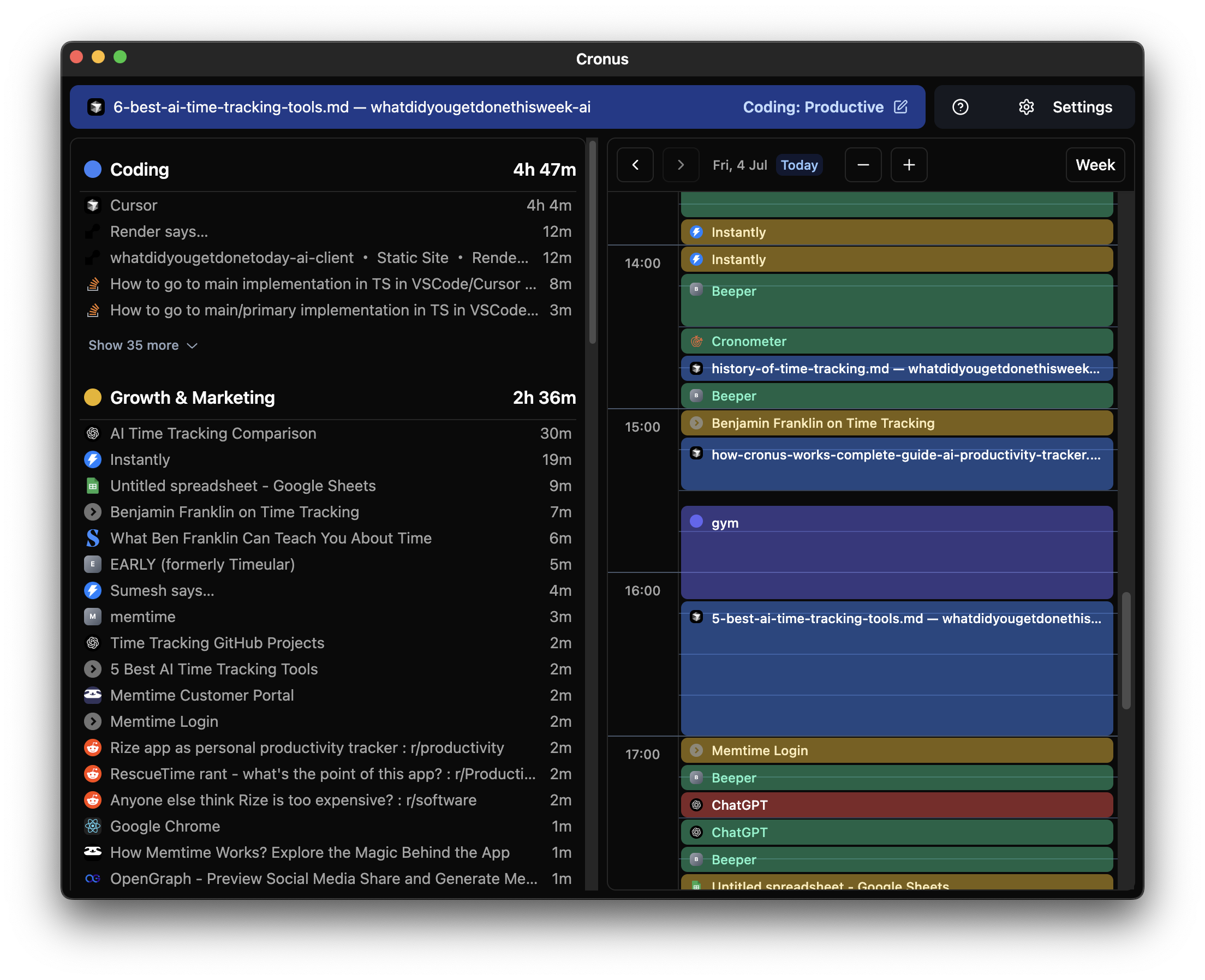
This is the one place where what we build is genuinely relevant. Cronus records where your time went automatically, with no timer to start and nothing to log, so a frozen day produces a complete record instead of a hole. Over a few weeks that turns a shapeless dread into something you can actually look at:
- When it happens. Time of day is the most common pattern, and it is usually stable.
- What precedes it. Often a meeting, a specific type of task, or a long stretch of context switching.
- How long it really lasts, which is very often less than it felt.
That last one matters more than it sounds. "I lost the entire day" and "I lost ninety minutes after the standup" are the same experience remembered differently, and only one of them is a problem you can do something about.
We should be equally clear about what it does not do. Cronus will not get you started. It has no idea you are frozen. If your problem is task initiation, a body double or a Pomodoro timer will do more for you today than we will. What we give you is the pattern, afterwards, which is what you need to arrange your week around it.
If you take one thing
Paralysis is a jam between deciding and starting, not a shortage of wanting to. So the interventions that work are the ones that route around the jam — a physical first action, another person in the room, fewer choices — rather than the ones that try to push harder through it.
And the guilt is not neutral. It is fuel for the next one.
Read next
- ADHD Time Blindness: Why You Lose Hours — the other half of why days disappear.
- ADHD and Time Tracking: Why Manual Trackers Fail You Specifically — why logging tools break down exactly when you need them.
- Where Did My Day Go? — the four places the hours actually turn up.
- Analysis Paralysis — when the freeze is about choosing rather than starting.
- ADHD Procrastination — when it only unfreezes at the deadline.
Curious where your hours actually go on a bad day? The newsletter below is a five-day audit, one short email a day, and none of it requires you to keep a log.
Find out where your week actually goes
The 5-day time audit: one short email a day, walking you through the experiments in this post. You will end the week with a real answer instead of an impression. Free, no app required, and it ends after five days.