ADHD and Time Tracking: Why Manual Trackers Fail You Specifically
If you have ADHD and you have tried time tracking, you have probably tried it more than once. Installed Toggl. Used it for four days. Forgot to start the timer, then forgot to stop it, then had a week of entries that were obviously wrong, then stopped opening it.
That is not a discipline failure. It is a design mismatch, and it is worth naming precisely, because once you see it you stop blaming yourself and start choosing tools differently.
Every popular time tracking method asks for the exact abilities that ADHD makes harder. That is the whole article. The rest is why, and what to do instead.
A note on scope: this is a post about tools, written by people who build one. It is not medical advice, and nothing here diagnoses or treats anything. If you want the clinical picture, talk to a clinician.
What the research actually says about ADHD and time
Time perception is not a side effect of inattention. In the temporal-processing literature it shows up as a core feature, with consistent differences across three domains: motor timing, perceptual timing, and temporal foresight, spanning intervals from milliseconds to years.
The differences are generally understood as downstream of the same executive-function and working-memory differences that make task initiation hard. Time blindness is not bolted on beside those; it comes from the same place.
Two findings matter enormously for tool choice.
First: reproduction is impaired while estimation is often intact. Asked afterwards how long something took, people frequently answer reasonably. Asked to track an interval while inside it, the ability is much weaker.
This is why "five more minutes" ends two hours later with no dishonesty involved, and why someone can plan a day well and still lose it.
Second: the internal clock appears to run fast. Studies using duration-discrimination tasks have found evidence of a faster internal clock in ADHD. A faster clock means subjectively more time seems to have passed than actually has, which is the mechanism behind chronically underestimating how much room is left.
Hold those two facts up against how time tracking tools work.
The mismatch, tool by tool
Manual timers (Toggl, Clockify, Harvest)
What they require: remember to start before you begin, remember to stop when you switch, and remember to categorize.
Why it fails: every one of those is a prospective memory task, performed at exactly the moment your attention is moving to something else. The switch is the moment you are least able to do admin about the switch.
Worse, the failure is invisible in a specific way. You do not get a blank timesheet. You get a plausible-looking one that is missing the chaotic hours, because those are the ones you forgot to log. So the tool quietly reports that your week was calmer than it was.
Pomodoro
What it requires: you notice the timer, stop mid-task, take a break, come back.
Why it fails: it is genuinely useful for starting, which is often the hardest part, so it is worth keeping for that. But it treats a 25-minute block as a container you can enter and leave on cue. If you are deep in something, the timer is an interruption you will dismiss. If you are not, the timer does not help you start.
Use it as an ignition system. Do not expect it to be a measurement system.
15-minute logging
What it requires: interrupt yourself every 15 minutes and write down what you did.
Why it fails: it asks the impaired faculty to do the measuring, four times an hour, all day. And it asks you to reconstruct from memory, which is a second impaired faculty. It collapses hardest on the fragmented days, which are exactly the days worth having a record of.
Blockers
What they require: predicting in advance which sites are distractions.
Why it fails: context is not a property of a URL. The blocker cannot tell research from procrastination on the same site, so it blocks legitimate work, and you disable it. There is also a specific cost here: a wall you cannot get through during hyperfocus on the wrong thing does not redirect the hyperfocus. It just adds friction and frustration.
The pattern
Line them up and the same thing is true of all four:
| Method | Requires |
|---|---|
| Manual timers | Prospective memory at task-switch |
| Pomodoro | Noticing and obeying an interruption |
| 15-minute logging | Self-interruption plus recall |
| Blockers | Predicting context in advance |
Prospective memory, self-interruption, recall, and forecasting. If those are the reliable strengths in your week, any of these tools will serve you fine.
If they are not, you have been repeatedly told to fix a problem using the thing that is causing it.
What a tool would need to do instead
Three properties, and they follow directly from the above.
1. Require nothing at the moment of switching. The switch is when you have the least to spare. A tool that needs anything from you then is a tool you will abandon, and the abandonment will feel like your fault.
2. Work on your worst day. Judge any system by what it does on a fragmented, overwhelming, nothing-went-to-plan day. That is the day you most need a record and are least able to maintain one. Anything that depends on consistency will fail exactly when it matters.
3. Tell you during, not after. Since reproduction is the weak part, the intervention has to arrive while you are still inside the interval. A weekly summary tells you about a week you can no longer change. A nudge at minute forty is information you can act on.
Notice that none of these is about willpower. They are all about moving the load off the person and onto the tool.
What we built, and where it fits
Cronus is designed around exactly that.
It watches which app and window you are in, and an AI model works out what the activity was in service of, judged against goals you set once. There is no timer to start, nothing to categorize, and nothing to remember at a task switch.
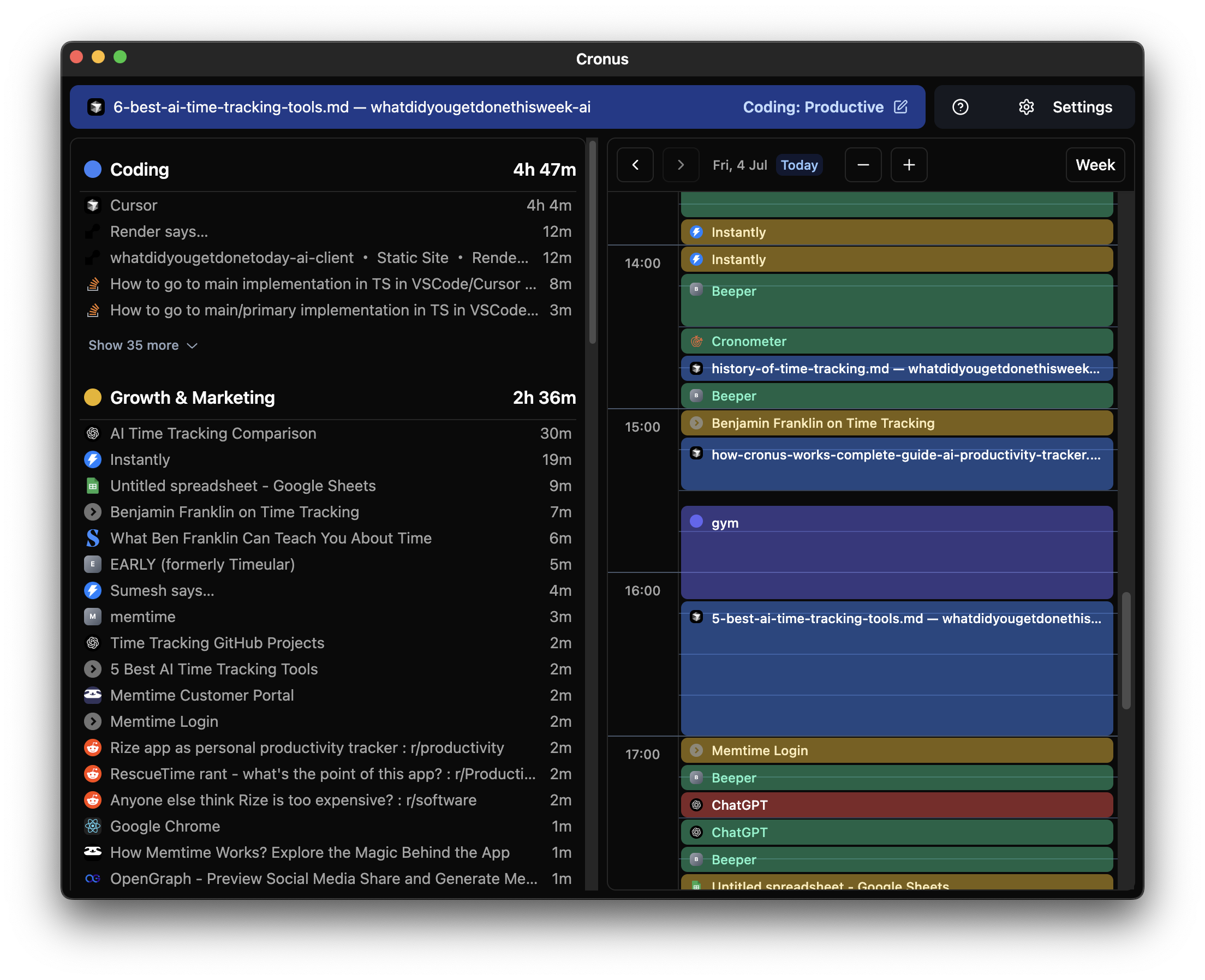
Concretely, against the three properties:
- Nothing at the switch. You switch apps. That is it. The record is complete whether or not you were paying attention, which means the chaotic hours show up rather than quietly disappearing.
- Works on the bad days. There is no streak to maintain and no habit to sustain, so a terrible week produces a full record rather than a gap. That is usually the first genuinely new information people get from it.
- Nudges during. When time is going somewhere you did not choose, it says so while you can still do something about it. It does not block, because blockers get uninstalled and because it cannot know that this YouTube video is the documentation you needed.
What it is not: a treatment, a coach, or a substitute for anything clinical. It is a measuring instrument. What it gives you is an accurate answer to "where did that day go," which is a question that is otherwise very hard to answer honestly, and which most strategies quietly assume you have already answered.
Where it will not help: if what you need is a hard blocker, we do not do that. If you want to inspect the exact rule that filed something, we do not have rules to inspect. And if your problem is starting rather than losing time, a Pomodoro timer is a better first purchase than we are.
What to do this week
If you take one thing: stop evaluating tools by how good they are when you are on form. Evaluate them by what they ask of you on the day everything is on fire.
Concretely:
- Drop anything that needs an action at task-switch. That is the requirement that fails, and it fails silently.
- Put time outside your head. An analogue clock in your eyeline beats a digital one, because you read elapsed time as a shape rather than comparing two numbers.
- Get a record you did not have to keep. Then look at a bad day, not a good one.
- Stop treating the lost hours as a character issue. It is a measurement problem with a measurement solution, and the guilt is what makes people abandon systems.
Try Cronus, 21 days free, then $6 a month. Nothing to start, nothing to remember.
Read next
- Time Blindness: Why You Lose Hours, and How to Get Them Back — the underlying mechanism, without the ADHD framing.
- Where Did My Day Go? — where the hours actually go once you measure.
- The Best Automatic Time Tracking Apps for Mac in 2026 — every tool that runs without you starting a timer, including the ones that beat us.
- Toggl Alternatives for People Who Forget the Timer — the most common version of this.
- Time Tracking Spreadsheet — and where a spreadsheet stops working.
Prefer to start without installing anything? The newsletter below is a five-day audit of your own time, one short email a day, and none of it requires you to keep a log.
Find out where your week actually goes
The 5-day time audit: one short email a day, walking you through the experiments in this post. You will end the week with a real answer instead of an impression. Free, no app required, and it ends after five days.