ADHD Hyperfocus: Why It Is Not a Superpower, and How to Aim It
You started looking up one thing. Eight hours later you know a great deal about a subject you have no use for, you have not eaten, and the thing you actually sat down to do is untouched.
That is hyperfocus, and it gets described online as the compensation prize of ADHD: the superpower that makes up for everything else. That framing is comforting and mostly wrong, and believing it makes hyperfocus harder to work with rather than easier.
Written by people who build a time tracker. About mechanism and practical consequence, not diagnosis or treatment.
Hyperfocus is not the opposite of distraction
This is the part that reframes everything else.
Distractibility and hyperfocus look like opposites — scattered versus locked on — and they are the same underlying thing: attention that is not under voluntary control.
In the distracted state, attention moves when you do not want it to. In hyperfocus, attention will not move when you do want it to. Neither is you choosing. That is the common factor, and it is why "just use your hyperfocus on work" is not advice anyone can act on.
If you could deploy it deliberately, it would be a superpower. You cannot. It arrives, attaches to something, and releases when it releases.
What it actually costs
The costs are real and they are systematically undercounted, because the state that produces them is the state least able to observe them.
Time disappears entirely. Not compressed, gone. Six hours can read as ninety minutes. This is the same mechanism as time blindness: your sense of duration runs on how occupied your attention is, and hyperfocus is maximum occupation, so almost nothing gets encoded as elapsed time.
Physical needs stop registering. Food, water, the bathroom, sleep. Not ignored — not noticed.
It frequently lands on the wrong thing. This is the expensive one, and it is the complaint that comes up most in ADHD communities: the observation that medication can help you hyperfocus productively on entirely the wrong task. Eight hours of genuinely excellent work on something that did not matter is still eight hours gone.
The re-entry cost is brutal. Coming out of a deep session that went somewhere useless, with the actual work untouched and the day gone, is a reliable route into the guilt spiral that feeds paralysis.
Why you cannot just stop it
The obvious answer is to notice you have been at it for hours and stop. That requires self-monitoring, which is the executive function that has gone quiet — it is precisely what hyperfocus suppresses.
So the interrupt has to come from outside. Not a resolution, not more awareness, not trying to keep half an eye on the clock. An external event.
This also explains why the usual suggestions fail:
- "Set a timer." Works only if you respond to it. Deep in hyperfocus, an alarm is a noise you dismiss without forming a memory of dismissing it.
- "Take regular breaks." Requires noticing that a break is due.
- "Check in with yourself hourly." The checking-in faculty is the one that is off.
How to aim it, since you cannot summon it
You get very little say over whether hyperfocus happens. You get more than you would expect over what it attaches to, and that is where the leverage is.
1. Load the environment before it starts
Hyperfocus tends to grab whatever is in front of you at the moment it engages. So the highest-leverage minute of your day is the one before you begin: the right document open, the wrong tabs closed, your phone in another room.
You are not choosing what to hyperfocus on. You are arranging what is available to grab.
2. Make the interrupt physical and external
An alarm you can dismiss is not an interrupt. Things that work better because they cost something to ignore:
- A person who will come and speak to you
- A calendar event with other humans in it
- A drink you have to refill
- An alarm across the room
The rule: it must require you to move.
3. Interrupt at the boundary, not on a timer
The useful moment is not "every 25 minutes." It is when you have been in one thing for an unusually long stretch. A fixed timer interrupts good sessions as often as bad ones, which is why people turn them off.
4. Learn your triggers
Hyperfocus is not random. Most people have a stable set of triggers: novel information, an unsolved technical problem, anything with a scoreboard, and often a specific time of day. Those are knowable, and once you know them you can put them either side of a boundary rather than in front of a workday.
5. Stop trying to eliminate it
Hyperfocus aimed at the right thing is the best work most people ever do. The goal is not less of it. It is a better hit rate on what it lands on, and knowing sooner when it has gone somewhere useless.
The measurement problem
Everything above depends on knowing when you hyperfocused, for how long, and on what. That is the one thing you cannot reconstruct afterwards.
The session did not feel like six hours. There is no sequence of events to recall, because it was one continuous event. And it is not a state in which anyone starts a timer or writes a log.
So people misjudge it badly in both directions. Some assume every deep session was productive. Others assume they lose whole days to rabbit holes when the record shows two of them a month, both on Fridays.
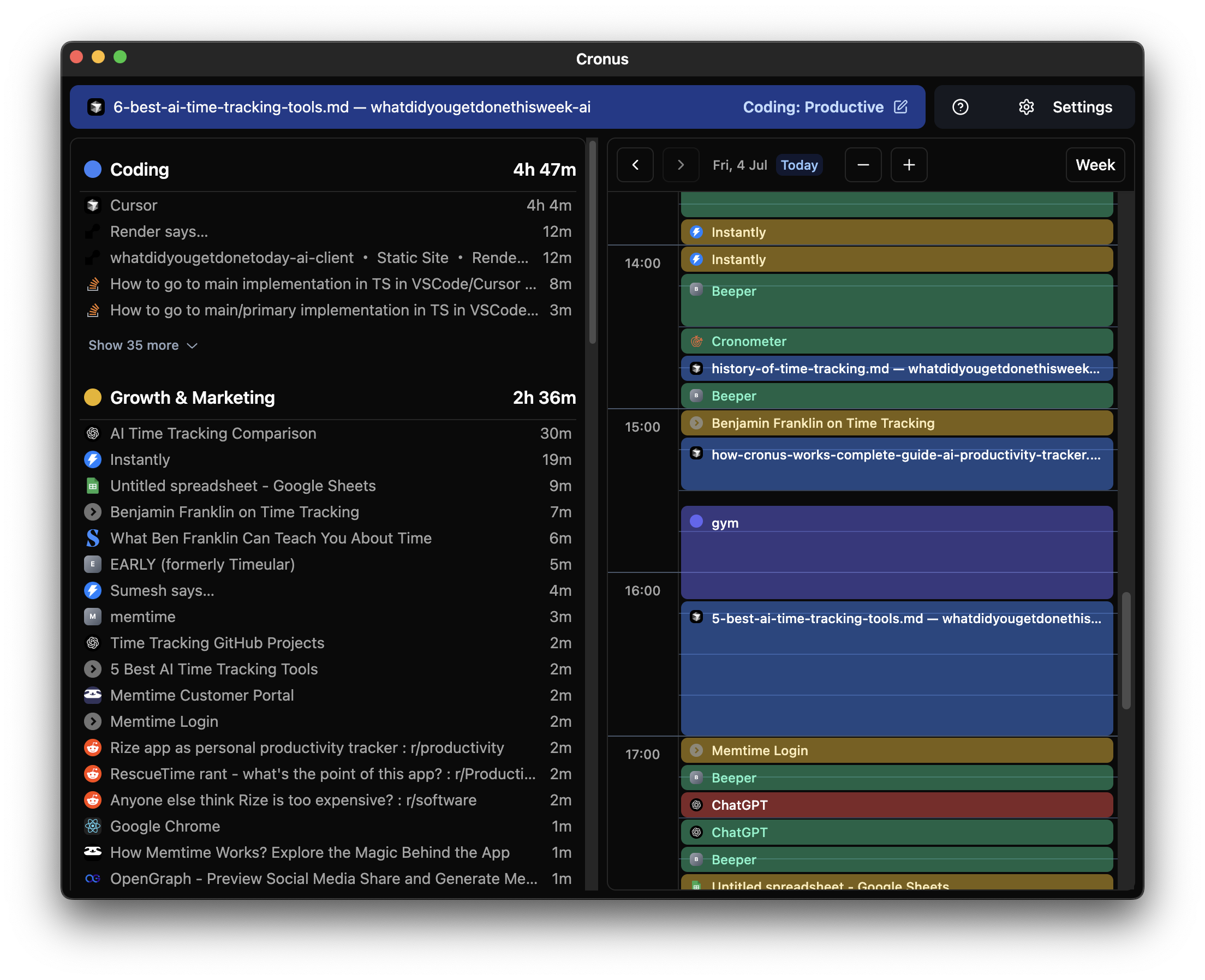
This is where Cronus is actually useful. It records what you were in and works out what the time was in service of, automatically. A six-hour block shows up as a six-hour block, and because it is judged against the goals you set, the record distinguishes the two cases that feel identical from the inside:
- Hyperfocus that landed well. A long unbroken stretch on the thing you said mattered. This is your best work, and it is worth knowing the conditions that produced it.
- Hyperfocus that landed badly. The same shape, pointed at something you never intended. Same feeling during, completely different value.
After a few weeks you get the two things that actually let you aim it: when hyperfocus tends to engage, and how often it lands on the right target.
One thing worth knowing about how it shows you this. Cronus does not send a notification you have to dismiss. It draws two live counters into the menu bar, either side of the notch on Macs that have one, showing productive and unproductive time as they accumulate. It is ambient rather than interrupting — closer to the analogue clock in your eyeline described earlier than to an alert.
That matters for hyperfocus specifically, because an alert deep in a session is dismissed without you forming a memory of dismissing it. Something already in your field of view does not have to break through.
Where we still do not help: it will not pull you out. Seeing a number is not the same as acting on it, and if you are deep enough, ambient information is exactly what you are ignoring. For getting out, a person or a hard calendar commitment beats any software, ours included.
The reframe worth keeping
Hyperfocus is not a gift and not a defect. It is attention that does not take instructions, which is inconvenient when it wanders off and remarkable when it lands right.
You cannot control the arrival. You can influence the target, by arranging what is in front of you beforehand, and you can shorten the bad sessions by making the interrupt something outside your own head.
Read next
- ADHD Paralysis: Why You Freeze — the other end of the same dysregulation.
- ADHD Executive Dysfunction, in Plain Language — the seven functions, and the two that fail silently.
- ADHD Time Blindness — why six hours read as ninety minutes.
- How to Stop Doomscrolling — hyperfocus pointed at a feed.
- ADHD and Relationships — why not registering someone speaking hurts so much.
Want to know how many hours a week go into rabbit holes? The newsletter below is a five-day audit, one short email a day, and nothing to log.
Find out where your week actually goes
The 5-day time audit: one short email a day, walking you through the experiments in this post. You will end the week with a real answer instead of an impression. Free, no app required, and it ends after five days.