Time Tracking for Consultants
We make a time tracker with no invoicing, no client projects and no billable rates. So this post is going to spend most of its length recommending other people's software.
That is not modesty. If your hours turn into an invoice, you need things we do not build, and pretending otherwise wastes your time. What we do have that is useful either way is the free arithmetic: a timesheet calculator, a time card calculator and a salary to hourly calculator.
The two problems, which are not the same
Consultants have two time problems and most tools solve only one.
The billing problem. Hours attached to a client and a rate, defensible if questioned, exportable as an invoice. A human has to stand behind each line, because a client might dispute it.
The reality problem. Where the week actually went, including the two hours of admin nobody bills, the context switching between four clients, and the project that quietly consumes twice its budget.
Billing tools answer the first well and the second badly, because they only contain hours you remembered to log. And the hours you forget are not random: they are the messy ones.
For the billing problem
Timely — around $11 per user per month. Its Memory app records in the background, AI drafts timesheet entries, you approve them. For consultants this is the strongest option on the market: the approval step that annoys individuals is exactly what you want when the output is an invoice. More detail.
Toggl Track — free tier, then $9–$18 per user per month. The best manual tracker there is, with projects, clients, rates and strong reporting. Requires you to press start, which is the whole question. More detail.
Harvest — invoicing and expenses built in, so time goes to invoice without an export step. Worth looking at if invoicing is currently a separate chore.
Timing — from about $10/mo, macOS only. Automatic recording with document-level detail, invoiceable reports, and uniquely it pulls iPhone and iPad hours from Screen Time, which matters if you take client calls on your phone. More detail.
Clockify — free for up to five users, then from $3.99 a seat. The cheapest credible option for a small team billing hours. More detail.
If you are choosing one for billing, that list is the answer. Pick on whether you want to approve drafts (Timely), press start (Toggl), or have invoicing in the same tool (Harvest).
For the reality problem
This is where a billing tool systematically misleads you, and it is worth understanding why.
Your timesheet is a record of what you remembered. Reconstructing Thursday afternoon on Friday morning produces something smoother and more purposeful than Thursday afternoon was. The fragmentation drops out, because it was never encoded.
The unbilled hours are invisible by design. Proposal writing, scoping calls that went nowhere, admin, the context switch between two clients. None of it goes on a timesheet, all of it consumes the week, and it is usually where a "profitable" engagement stops being profitable.
Nobody logs the bad days. The days worth examining are the chaotic ones, and those are exactly the days a timesheet has holes in.
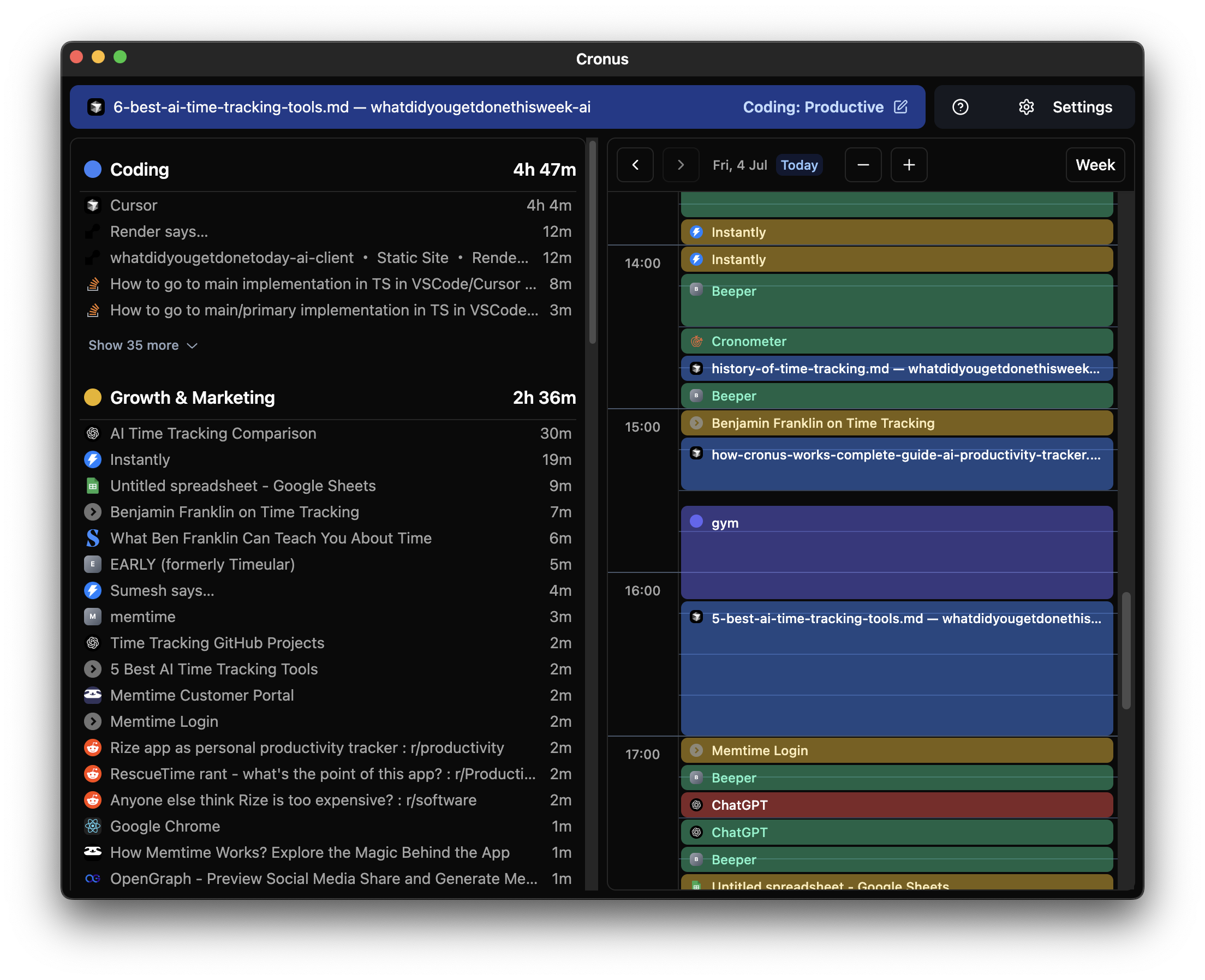
Cronus does the second job. It records what you were in and works out what the time was in service of, automatically, with no timer and nothing to log. So the record includes the hours you would never have billed and never have logged.
What that gets you as a consultant:
- Real project cost, including the unbilled half. Frequently the difference between a client you think is profitable and one who is not.
- How much switching between clients costs you. Usually more than expected, and a direct argument for fewer concurrent engagements.
- Where your good hours go. If client calls sit in your best three hours, your own thinking gets the remainder.
It will not produce an invoice. No rates, no client reports, no export a client would accept. $6 a month after a 21-day trial, and it never captures your screen.
The honest recommendation: run both
For most consultants the right answer is two tools, and that is less silly than it sounds because they solve different problems.
A billing tool for the hours that become money. Timely if you want drafts to approve, Toggl if you will press start.
An automatic tracker for the picture of where the week actually goes, including everything that never reaches an invoice.
The first is an accounting problem and needs a human signature. The second is a measurement problem and needs to happen whether you are paying attention or not. One tool doing both would have to be defensible and unsupervised at once, and nothing is.
If you only want one
If you bill more than about half your hours, take a billing tool and accept that you will not know where the unbilled half went.
If you bill a small share, or you are mainly trying to work out whether the business is working, an automatic tracker tells you more, and you can invoice from calendar entries.
If you have tried three timesheet tools and abandoned all three, the problem is not which one. It is that they all need an action at the moment you switch tasks, which is when you have the least to spare. That is worth reading about in more detail before you buy a fourth.
Read next
- Best Timely Alternatives — if you bill and Timely is not right.
- Time Tracking Spreadsheet — a template, and the point where it stops working.
- How to Do a Time Audit — finding the unbilled half.