ADHD Shutdown
The stereotype of ADHD under stress is speeding up: restless, scattered, talking faster, doing six things badly.
For a lot of people it goes the other way. Everything stops. You sit down and cannot get up. Words are hard. The list of things you need to do is right there and it might as well be written in another language. You are not upset, exactly. You are just not operational.
This is often called ADHD shutdown. Like a lot of useful ADHD vocabulary it is a community term rather than a clinical one, and it describes something real.
What is happening
Shutdown is what overload looks like when the system responds by reducing output instead of increasing it.
Executive function has run out. Every decision, every task initiation, every act of suppressing a distraction costs from a finite pool. When it empties, what remains is not a slightly worse version of you — it is an inability to run the functions at all.
Too many demands arrive at once. Not one hard thing, but nine medium things with no obvious order. The prioritising is itself an executive function, so an overloaded system cannot do the one thing that would reduce the overload. That loop is the shutdown.
Emotional load has taken the capacity. Emotional dysregulation is expensive, and recovery consumes the same resource that starting tasks needs.
It often follows a good stretch. Shutdowns commonly arrive after intense productivity, particularly after hyperfixation. The capacity was spent, and the bill arrives afterwards.
How it differs from things it resembles
Not ADHD paralysis, quite. Paralysis is being unable to start a specific task while otherwise functional. Shutdown is broader: nothing is available, including things you want to do.
Not laziness. Worth stating plainly, because it is what most people conclude about themselves. Laziness implies the capacity exists and is not being used.
Not depression, though it can look identical from outside and they can co-occur. Shutdown is episodic, follows identifiable overload, and lifts when demand is reduced. If the flatness is persistent across weeks regardless of load, that is worth a doctor's attention rather than a productivity technique.
Related to autistic shutdown but not identical. The autistic version is more often driven by sensory and social load and more often involves losing speech. There is real overlap, and many people experience both.
What brings you out of it
Almost nothing on the standard advice list works, because that list assumes executive function is available.
Reduce input, first. Somewhere quiet, screens off, alone. Adding stimulation to a shut-down system extends it.
Do not decide anything. Deciding is the broken function. This is the worst possible moment to re-plan your week or reorganise your list.
Move your body, minimally. Stand up. Walk to another room. Go outside for four minutes. Physical state change is one of very few things that works without needing the executive system, and it is the most reliable intervention here.
Physical inputs before psychological ones. Water, food, medication if it is due. A meaningful share of shutdowns are blood sugar and dehydration wearing a more dramatic costume.
Pick something with no decision in it. Not the important task. Washing up, a shower, folding something. A completed trivial action often restores enough to start a real one, and the point is momentum rather than the task.
Ask someone to be present. Not to help, just to be there or on a call. Body doubling works when nothing internal does, because it substitutes external structure for the function that is offline.
Accept the day if it is gone. Fighting a shutdown reliably extends it and adds guilt on top. One lost afternoon is cheaper than three days of a compounding cycle.
Preventing them
Prevention works better than recovery, and it is mostly about spotting the accumulation.
Watch the load, not the hours. Shutdowns follow demand density: decisions, transitions, social performance, emotional events. A short day full of those costs more than a long quiet one.
Do not schedule after known-expensive things. Leave the hours after a difficult meeting empty on purpose.
Reduce decisions in advance. Same breakfast, same first task, clothes decided. Every removed decision is capacity retained.
Take the early signs seriously. Words getting harder, irritability, a shorter fuse, small obstacles feeling enormous. These arrive well before the shutdown and are almost always pushed through.
Finding the pattern
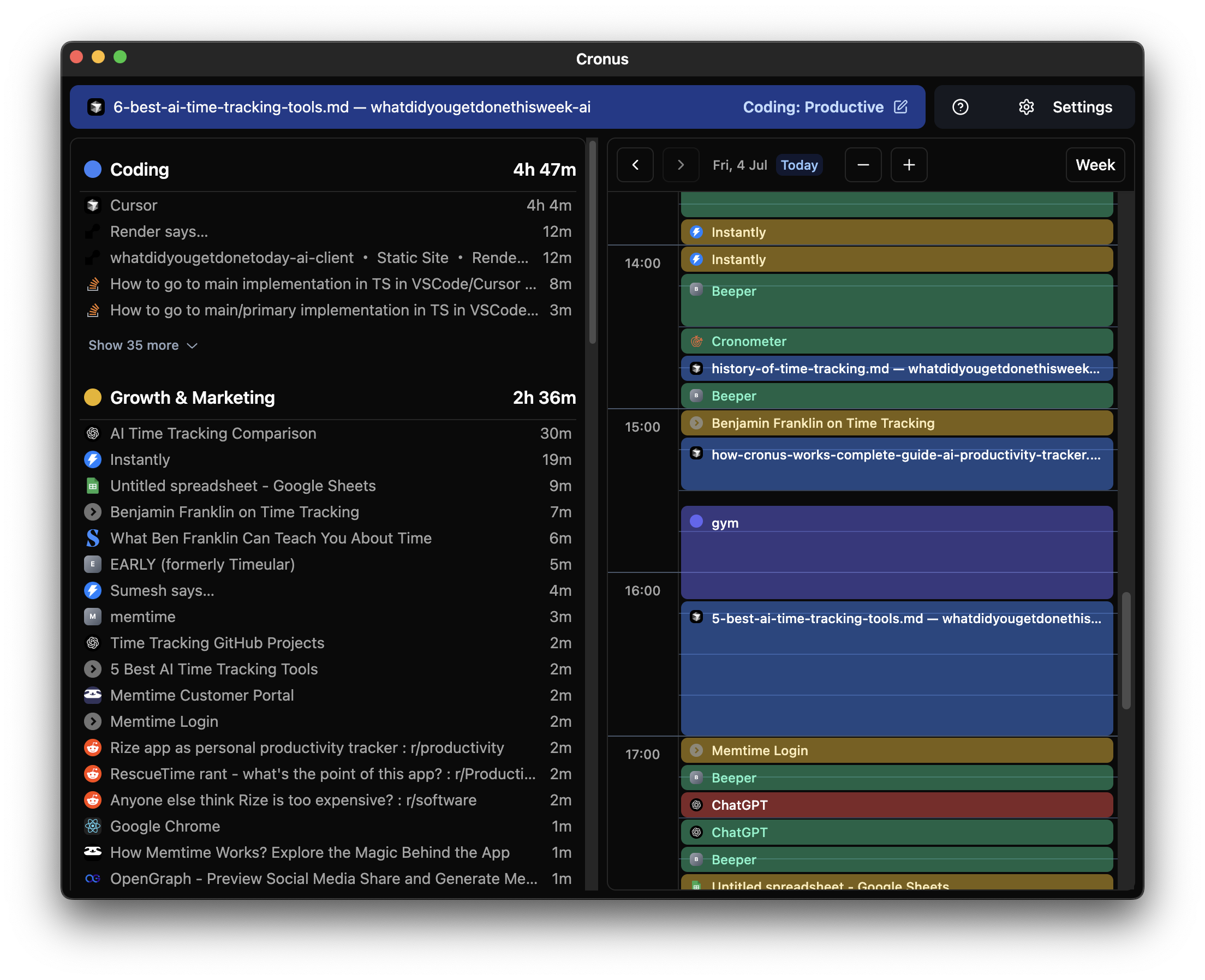
Shutdowns feel random from the inside because they follow accumulation, and the day they land is rarely the day that caused them. Without a record, you cannot see what the preceding days actually contained — and during a shutdown you are certainly not logging anything.
Cronus records automatically on your Mac, with no timer and nothing to log, so bad stretches produce data instead of a gap.
The useful question afterwards is what the two or three days before it looked like. When the answer is consistently "four heavy, fragmented days in a row", that is a schedule problem with a schedule fix, and much easier to act on than a mystery.
$6 a month after a 21-day trial, and it never captures your screen: window titles only, redacted on your device.
Honest limits. It sees a laptop, so it knows nothing about sleep, food, medication timing or anything that happened away from the desk — and those are frequently the larger causes. It is one column. A one-line note of energy level each evening alongside it will tell you more than either on its own. And during a shutdown, do not look at it: a dashboard showing an unproductive day is the last thing that helps.
Read next
- ADHD Paralysis — the task-specific version.
- ADHD Burnout — what frequent shutdowns usually indicate.
- Autistic Shutdown — the overlapping autistic version.