Autistic Shutdown
A shutdown is what happens when the load exceeds what the system can process and it responds by going quiet rather than loud.
Speech becomes difficult or impossible. Movement slows or stops. Input stops landing — people are talking and the words are not resolving into meaning. From outside it can look like sulking, rudeness, or someone being fine and simply not answering. From inside it is closer to being unable to reach the controls.
It is not a choice, it is not a tantrum, and it is not something being done at anyone.
Shutdown vs meltdown
Both are responses to the same thing: more input, demand or distress than can be handled. They differ in direction.
| Meltdown | Shutdown | |
|---|---|---|
| Direction | Outward | Inward |
| Looks like | Crying, shouting, visible distress | Silence, stillness, withdrawal |
| Noticed by others | Immediately | Often not at all |
| Common response | Alarm, sometimes punishment | Assumed to be fine, or rude |
| Speech | May be lost | Usually lost |
The most dangerous thing about shutdowns is that they go unnoticed. A meltdown gets a response, whether or not a good one. A shutdown frequently reads as compliance, so nothing changes, and the person is left in the environment that caused it. People who shut down rather than melt down often accumulate far more damage before anyone realises anything is wrong.
Not the same as dissociation, though they can overlap and can look similar from outside. Dissociation is a disconnection from self, body or reality, often trauma-linked. A shutdown is a processing and capacity failure. If what you experience involves losing time, feeling unreal, or watching yourself from outside, that is worth raising with a clinician specifically, because it is treated differently.
Not the same as being tired. Tiredness responds to rest on a normal timescale. A shutdown ends when the load is removed and the system has had time to come back, and pushing through it reliably makes it worse and longer.
What triggers them
Rarely one thing. Almost always accumulation, which is why the final trigger so often looks trivial and gets treated as an overreaction.
- Sensory load. Noise, light, crowds, temperature, smell, the texture of what you are wearing.
- Social load. Extended interaction, especially unstructured or unpredictable.
- Demand. Being asked for decisions, output or responses faster than they can be produced.
- Unpredictability. Plans changing, especially late.
- Sustained masking. The performance has a budget, and when it runs out this is often what is underneath.
- Interruption of deep focus. For a monotropic mind, being pulled out of an attention tunnel repeatedly is genuinely expensive.
A useful reframe: the trigger is the last item, not the cause. The cause is everything that came before it that day and that week.
What helps during one
If it is you:
Reduce input first. Dark, quiet, alone. Everything else is secondary and most of it can wait.
Do not try to speak. Losing speech is common and forcing it extends the shutdown. Text, point, use a prepared card, or say nothing.
Stim freely. Rocking, pressure, repetitive movement. This is the system regulating itself, and suppressing it makes recovery slower.
Drop every demand you can. Including your own. Nothing needs deciding right now.
Expect the tail. Recovery is not instant and there is usually a flat, depleted period afterwards. Planning anything demanding immediately after is how a shutdown becomes two.
If it is someone else:
Stop talking. Questions, however kind, are more demand. "Are you okay?" requires a response they cannot produce.
Reduce the environment. Dim the lights, clear the room, get them somewhere quiet.
Do not touch without asking, and accept no answer as no.
Do not treat silence as agreement or as rudeness. They are not ignoring you.
Wait. This is almost all of it. Presence without demand is the most useful thing available.
Preventing them
You cannot prevent every shutdown, and the goal is to make them rarer rather than to eliminate them.
Treat capacity as a budget, not a mood. It depletes through the day and the week, and it is spent by sensory and social load rather than by hours worked.
Put recovery after known-expensive things, before you need it. A blocked hour after a long meeting is worth more than an hour of leave later.
Reduce unpredictability where it is cheap to do so. Knowing the plan is regulating; ambiguity is expensive.
Take the early signs seriously. Sensory tolerance dropping, words getting harder to find, a shorter fuse. These arrive well before a shutdown and are almost always ignored.
Fix the pattern, not the episode. Repeated shutdowns mean the ongoing load is above capacity, and no amount of recovery technique fixes an environment that is simply too demanding.
Finding the pattern
The hardest part is that shutdowns feel random from the inside. They arrive after the accumulation, so the day they land is rarely the day that caused them.
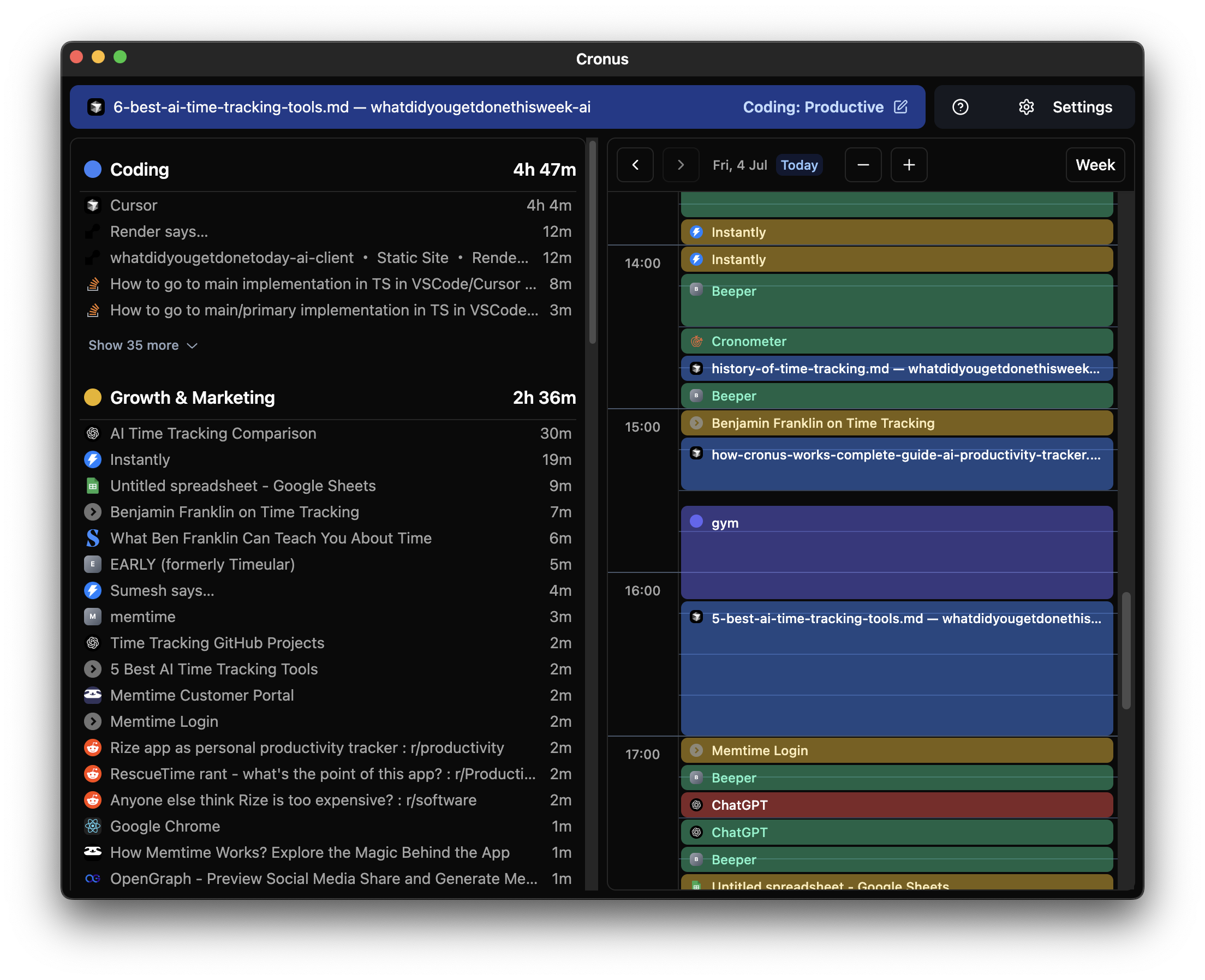
You cannot measure sensory load, and I am not going to pretend a Mac app can see the things that matter most here. What it can see is one contributor, and it happens to be one people underestimate: how fragmented and meeting-heavy the days before a bad day were.
Cronus records that automatically, with no timer and nothing to log, which is the only kind that survives a bad week. Looking back after a shutdown, the useful question is what the preceding two or three days actually contained, and most people cannot answer that from memory.
When the answer turns out to be "four heavy days in a row, every time", that is a schedule problem with a schedule fix.
$6 a month after a 21-day trial, and it never captures your screen.
Honest limits: it sees a laptop. Not noise, not lighting, not commuting, not the family gathering, not the supermarket. For a lot of people those matter more than anything it can record. Treat it as one column in a bigger picture, and if you want the whole picture, a simple paper note of energy level each evening alongside it will tell you more than either alone.
When to seek support
Worth raising with a professional if shutdowns are frequent enough to affect work or relationships, if they are getting more frequent, if you are unsure whether what you experience is shutdown or dissociation, or if they come with persistent low mood. Frequent shutdowns are often a sign of burnout rather than an isolated problem.
Read next
- Neurodivergent Burnout — what frequent shutdowns usually indicate.
- Autistic Masking — the load underneath most of them.
- Autistic Inertia — the starting and stopping problem.
Sources: Raymaker et al. (2020), Defining Autistic Burnout, Autism in Adulthood · National Autistic Society: meltdowns and shutdowns