Accountability Partners and Body Doubling: Why They Work Better Than Apps
We build productivity software. This post argues that a person is usually better than software, including ours.
That is not modesty. It is what the pattern shows, and pretending otherwise would waste your time.
Two different things
They get used interchangeably. They are not the same.
Body doubling is someone present while you work. They are not checking on you. They are doing their own thing, in the room or on a call. The presence is the whole intervention.
An accountability partner is someone you report to. You state what you will do, then tell them whether you did. The reporting is the intervention.
Body doubling helps you start and stay. Accountability helps you commit and finish. Different problems.
Why body doubling works
Nobody has a complete explanation, but the components are reasonably clear.
It supplies external structure. Starting is a transition, and transitions are the expensive part. Another person's presence provides a boundary you did not have to generate.
It makes the abstract concrete. "I will work this afternoon" is vague. "I am on a call with Sam from 2 until 4" is an event with edges.
It borrows regulation. Watching someone else work steadily is a cue your own system can follow. This is why it works even when the other person is doing something unrelated.
It raises the cost of drifting. Not through surveillance. Just enough friction that opening a new tab is a decision rather than a reflex.
Why it beats apps
An app can remind, block, or record. It cannot do the one thing that matters most here: provide presence.
The specific failures are consistent:
- A blocker gets uninstalled. A person is still there on Thursday.
- An app cannot tell you are stuck. A person notices you have not typed in twenty minutes.
- Nothing an app does costs you anything to ignore. Standing someone up does.
- Software cannot start the session. Presence is the intervention, and no interface supplies it.
If your problem is task initiation — paralysis, inertia, or not starting until it is urgent — a body double will do more for you this week than any tool on the market.
How to set one up
Find one person, not a system. A colleague, a friend, someone from a group with the same problem. It does not need to be a peer in your field; they are not reviewing your work.
Same time each week. Recurring beats ad hoc, because the point is a structure you do not have to generate.
Say what you are doing at the start. One sentence each. This is the accountability component, and it is worth the thirty seconds.
Then be quiet. No chatting. Cameras on if it helps, muted throughout.
Two hours maximum. Longer sessions decay.
Do not check in on each other. The temptation is to be helpful. It converts a body double into a manager, and it stops working.
If you have nobody to ask, paid and free virtual coworking services exist, and there are large communities that arrange this for free. It works with strangers, which is one of the more surprising things about it.
When accountability is the better fit
Body doubling suits work that is hard to start. Accountability suits work that is easy to defer.
Use a reporting partner when:
- The task has a genuine deadline you keep sliding
- You need to finish, not to begin
- The work happens across days, not in one sitting
The setup that works: state the commitment specifically ("draft sent by Thursday 5pm"), report at a fixed time, and do not soften it. Vague commitments produce vague results.
Where a tool still earns its place
Having conceded the main point, the honest boundary:
A person is better for starting, sustaining and committing. Those are the hard parts.
Software is better for knowing what actually happened. Your partner cannot tell you that your longest unbroken block last week was 22 minutes, or that the sessions on Tuesdays are consistently your best. Neither can you, from memory.
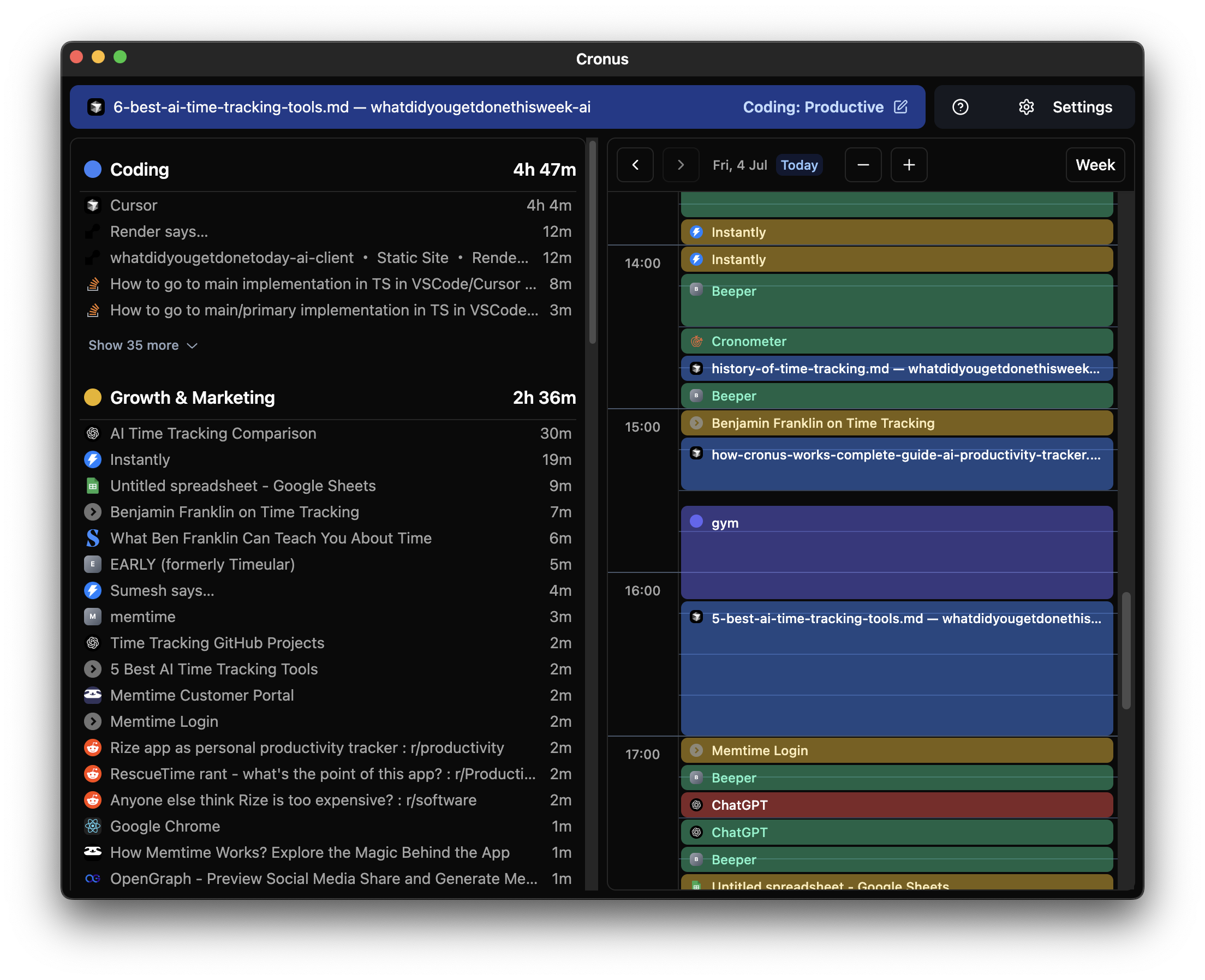
Cronus records where your time goes automatically, so you can see whether the co-working sessions are actually producing longer stretches of focused work, and when your good hours really are. Useful for scheduling the sessions well.
That is a genuinely narrower job than getting you started. Worth doing, and worth being clear about.
The short version
If you are choosing between installing something and asking someone to work alongside you for two hours on Thursday, ask the person.
Then measure whether it worked, which is where a tool comes in.
Read next
- ADHD Paralysis — the problem body doubling addresses best.
- ADHD Procrastination — why external deadlines work when internal ones do not.
- Time Blocking: Why It Fails — structure for the rest of the week.