ADHD and Emotional Dysregulation
Ask adults with ADHD what causes them the most trouble and a large share will not say attention. They will say something about emotion: reacting too fast, too hard, and taking hours to come back down from something that should have been minor.
This is not in the DSM-5 criteria for ADHD. Not as a core symptom, not as an associated feature with any prominence. Which is remarkable, because it is one of the most consistently reported and most disabling parts of the condition.
The omission is largely historical. ADHD was defined through observation of children in classrooms, where inattention and hyperactivity are what a teacher sees. Emotional dysregulation is internal, so it did not make the list. Researchers including Russell Barkley have argued for years that it belongs there, and that leaving it out means adults get diagnosed against criteria that miss what actually affects them.
What it actually is
Not "having strong feelings". The dysregulation is in the control system, and it shows up in three measurable ways.
Faster onset. The gap between trigger and full emotional response is very short. There is often no window in which you notice something rising and intervene, because by the time you notice, you are already there.
Higher intensity. The response is out of proportion to the trigger, and you frequently know this at the time, which does not help.
Slower recovery. This is the part that costs the most and is discussed the least. Neurotypical upset resolves in minutes. ADHD upset can take hours, and the whole time it is consuming the capacity you needed for everything else.
The mechanism is the same one behind the rest of ADHD: weak inhibition and poor top-down regulation. The same system that cannot stop you interrupting cannot stop an emotional response mid-arc.
The specific forms it takes
Rejection sensitive dysphoria. Intense pain in response to perceived rejection or criticism. Common enough in ADHD populations that many people find it the most defining feature of the condition. Not a formal diagnosis, and it describes something extremely real. We covered it separately.
Frustration intolerance. Small obstacles produce outsized responses. The website that will not load, the thing that will not fit. Especially bad during a task you were already struggling to start.
Irritability under load. Short fuse when overwhelmed, which then produces guilt, which adds load.
Emotional flooding. Everything at once, with no ability to isolate what you actually feel or why.
Euphoric swings too. It is not only negative. Enthusiasm can be equally disproportionate, which is where impulsive commitments and abandoned projects come from.
Why it costs so much time
This is a site about time, so here is the connection, and it is a large one.
The recovery period is the real cost. A four-minute upset can remove three working hours. Not because you are sulking, but because the regulation system is fully occupied and there is nothing left for anything demanding.
Avoidance compounds it. If a task carries a risk of criticism, the anticipated emotional cost gets weighed against doing it, and the task gets deferred. This produces a specific and expensive pattern: the most important tasks are avoided precisely because they matter most, since the ones that matter are the ones where failure would hurt.
Emotional load makes starting harder. Task initiation is already expensive. Under emotional load it can become impossible, which is why bad mornings so reliably become lost days.
Nobody counts it. No calendar has a block for "recovering from a Slack message". So the day looks like it should have worked, and did not, and the conclusion available is that you wasted it.
What actually helps
Name it as a symptom, not a character trait. This matters more than it sounds. "I have a slow emotional recovery" is a fact you can plan around. "I am too sensitive" is an identity you cannot.
Buy time before responding. You cannot stop the onset — it is too fast — but you can control what happens next. Do not reply to the message for an hour. Draft it and do not send. Almost all of the damage is in the response, not the feeling.
Treat physical state as a first cause. Hunger, sleep debt, and the medication wearing off in the late afternoon account for a large share of dysregulated episodes. Check those before interpreting the feeling as being about the situation.
Plan for the recovery period. If you know a difficult conversation is coming, do not schedule demanding work after it. This one change recovers more hours than any technique.
Ask whether it is accurate. RSD in particular produces certainty about what other people think that is often wrong. "Do I have evidence for this, or did I infer it from a short reply?" is a useful question.
Take treatment seriously. Stimulant medication improves emotional regulation for many people, sometimes more noticeably than it improves attention. Therapy — particularly DBT-derived skills, which were built for exactly this — has good evidence. This is one area where clinical treatment substantially outperforms self-management, and it would be dishonest to imply otherwise.
Seeing the cost
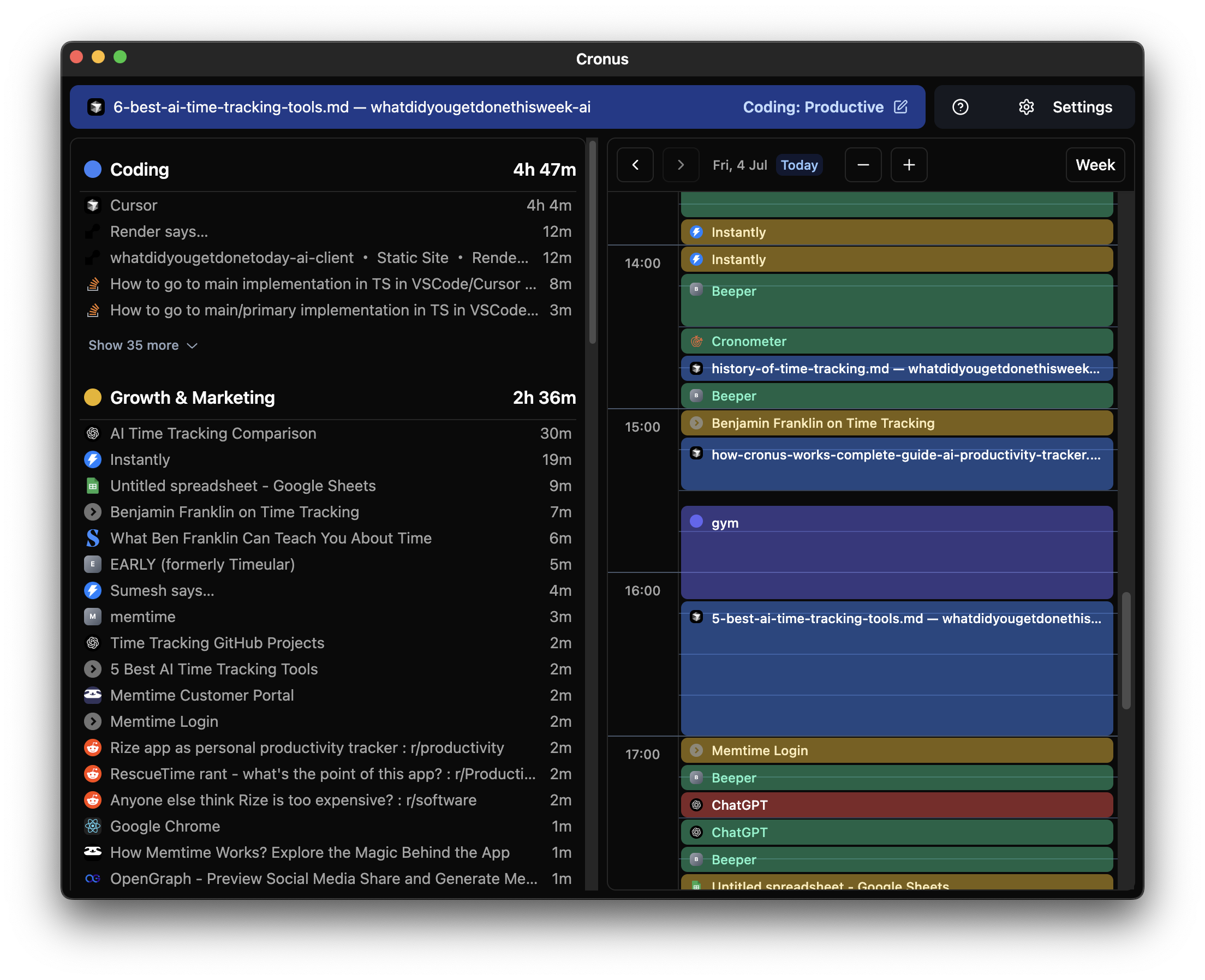
The reason this stays invisible is that emotional cost is not recorded anywhere. The trigger takes four minutes and leaves no trace, while the three hours after it look like ordinary unproductive time.
Cronus records what actually happened on your Mac automatically, with no timer and nothing to log — which matters here specifically, because nobody logs a bad afternoon while it is happening.
Looking back, the useful pattern is what the hours after a difficult meeting or message actually contained. When it turns out to be consistently two or three hours rather than the twenty minutes you assumed, two things follow: you stop scheduling hard work after hard conversations, and you stop reading those afternoons as personal failure.
$6 a month after a 21-day trial, and it never captures your screen: window titles only, redacted on your device.
Clear limits. It cannot see emotion, only the shape of the time around it. It is a record, not a regulation tool, and it will not help in the moment. If dysregulation is significantly affecting your life, the thing with actual evidence behind it is treatment, not a dashboard.
When to get help
Worth raising with a doctor if emotional dysregulation is damaging your relationships or work, if the recovery periods are getting longer, if it comes with persistent low mood, or if you find yourself organising your life around avoiding situations that might trigger it. If there are thoughts of self-harm, please treat that as urgent — in the US you can call or text 988, and in the UK Samaritans is 116 123.
Also worth knowing: emotional dysregulation is not unique to ADHD, and if the picture is not a good fit — particularly if it involves unstable relationships and identity — it is worth a proper assessment rather than assuming.
Read next
- Rejection Sensitive Dysphoria — the most discussed form of it.
- ADHD Burnout — where sustained emotional load ends up.
- ADHD Paralysis — why bad mornings become lost days.
Sources: Barkley (2010), Deficient Emotional Self-Regulation: A Core Component of ADHD · Shaw et al. (2014), Emotion Dysregulation in ADHD, American Journal of Psychiatry