ADHD Planners
We do not make a planner and we are not going to try to sell you one. What follows is what actually works, why the graveyard of abandoned planners exists, and what to look for if you are buying.
Why planners get abandoned
Almost everyone with ADHD has a drawer with three planners in it, each used properly for about two weeks.
The pattern is so consistent it is worth explaining rather than apologising for.
Dated pages punish gaps. You miss four days. Now there are four blank, dated pages staring at you, and opening the planner means confronting evidence of failure. So you do not open it. So the gap grows. The planner becomes a record of your inconsistency, which guarantees you stop using it.
Setup is more rewarding than use. Choosing the planner, designing the layout, buying the pens: novel, creative, dopamine-rich. Writing "email Dave" on a Tuesday in March: none of those things. The enthusiasm is spent before the useful part begins.
They assume the problem is knowing what to do. For most ADHD adults the list is not the hard part. Starting is. A planner that produces a beautiful list has not touched the actual obstacle.
They live somewhere you do not look. A closed planner in a bag is functionally invisible. Out of sight is genuinely out of mind, and that applies to the planner itself.
They ask for time estimates you cannot make. Time-blocked layouts require knowing how long things take. Most people are badly wrong about this, so the plan fails by 10am and the day feels lost.
None of that is a discipline problem. It is a mismatch between how these products are designed and how the relevant brain works.
What actually matters in a planner
Undated pages. The single most important feature. Undated means a missed week costs nothing and you can restart on any day without a page of evidence against you. If you buy one thing from this page, buy undated.
It stays open, in your way. Lay-flat binding, and a physical home on the desk where you cannot avoid seeing it. A planner you have to open is a planner you will not open.
Very little structure. Elaborate templates are fun once and a burden thereafter. The more boxes a page has, the more ways there are to fail at filling it in.
Room for a brain dump. Capturing everything unstructured is more useful than sorting it into categories, and sorting is where people stall.
Space for three things, not fifteen. A realistic day is three tasks. A fifteen-item list guarantees a day that ends in failure regardless of what you did.
No time-blocking grid, unless you already know your estimates are good. It is the feature that breaks days.
Specific ones worth considering
Bullet journal (any plain dotted notebook) — around $20 for a Leuchtturm or Rhodia. Undated by definition, infinitely flexible, and cheap. The genuine risk is that the system becomes the hobby — the elaborate spreads you see online are the failure mode, not the goal. Use the original minimal method: rapid logging, short lines, no decoration.
Panda Planner — around $30, undated, explicitly built around brain science with prompts for priorities and wins. The daily "what went well" prompt is more useful than it sounds for a population that mostly logs its failures.
Passion Planner — around $30, undated versions available, generous unstructured space, strong community. Good if you want reflection alongside tasks.
Hobonichi Techo — around $40, dated but with one full page per day and no imposed structure. Excellent paper. The dated format is the risk; the freedom of the page is the appeal.
Full Focus Planner — around $40, quarterly rather than annual, which is the underrated feature: a quarter is short enough to finish, so a bad month does not poison a whole year.
A single sheet of paper — free. Genuinely competitive. Three tasks, today's date, on the desk, thrown away at the end of the day. Nothing to maintain, nothing to fall behind on, nothing to feel bad about.
Do not overlook the last one. For a lot of people it outperforms every product above, because its maintenance cost is zero and there is no history to disappoint you.
Paper or digital
Both work; they fail differently.
Paper is better for: thinking, memory (writing by hand encodes better), and not being adjacent to every distraction you own. Its weakness is that it cannot remind you of anything.
Digital is better for: reminders, especially location-based ones, capture speed, and being in your pocket. Its weakness is that it lives on the device that is actively competing for your attention, and an app you must open is invisible.
The combination most people land on: digital for anything time-bound (calendar and reminders, with alarms), paper for today's three things. Time-bound items need to interrupt you, and paper cannot interrupt. Everything else benefits from the friction of writing.
If you use digital, use location reminders — free in Apple Reminders and Google Tasks, and the most ADHD-useful feature on any phone. "When I get home" beats "3pm" because you will notice arriving home.
The estimates problem
Whichever you choose, planning fails on the same thing: you do not know how long anything takes.
Plans are built on estimates, ADHD estimates are unreliable, and so the plan collapses by mid-morning and the day gets written off. Then tomorrow's plan is built from the same bad estimates, because nothing was learned.
This is not an ADHD-only weakness. In a randomised controlled trial, experienced developers estimated a tool had made them 20% faster on real tasks; measured, they were 19% slower — a forty point error about work they had just finished. The study.
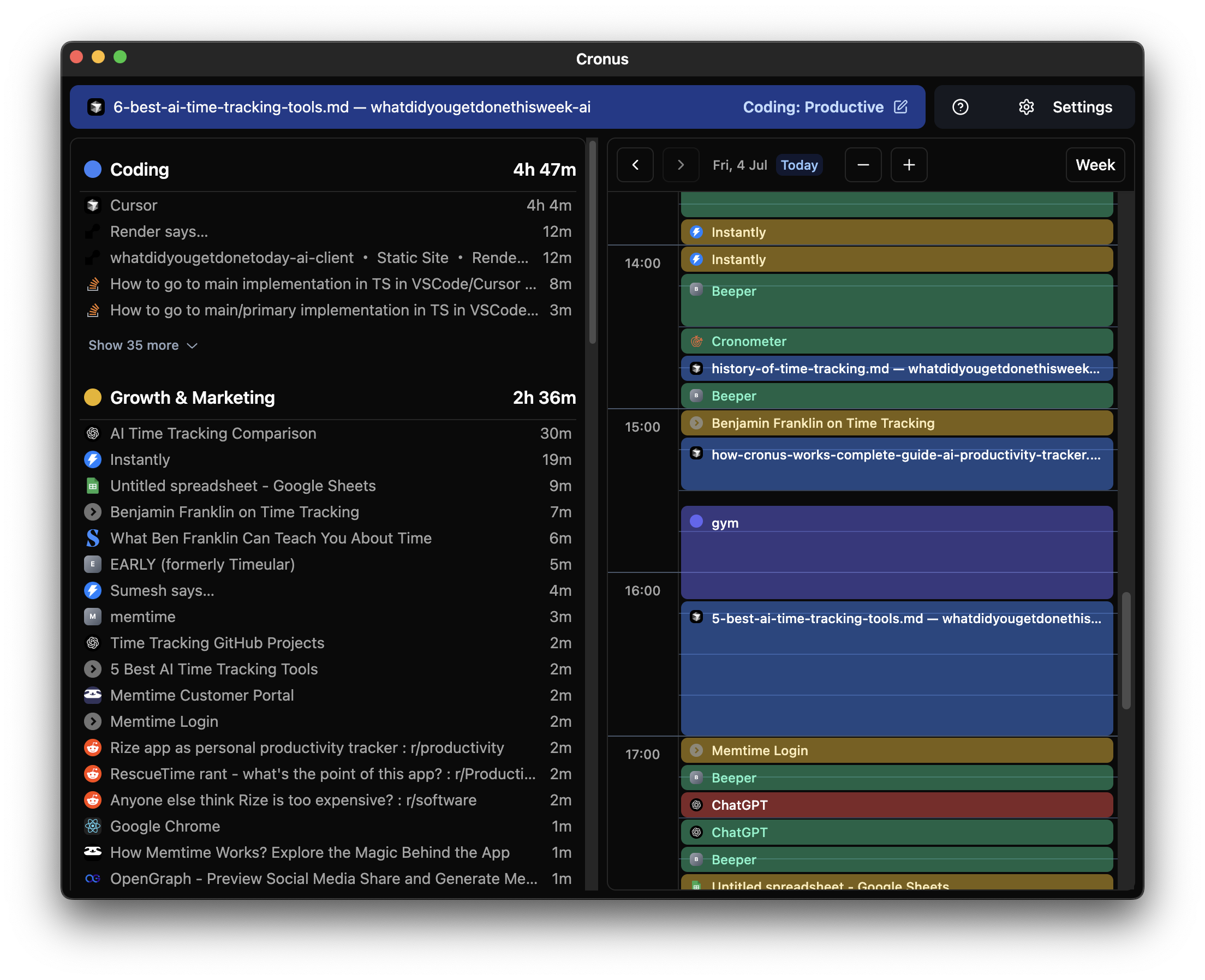
Cronus records how long things actually take on your Mac, automatically, with no timer and nothing to log. After a couple of weeks you can plan against real numbers instead of hopeful ones, which is the difference between a plan that survives contact with the day and one that does not.
$6 a month after a 21-day trial, and it never captures your screen.
It is not a planner and will not become one. No tasks, no lists, no reminders. It tells you what happened, so the planning you do elsewhere is based on something real. If you want the planning part, use one of the products above.
If you have abandoned three planners
The fourth one is not the answer, and the pattern is telling you something useful: the problem is not capture, it is starting.
Worth reading ADHD paralysis before buying anything else, and worth knowing that body doubling — a person in the room, or on a call — outperforms every planner on this page.
Read next
- ADHD Paralysis — if starting is the real obstacle.
- The Best Apps for ADHD Adults — the digital half.
- Time Blocking: Why It Fails — why the grid layouts break.