The Best Apps for ADHD Adults
We make an ADHD-adjacent app, so weigh this page accordingly. What we have tried to do is write the list we would want: what each thing costs, what it is genuinely good at, and where it fails.
Before the list, one thing worth more than any app on it.
Why most ADHD apps get abandoned
Almost every productivity app assumes the hard part is knowing what to do. For ADHD the hard part is doing the thing you already know you should do, and no amount of organising touches that.
So the pattern goes: install, set it up beautifully in a burst of enthusiasm, use it for nine days, miss one, and never open it again. That is not a discipline failure. It is what happens when a tool requires consistent voluntary action from an executive function system that is unreliable by definition.
The test for any tool on this list: what happens on a bad day? A system that only works when you are already doing well is a system that fails exactly when it matters.
Anything requiring daily manual input will eventually be abandoned. That is not an argument against using them — it is an argument for expecting it, using them in the burst while it lasts, and not concluding anything about yourself when it ends.
Reminders and capture
The most useful category, because forgetting is the most consistent problem.
Apple Reminders / Google Tasks — free. Genuinely underrated. Location-based reminders ("when I get home") are the single most ADHD-useful feature in any app on this page, and both do it natively. Start here before paying for anything.
Todoist — free tier, $4/mo for Pro. Natural language entry ("call dentist tomorrow 3pm") means capture takes two seconds, which matters more than any other feature because a task you did not capture does not exist.
Goblin Tools — free, with a small charge on mobile. The "Magic ToDo" breaks a task into steps at a spikiness level you choose. Built for neurodivergent users and the best answer available for "I cannot start because I do not know what the first step is."
Voice memos — free, already installed. Faster than typing at the moment an idea arrives.
Focus and starting
Forest — around $4 one-off. Plant a tree, it dies if you leave. Gimmicky and effective for some people, useless for others.
Focusmate — free tier, $5–10/mo. Scheduled 50-minute video sessions with a stranger, both working silently. This is the highest-impact tool on this page for a lot of people, because it is body doubling, and a person outperforms every app including ours. If you only try one thing here, try this.
Brain.fm — around $7/mo. Music engineered for focus. Evidence is thin, subjective response is strong for a subset of people. Free trial, so it costs nothing to find out.
Cold Turkey / Freedom — $40 one-off / $9 a month. Hard blocking of sites and apps. Effective specifically because they are hard to undo. Anything easily dismissed will be dismissed.
Notes and memory
Obsidian — free. Powerful, local, and a genuine trap: it is so customisable that setting it up becomes the project instead of the work. Recommended only if you already know you want it.
Apple Notes — free, and honestly sufficient for most people. Low friction beats capable.
Otter / Granola — meeting transcription. Useful if you lose what was said in meetings, which is a working memory problem rather than an attention problem.
Time and where it went
This is our category, so treat the following with appropriate suspicion.
Toggl Track — free tier. Excellent manual tracker. Requires pressing start, which for ADHD is the entire problem, so it is on this list mainly to say: if you have abandoned this twice, the tool was not the issue. More detail.
RescueTime — around $12/mo. Automatic, category-based, mature. Fixed rules mean it decides once whether a site is "productive", which is wrong about half the time for research-heavy work.
Rize — from $12.99/mo. Automatic and capable, with blocking and Pomodoro built in. Also a lot of product, and it asks you to categorise things it has not seen. Full review.
ActivityWatch — free, open source, entirely local. Nothing leaves your machine. No interpretation layer, so you get raw data and do the thinking yourself. More detail.
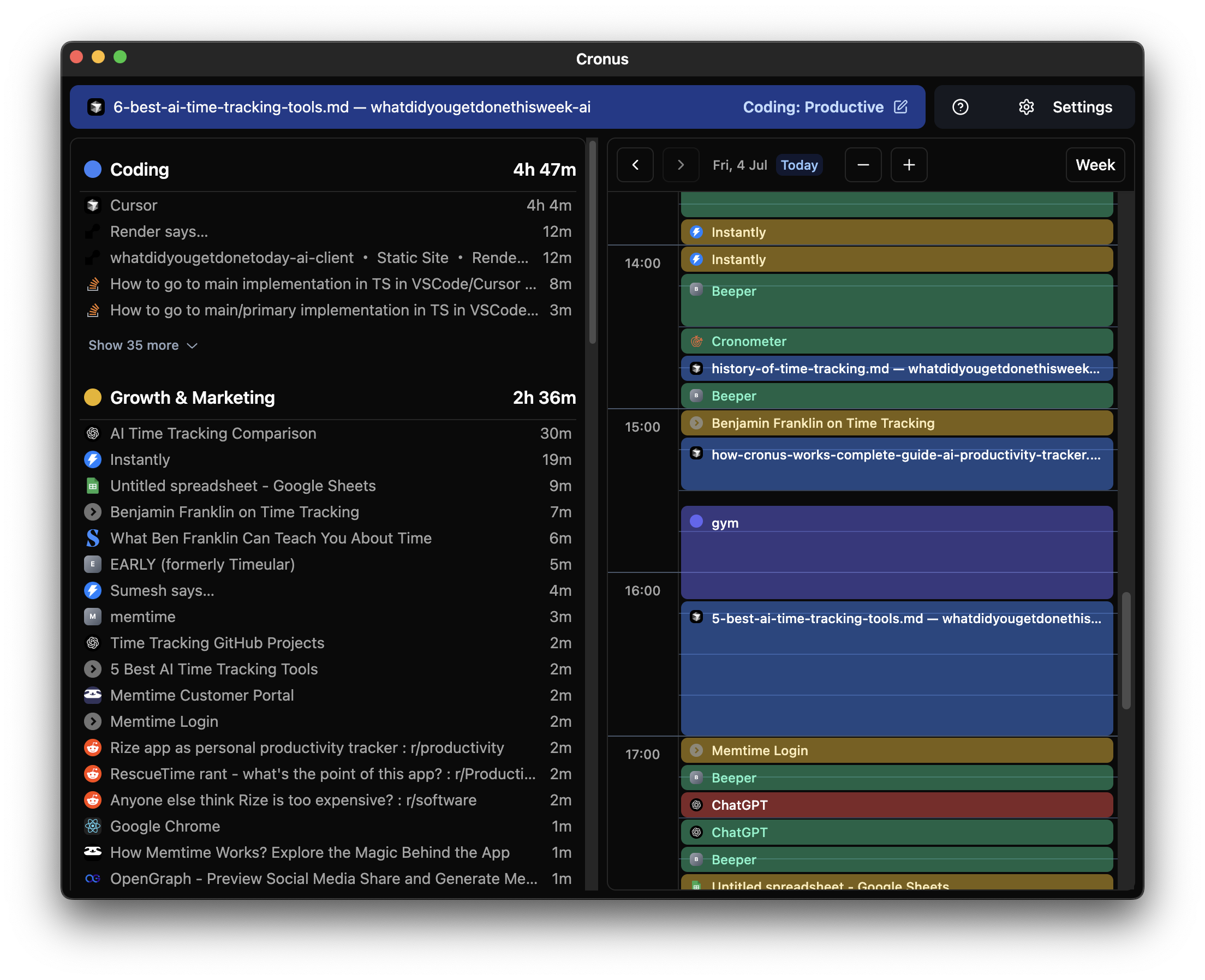
Cronus — $6/mo after a 21-day trial, macOS. Ours. It records automatically and works out what the time was for based on goals you set once, so there is no timer to start and nothing to log. The design goal was specifically the bad-day test above: it produces a complete record on the days you would never have logged anything.
Where it is the wrong choice: if you need Windows today, if you bill clients, if you want blocking and Pomodoro built in, or if your requirement is that nothing leaves your machine. It also will not make you do anything — it is a record, not an intervention, and anyone claiming their tracker fixes ADHD is selling something.
Medication, sleep and admin
Medisafe — free. Medication reminders, which is a genuine problem for a population that forgets things.
Sleep Cycle / Rise — sleep is upstream of everything else here, and improving it does more than most productivity tooling.
Monarch / Copilot / YNAB — the ADHD tax is real and mostly comes from late fees, forgotten subscriptions and unopened post. Automation beats vigilance.
What actually works better than apps
Worth saying, because we sell one.
Another person. Body doubling outperforms every tool listed here. Focusmate, a friend on a call, or working in the same room as someone.
External, physical anchors. An alarm across the room. A whiteboard you cannot avoid seeing. Anything requiring movement to dismiss.
Reducing the number of systems. Three apps that each hold part of your life is worse than one mediocre one, because deciding where something goes is itself an executive function cost.
Treatment. Medication and ADHD-specific coaching or therapy have far better evidence behind them than any app. If you have not explored those, that is a bigger lever than anything on this page.
The short version
Start free. Apple Reminders with location triggers, Goblin Tools for starting, Focusmate for the hard stuff. That combination costs nothing and beats most paid stacks.
Add capture if things vanish: Todoist.
Add blocking if you lose hours to specific sites: Cold Turkey.
Add automatic time tracking if you genuinely do not know where the time goes, and only if it needs nothing from you daily.
Do not build a system. Building the system is the most enjoyable and least useful part, and it is where most of this ends.
Read next
- Why Every Time Tracker You Tried Failed — the mechanism behind the abandonment.
- Body Doubling and Accountability Partners — why a person beats an app.
- ADHD Paralysis — if starting is the problem, no app fixes it alone.