ADHD and Object Permanence
Ask most people with ADHD what happens to a task they cannot see and you get some version of the same answer: it stops existing.
Not "I deprioritised it". Not "I forgot and then remembered". It was simply not there, and then something surfaced it and the guilt arrived all at once.
The term is wrong, and the thing is real
Object permanence, in developmental psychology, is Piaget's term for an infant understanding that a hidden toy still exists. Typically developing children have it by about two years old, and ADHD does not affect it. You know the milk exists inside the fridge.
So the borrowed term is technically incorrect, and it is worth knowing that if you plan to use it with a clinician, who may push back.
What the community means by it is nonetheless real and better described as a mix of two things:
Working memory. Holding things in mind without an external cue. This is one of the most consistently replicated deficits in ADHD research, and it is genuinely impaired.
Cue-dependent retrieval. Knowing something in the abstract and having it occur to you at the right moment are different operations. The knowledge is intact; the prompting is unreliable.
The everyday result is functionally indistinguishable from things ceasing to exist, which is why the borrowed term stuck despite being wrong. The experience it names is accurate even when the label is not.
What it applies to
Objects. Food rotting in opaque containers. Clothes in drawers you never open. Anything in a cupboard.
Tasks. A closed browser tab, an unopened email, a to-do list app you have to launch. A task in an app you do not open is not a task.
People. This is the one that damages relationships and is worth explaining early. Not messaging someone for four months is not a statement about how much you like them, and it lands like one. Our post on ADHD and relationships covers this properly.
Time. The version relevant here. An appointment at 4pm does not sit in the background quietly counting down. It does not exist until something surfaces it, and then it exists urgently. This is a large part of time blindness and much of why people are chronically late while genuinely caring about being on time.
Yourself, a week ago. Ask what you did last Tuesday and there is often very little. This matters more than it seems: it is hard to learn from patterns you cannot recall.
What actually helps
The principle is short: externalise, and make the external thing unavoidable rather than merely available.
An app you must open to see is not external. It is a second place for things to disappear into.
Transparent and open storage. Clear containers, open shelving, glass jars. Sounds trivial, works reliably.
One visible surface. A whiteboard where you actually stand. A single sheet of paper on the desk. Not an app.
Put objects in the path. Gym bag in front of the door. Medication next to the coffee. The route through your home is a scheduling system.
Location-based reminders. The most ADHD-useful feature in any phone, free in both Apple Reminders and Google Tasks. "When I get home", "when I arrive at work". A reminder tied to a moment beats one tied to a time you will not notice.
Keep the calendar visible. Not on your phone behind a swipe. A widget, a second monitor, a printed week. An invisible calendar is a calendar for things that do not exist.
Say it out loud to the person. For relationships this genuinely helps: "if I go quiet it is not about you, please poke me." Most people accept it once it is explained.
The time version, and what to do about it
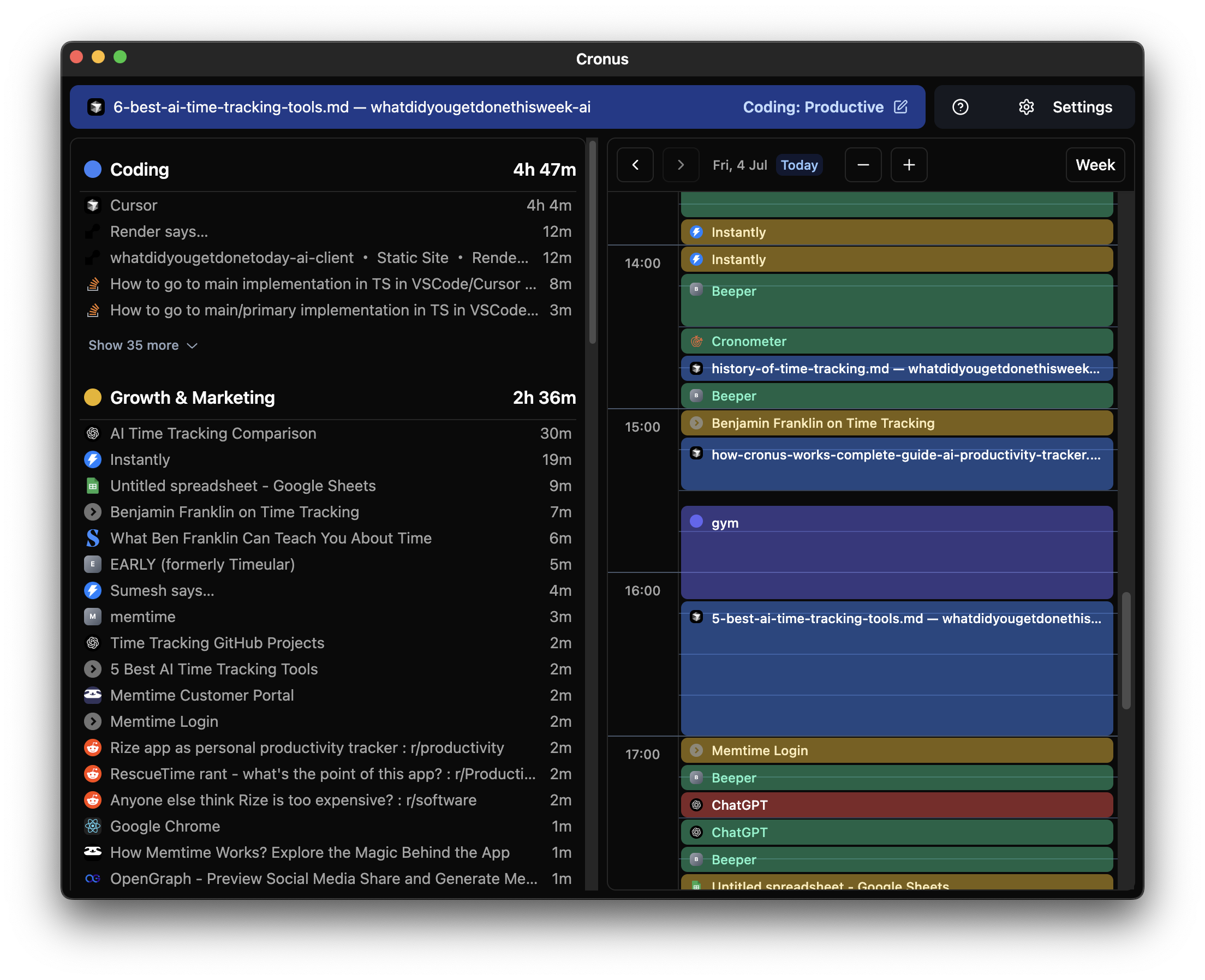
The hardest part to externalise is your own past, and it is the part that would help most.
Without a record, every week starts from nothing. You cannot tell whether Thursday is always bad, whether the project genuinely took three times the estimate, or whether the thing you are dreading actually takes forty minutes. So every estimate is made fresh, and estimates made fresh are the ones that are wrong.
People are unreliable about this even without ADHD. In a randomised controlled trial, experienced developers estimated a tool had made them 20% faster on real tasks; measured, they were 19% slower — a forty point error about work they had just finished. The full study.
Cronus keeps that record automatically on your Mac. No timer, nothing to log, nothing to open — which is the point, because a tracker you have to remember is subject to exactly the problem this page is about. A manual tracker is just another object out of sight.
What it gives you is an external memory of your own time: how long that task really takes, which days are actually bad, where last week went. Not motivating, just factual, and much better than reconstructing from nothing.
$6 a month after a 21-day trial, and it never captures your screen: window titles only, redacted on your device.
Honest limits. It sees your Mac, so it knows nothing about the milk, the gym bag or the friend you have not texted. And it will not remind you of anything — it is a record, not a prompt. For prompts, use location reminders, which are free and better at that job than we are.
On explaining it to other people
Two things make this land, if you have to explain it:
Lead with the mechanism, not the label. "I only remember things I can see" is understood immediately. "I have ADHD object permanence issues" invites an argument about Piaget.
Ask for the specific accommodation. "Message me twice if it matters" or "put it in the shared calendar, not in a message" are concrete and easy to agree to. General understanding changes nothing.
Read next
- Time Blindness — the time version, in detail.
- ADHD Forgetfulness — the working memory side.
- ADHD and Relationships — the version that hurts people.