ADHD and Sleep: Why You Cannot Go to Bed, and Why Mornings Are Worse
You are tired at 10pm. At midnight you are wide awake and reorganising something.
Then the alarm goes and the first two hours of the day are a write-off.
Both ends of that are common with ADHD, and they are not the same problem.
Written by people who build a time tracker, not clinicians. About patterns and practical steps, not diagnosis or treatment. Sleep problems can have serious medical causes — see a doctor.
Four things going on at night
Most people have one or two dominant. Telling them apart matters, because the fixes differ.
1. A later body clock. Delayed sleep phase — a circadian rhythm shifted later than the schedule you have to keep — turns up more often alongside ADHD. If your natural window is 2am to 10am and your job starts at 9, you are running a permanent time-zone mismatch.
2. Transition difficulty. Going to bed is a change of state, and changing state is the expensive part. This is inertia at the end of the day, not tiredness failing to arrive.
3. The mind switching on. The quiet after the day removes the external demands, and everything you did not have room to think about arrives at once. Common, and genuinely unpleasant.
4. Revenge bedtime procrastination. If the whole day belonged to other people, the hours after bedtime are the only ones that feel like yours. Staying up is not irrational. It is reclaiming something. This one is a schedule problem wearing a sleep problem's clothes.
Why the standard advice bounces off
"Go to bed earlier." If the issue is a shifted body clock, lying down earlier produces lying awake earlier.
"Have a wind-down routine." Requires initiating a transition, which is the impaired step. A routine you cannot start is not a routine.
"No screens an hour before bed." Reasonable, and it removes the stimulation without replacing it. An hour of understimulated waiting is its own problem.
"Just be disciplined about it." Bedtime is the moment of the day with the least self-regulation left. It is the worst possible time to rely on it.
What helps
Anchor the morning, not the night. Wake time is the more powerful lever on a body clock than bedtime. A consistent wake time, with light soon after, moves the whole rhythm. It is unpleasant for about a week.
Get light early and deliberately. Outside if possible, within an hour of waking. This is the single most effective circadian intervention available and it costs nothing.
Make bedtime a sequence, not a decision. Same three actions, same order, every night. The point is to remove the choice, because the choice is what fails.
Externalise the trigger. An alarm that means "start the sequence", not "be asleep". Placed where you have to get up to silence it.
Deal with revenge bedtime during the day. If you are staying up to reclaim time, the fix is not at 1am. It is a genuinely unclaimed hour earlier in the day. Nothing you do at bedtime addresses a day with no free time in it.
Write the mind-racing down. Not to organise it. Just to put it somewhere so it stops being held.
Why mornings are worse than they should be
Two compounding things.
Sleep debt is chronic, not occasional. A later body clock against an earlier schedule means every workday starts short. It accumulates.
Executive function is at its lowest on waking. The functions you need to get going — initiation, sequencing, working memory — are the ones least available first thing. That is why "getting ready" can take ninety minutes with nothing to show for it, and why being late is not fixed by leaving early.
The practical response is to remove decisions from mornings. Clothes decided the night before, the same breakfast, bag packed, keys in one place. Not because you are disorganised — because decisions are expensive at the exact hour you have fewest to spend.
The measurement bit
Two things are worth knowing and neither is available from memory.
When your good hours actually are. If your body clock runs late, your best thinking may genuinely be at 4pm or 10pm. Most people assume mornings should be their peak and schedule accordingly, then perform badly and conclude something is wrong with them.
What the night is costing the day. The relationship between a late night and the next day's output is real, and impossible to see one day at a time.
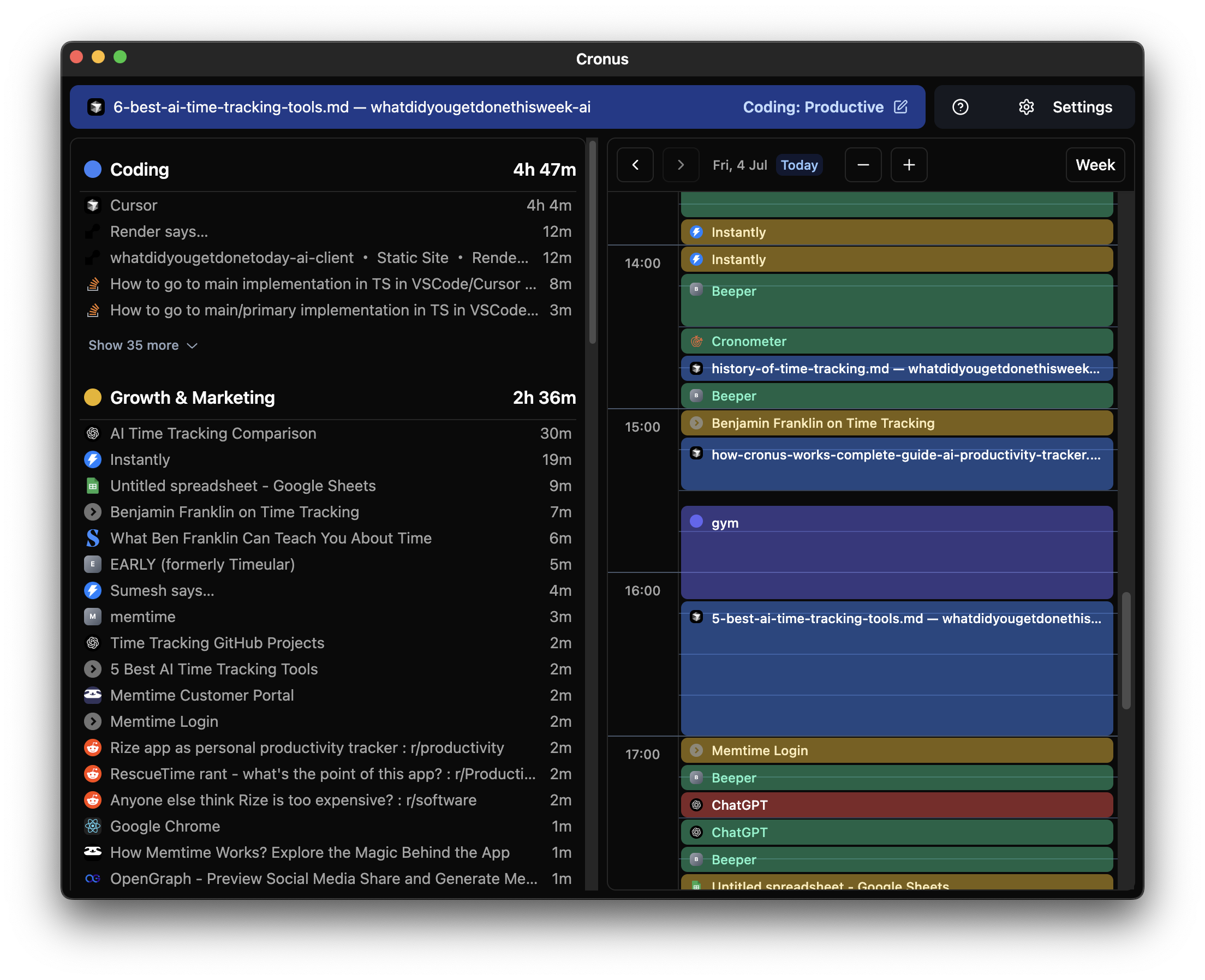
Cronus records where your hours go automatically, with nothing to log. Over a few weeks the pattern shows: where your effective hours sit, and how the days after a late night differ from the days after a normal one.
If your peak turns out to be late afternoon, that is worth knowing. It is much easier to move a meeting than to move a circadian rhythm.
It does nothing for sleep itself. It measures the daytime consequence. For the sleep, see a doctor, especially if this is chronic.
The one thing to try first
Fix wake time and morning light before anything else. It has the largest effect on the body clock, it costs nothing, and it does not depend on making a good decision late at night when you have none left.
Read next
- Why Am I Always Late? — the morning problem in detail.
- ADHD Burnout — where chronic sleep debt eventually leads.
- Autistic Inertia — the transition difficulty behind not going to bed.
Find out where your week actually goes
The 5-day time audit: one short email a day, walking you through the experiments in this post. You will end the week with a real answer instead of an impression. Free, no app required, and it ends after five days.