Productivity Guilt
You worked all day. At 6pm you cannot name a single thing you finished, and you go to bed with the sense that you wasted it.
Then you do it again the next day.
The interesting part is that this happens to people who are, by any external measure, working hard. Productivity guilt is not well correlated with actually being unproductive. It has its own causes.
Why the feeling and the facts come apart
Progress is invisible when work is fragmented. A day of one big task leaves you with a thing that exists. A day of nine small ones leaves you with nothing to point at, even if it was more total work. Your sense of a day comes from what you can recall, and interrupted work is much harder to recall than continuous work.
Nothing counts unless it finished. Four hours of real progress on something unfinished registers, emotionally, as zero. So a week of substantial work on a long project can feel like a week of nothing.
The list only ever shows what is left. Every system you use is a list of the undone. Nothing in your day shows the done. You are looking at a scoreboard that only counts against you.
Invisible work is genuinely invisible. Reviewing, unblocking someone, thinking, deciding not to do something, the meeting that prevented a bad decision. All real, none of it leaves an artefact, none of it makes it into your evening assessment.
You are comparing against a fictional day. The reference point is a day with no interruptions, no admin and no fatigue. That day does not exist and has never existed, and measuring against it guarantees a deficit.
The self-report problem
Here is the part that should change how much you trust the feeling.
People are bad at estimating their own work, and they are bad in both directions with large errors. In a randomised controlled trial, experienced developers estimated a tool had made them 20% faster on real tasks from their own repositories. Measured, they were 19% slower. A forty percentage point error about work they had just completed.
Those people were not casually guessing. They were reporting on their own recent, concentrated work.
So when you conclude at 6pm that the day was a write-off, you are using a faculty with a demonstrated error range wide enough to invert the answer. The feeling is not evidence. It is a guess, generated when you are tired, from a memory that systematically drops fragmented work.
What actually helps
Keep a done list, not just a to-do list. The cheapest fix and it works. One line per thing, written as you go, not from memory at 6pm. Recall is the broken component, so anything written down at the time bypasses it.
Count blocks, not tasks. Some days produce no completions and three hours of real work on something hard. That is a good day, and only a block-based view will show it as one.
Separate "I did nothing" from "I did the wrong things". They feel identical and are not. The first is usually false. The second is often true and is a scheduling problem, not a guilt problem.
Give unfinished work partial credit explicitly. Write down where you got to. Otherwise your brain scores it as zero, every day, until the day it ships.
Set a floor, not a target. Targets manufacture failure, because they are set on optimistic mornings. A floor — the minimum that makes a day acceptable — can actually be met, and meeting it is what ends the guilt.
Getting the actual number
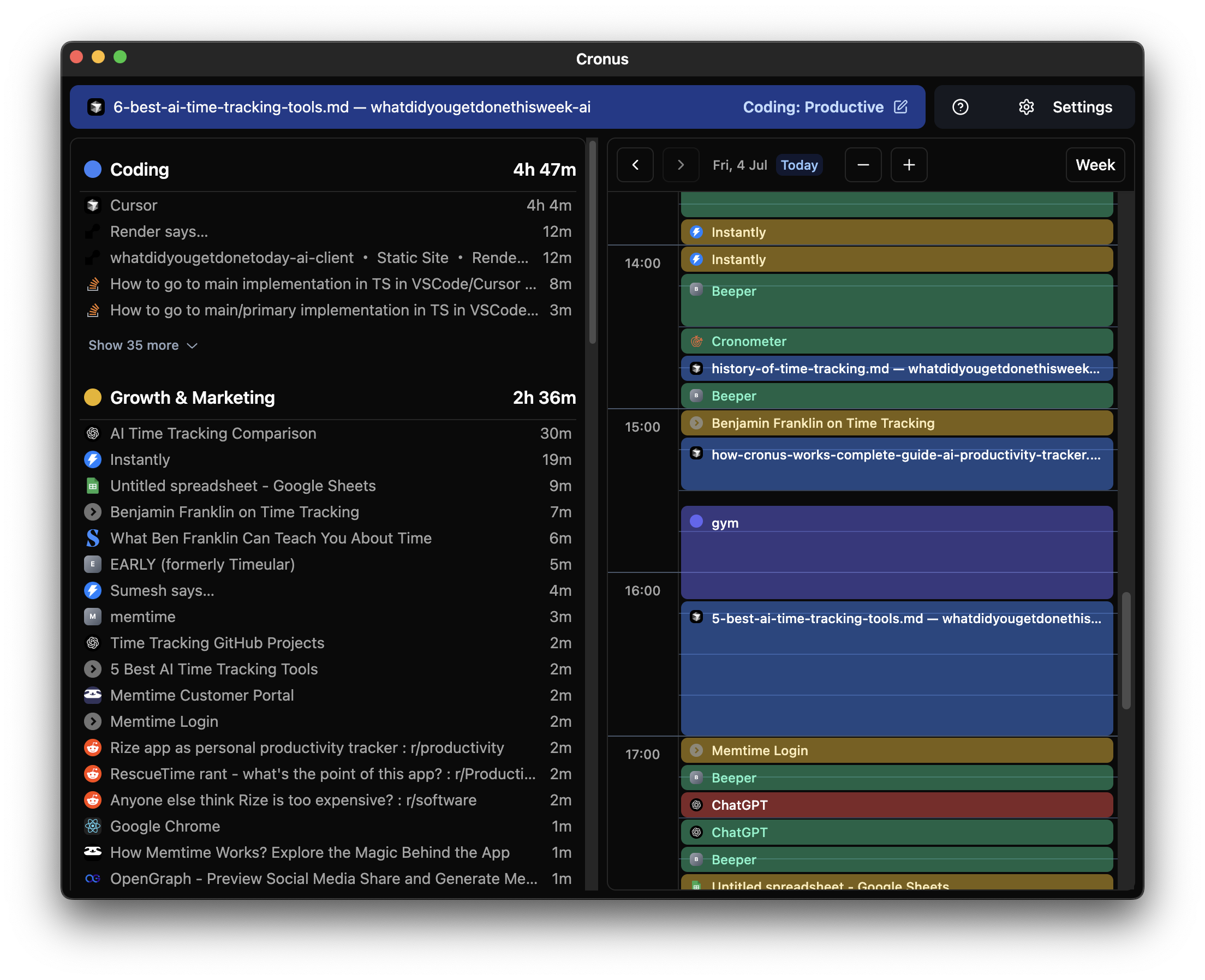
The most direct fix is to replace the evening guess with a record, because the guess is where the problem lives.
Manual tracking does not work here, for a specific reason: it needs an action at every task switch, and the fragmented days that generate the most guilt are exactly the days you will not log. So the record covers your calm days and misses your worst ones, which makes the picture worse than no record.
Cronus records it automatically on your Mac. No timer, nothing to log, so a chaotic day produces a complete picture rather than a gap.
The two things people find:
You worked more than you thought. Consistently. The hours were real and fragmented, so they left no memory of progress.
The gap is concentration, not effort. Usually the honest finding is not "I was lazy" but "my longest unbroken block was 22 minutes". That is a real problem, and it is a fixable, unemotional one, unlike guilt.
$6 a month after a 21-day trial, and it never captures your screen: window titles only, with sensitive information redacted on your device.
One caution, and it matters here: if you are prone to this feeling, a tracker can become another scoreboard to fail against. Look at it weekly, not daily. The purpose is to settle the question of where the time went, not to add a new daily verdict.
When it is not really guilt
If this is constant and comes with feeling unable to stop working, that is closer to burnout than to productivity guilt, and doing more will not resolve it.
If you genuinely cannot start, the guilt is downstream of task initiation, and that is the thing to address.
If nothing produces satisfaction, including things that used to, that is worth raising with a doctor rather than solving with a system.
Read next
- Where Did My Day Go? — the fragmentation behind most of it.
- Time Anxiety — the wider version of the same feeling.
- You Are Wrong About How Fast AI Makes You — the trial, in full.