Time Anxiety
Time anxiety is the persistent, low-grade dread that you are wasting your life.
It shows up in specific ways. Sunday evening feels like a countdown. You cannot enjoy a free afternoon because you should be using it better. You feel behind without being able to say behind what. Finishing something brings relief rather than satisfaction, and the relief lasts about ten minutes.
It is not the same as being busy. Plenty of people with time anxiety are not especially busy, and plenty of extremely busy people do not have it.
Chris Guillebeau's Time Anxiety: The Illusion of Urgency and a Better Way to Live (Penguin Random House, April 2025) is the book-length treatment, and it is the reason you are probably seeing the phrase everywhere. This post is the shorter version, plus one thing the genre tends to leave out.
The three flavours
They feel similar and respond to completely different things, which is why generic advice bounces off.
Not enough time. The clock version. Too much to do, not enough day. This one is at least tractable: it responds to cutting commitments and to actually seeing where the hours go.
Not enough life. The existential version. Time is finite, you will not do most of what you might have done, and no scheduling change touches that. This is the one Oliver Burkeman's Four Thousand Weeks is about, and the honest answer is acceptance rather than optimisation.
The wrong things. The most common and the most fixable. Not that you have too little time, but a suspicion that what you did with it does not match what you care about.
Most people diagnose themselves with the first, and actually have the third. That matters, because they have opposite treatments: the first says do less, the third says do differently. Doing less of things you already did not value changes nothing, which is why "just cut back" so often fails to help.
Why productivity systems make it worse
If you have time anxiety and you responded by buying a planner, you probably noticed it got worse for a while.
They add a scoreboard. A system tells you what you were supposed to do, so now there is a daily record of falling short. The anxiety had no evidence before. Now it does.
They imply the problem is you. The premise of most systems is that with the right method you would fit it all in. When you do not, the conclusion available is that you failed, rather than that the volume was never possible.
They optimise throughput, which is not the complaint. Time anxiety is rarely "I did too few tasks". It is "I am not sure any of it mattered". Getting more done faster is a solution to a different problem, and it can quietly make this one sharper.
Urgency is the mechanism, and they run on urgency. Deadlines, streaks, timers. Effective for output, and they are made of the exact substance the anxiety is made of.
What actually helps
Find out where the time really goes. This sounds like the productivity advice above and it is the opposite of it, because the goal is not to fit more in.
Time anxiety runs on a guess. You do not know what your week contains, so the space fills with a worst-case estimate, and the worst case is always worse than the truth. Almost everyone who measures a week finds the anxious story was wrong. Not flattering, but wrong: the hours were somewhere specific, usually fragmented and mostly not frivolous.
Replacing a vague dread with a boring, concrete fact is the single most reliable intervention here, and it is one of very few that works on all three flavours at once.
Separate "not enough time" from "wrong things", using the actual numbers. Once you can see the week, the question becomes answerable. If the hours are going to things you endorse, you have a volume problem: cut commitments. If they are not, you have an alignment problem, and no amount of efficiency fixes it.
Do the arithmetic on the future. Time anxiety is bad at scale and treats every horizon as urgent. Twenty minutes a day is 120 hours a year. Vague dread about "never having time to learn X" usually does not survive that calculation.
Stop measuring days. A single day is too small a unit to carry a life's worth of meaning, and judging one is how a normal Tuesday becomes evidence of failure. Weeks are the smallest honest unit.
Schedule genuinely unproductive time, protected. Not "rest so you perform better", which is the same anxiety wearing a costume. Time that is allowed to produce nothing. If every hour must justify itself, none of them can.
Notice if it is actually anxiety. If this is present most days, comes with physical symptoms, or sits alongside sleep problems and rumination, it is worth raising with a doctor. A time tracker is not a treatment for an anxiety disorder and it would be dishonest to imply otherwise.
The measurement part, concretely
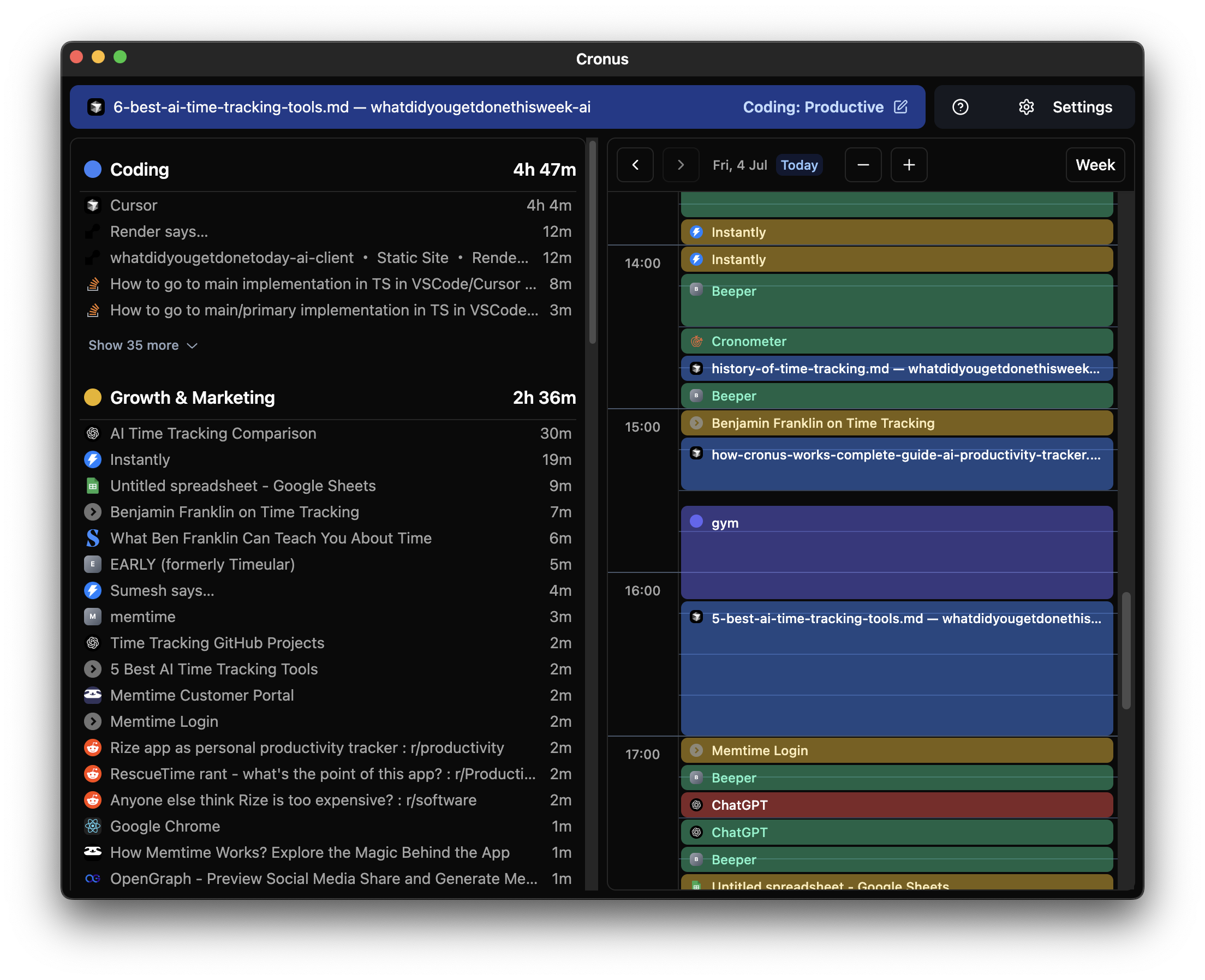
The catch is that manual tracking is a bad fit for exactly this problem. It adds a logging obligation, and an obligation you keep failing is more anxiety, not less. It also fails hardest on chaotic days, which are the days generating the dread.
Cronus records where your time went automatically on your Mac. No timer to start, nothing to log, no scoreboard to fall short of. Once a week you get an accurate picture instead of a guess.
Two things people find, both of which reduce the anxiety rather than feed it:
The lost hours were not what you thought. The story is usually "I wasted the week". The record usually shows meetings, admin and switching. Still a problem, and a completely different problem, with a completely different fix.
You worked more than you thought. Common, and the anxiety never credits it, because it was fragmented and left no memory of progress.
$6 a month after a 21-day trial, and it never captures your screen: window titles only, redacted on your device.
A real caution: if you already have anxiety about time, a daily dashboard can become one more thing to feel bad about. Look weekly, not daily. If you find yourself checking it repeatedly, that is a signal to close it, not to track harder.
What does not help
Reading more about it. Time anxiety is unusually good at converting itself into research about time anxiety, which feels like progress and costs the exact resource in question.
Another system. If three have not worked, the fourth is not the answer. That pattern is itself information.
Waiting for a calm period to sort it out. It does not arrive, and the waiting is part of the thing.
Read next
- Where Did My Day Go? — the fragmentation that usually explains it.
- Is Half Your Life Over by 18? — the existential flavour, with the actual maths.
- How to Do a Time Audit — the concrete version of the first suggestion.
Sources: Chris Guillebeau, Time Anxiety (Penguin Random House, 2025) · Healthline: Time Anxiety — Signs, Causes, and How to Cope