Types of Procrastination
Most procrastination advice fails for a simple reason: it treats one word as one problem.
At least six distinct things get called procrastination. They have different causes and different fixes, and applying the wrong fix reliably makes things worse. The point of sorting them is not taxonomy for its own sake — it is that identifying which one you have narrows the useful advice from fifty techniques to about three.
A note on the popular "six procrastinator personality types" lists you will find elsewhere: those are marketing frameworks, not research. The categories below are organised by cause, because cause is what determines the fix.
1. Avoidance of a feeling
The best-supported account. You are not avoiding the task, you are avoiding an emotion attached to it: anxiety, boredom, resentment, or the fear of finding out you cannot do it.
How to recognise it: the dread is disproportionate to the work, and starting is far worse than continuing. The task usually turns out to be easier than the avoidance implied.
What helps: name the feeling specifically. "I am avoiding this because I am afraid it will be rejected" is actionable in a way "I am procrastinating" is not. Then make the first step trivially small, because the emotion attaches to the whole task and not to opening a file.
What makes it worse: self-criticism. This is well documented — harsh self-judgement increases avoidance, because it adds to the feeling you were already avoiding. Self-forgiveness after procrastinating measurably reduces it next time.
2. Perfectionism
Not starting because it cannot be done well enough. Often mistaken for laziness, and it is closer to the opposite.
How to recognise it: you have unusually high standards for this specific task, you would rather not do it than do it badly, and unstarted work feels safer than imperfect work.
What helps: make a deliberately bad first version. Explicitly bad, on purpose. It breaks the standard that is blocking the start. Set a floor rather than a target.
What makes it worse: planning. More preparation feels productive and raises the stakes further.
3. Task initiation failure
You want to do it, you are not anxious, you have decided to start, and you do not start. There is no emotional content to find.
How to recognise it: the absence of a story. You are not avoiding anything and nothing happens anyway.
What helps: external activation. Another person, a scheduled call, a hard deadline, body doubling. Also reducing the gap between deciding and beginning to as close to zero as possible.
What makes it worse: looking for the emotional cause. There often is not one, and searching for it becomes another delay. This form is strongly associated with ADHD and it is worth reading about it directly.
4. Decision paralysis
The work is not started because a decision upstream of it is unresolved. Frequently misread as laziness by the person experiencing it.
How to recognise it: you cannot say what the first step is. Asked what you are procrastinating on, the answer is vague.
What helps: separate deciding from doing, and treat the decision as the task. Set a deadline for it, cut the options deliberately, or accept a good-enough answer. See analysis paralysis.
What makes it worse: more research.
5. Deliberate delay
Genuinely waiting because waiting is correct: more information is coming, the situation may change, or it is not the priority. This is not procrastination, though it feels identical from the outside and often attracts the same guilt.
How to recognise it: you can state a reason and a date at which you will act.
What helps: writing the reason and the date down, so it stops costing you background anxiety.
6. Arousal procrastination
Waiting for the deadline pressure because you genuinely work better under it. Common with ADHD, where urgency is one of the few reliable activators.
How to recognise it: it works. You deliver, on time, under pressure.
What helps, honestly: admit it and build for it. Real intermediate deadlines with other people attached, so the pressure arrives earlier than the cliff.
What makes it worse: pretending you will start early. You will not, and the intervening weeks are spent feeling guilty rather than doing anything else useful.
One caution: the belief that you work better under pressure is often wrong, and it is the kind of belief self-report is bad at checking. Which brings us to the general problem.
The measurement problem
Two questions decide most of this and almost nobody can answer them accurately: how long did you actually delay, and was the work under pressure any good?
Self-report is unreliable here in a documented way. In a randomised controlled trial, experienced developers estimated a tool had made them 20% faster on real tasks from their own repositories. They were 19% slower — a forty percentage point error about work they had just completed. The study.
So "I work better under pressure" and "I lost the whole week to this" are both claims from an instrument that misses by a wide margin.
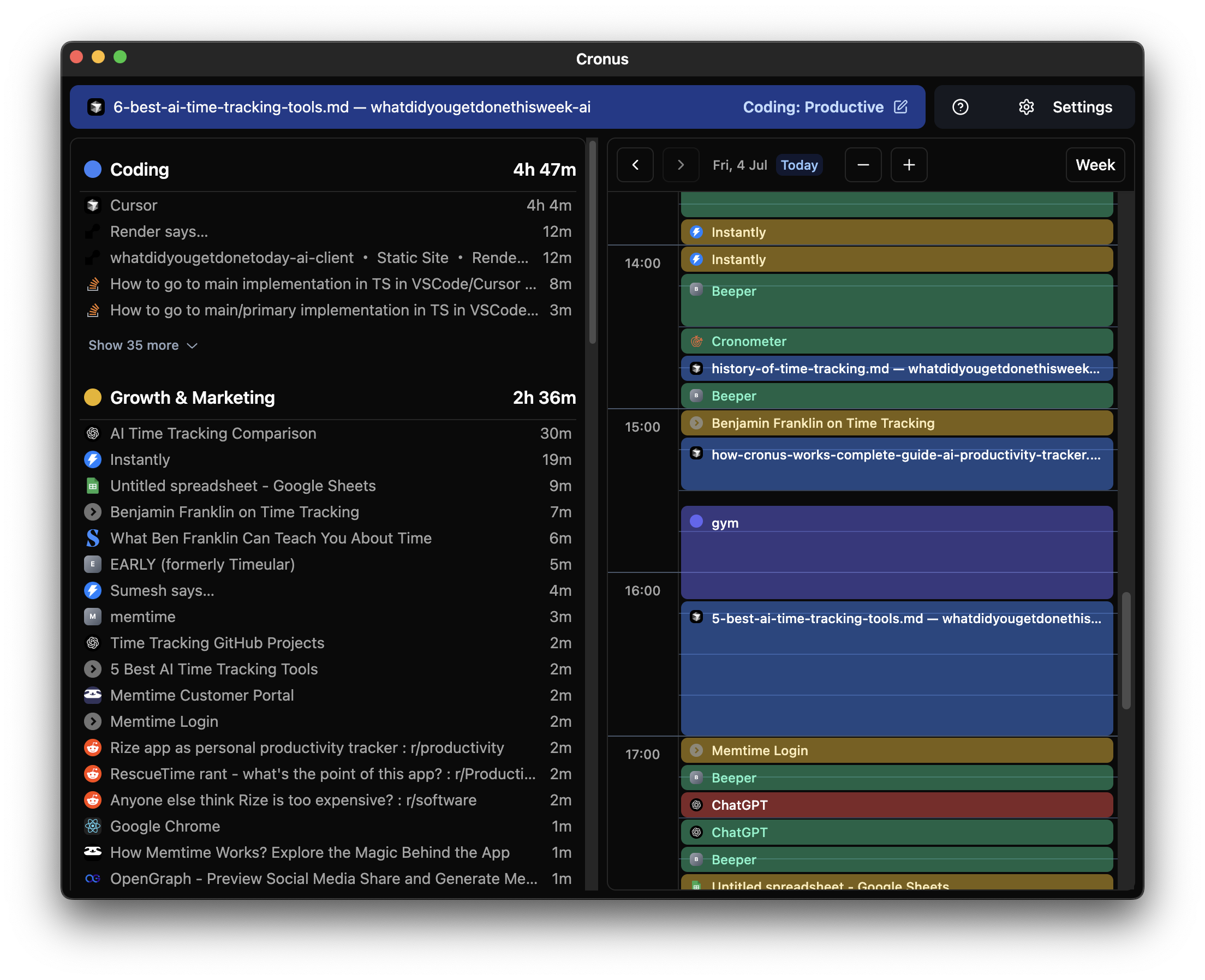
Cronus records what actually happened on your Mac, automatically, with no timer and nothing to log — which matters, because you were never going to log a week of avoidance while it was happening.
What it gives you is the shape: when you actually started, how much of the delay was other work versus nothing, and how the final push compared. That is usually enough to tell type 1 from type 3, which need opposite responses.
$6 a month after a 21-day trial, and it never captures your screen.
Fair limit: it cannot see the feeling, which is the cause in at least two of the six types. It tells you the pattern. You still have to interpret it.
If none of this fits
Two things worth considering.
Chronic procrastination across every area of life, resistant to every technique, is worth taking to a professional rather than a productivity article. It is frequently downstream of ADHD, depression or anxiety, and all three respond to treatment in a way procrastination techniques do not.
Procrastination on one specific thing, persistently, is often information. Sometimes the reason you will not start is that you do not want the outcome, and no technique will fix a task you have quietly decided against.
Read next
- Why Am I Always Late? — the time-estimation cousin.
- Analysis Paralysis — type 4, in detail.
- ADHD Paralysis — type 3, in detail.