Analysis Paralysis: Why More Information Makes Decisions Harder
You have read fourteen reviews. You have a spreadsheet. You know more about this decision than anyone you know.
You still have not made it.
That is analysis paralysis: the point where gathering information stops improving the choice and starts replacing it.
Why it happens
Four causes. Most people have one dominant.
1. Too many options. More choice feels better and performs worse. The classic demonstration is Iyengar and Lepper's jam study: a display of 24 jams drew more interest than one of 6, but shoppers were far more likely to actually buy from the smaller display. Choice attracts. It also stalls.
2. Fear of the wrong call. If a decision feels irreversible, the cost of being wrong dominates. So you keep researching, which feels like progress and is actually delay.
3. The options are genuinely close. Sometimes you cannot decide because it does not matter much. Two similar options produce a long deliberation about a small difference.
4. Research is more comfortable than deciding. Reading is pleasant and low-risk. Choosing is neither. This is the version that masquerades as diligence.
The tell
Ask one question: has anything I learned in the last hour changed which way I am leaning?
If no, you are no longer analysing. You are avoiding.
That is the moment the extra information stopped paying for itself. It usually arrives much earlier than people think.
Five ways out
1. Decide how to decide, first
Before more research, write down the two or three things that actually matter. Price, or speed, or who else uses it.
Then judge only on those. Most stalls come from weighing every attribute against every other one, which has no natural end.
2. Set a decision budget
"I will choose by 4pm." Or "after three more reviews."
Arbitrary, and it works. Deliberation expands to fill available time in the same way tasks do. A deadline caps it.
3. Cut to two
Not the best two. Any two.
Ranking twelve options is much harder than comparing two, and the quality of the final choice rarely justifies the extra work. Pick two, choose one, move.
4. Ask if it is reversible
Most decisions are. If you can undo it in a week for little cost, the correct amount of analysis is small.
Reserve the spreadsheet for things that are genuinely hard to unwind.
5. Set a regret floor
"Would the worst option here actually be fine?"
Often it would. When every option clears the bar, the differences are smaller than the time you are spending on them.
When it is not really about the decision
Two cases worth separating out.
If it is one specific task you cannot begin, that is closer to task paralysis than analysis paralysis. The fix is different: shrink to a physical first action, not better criteria.
If everything feels equally urgent, that is choice paralysis. Reduce the field before you try to rank it.
Same appearance. Different repairs.
The hidden cost
Here is the part people miss.
The cost of analysis paralysis is not the bad decision. Usually the decision is fine.
The cost is the hours, and they are almost impossible to see afterwards. Research does not feel like time passing. It feels productive right up to the moment you notice the afternoon has gone.
That is the same mechanism behind time blindness: your sense of duration runs on how occupied your attention is, and comparison shopping is absorbing.
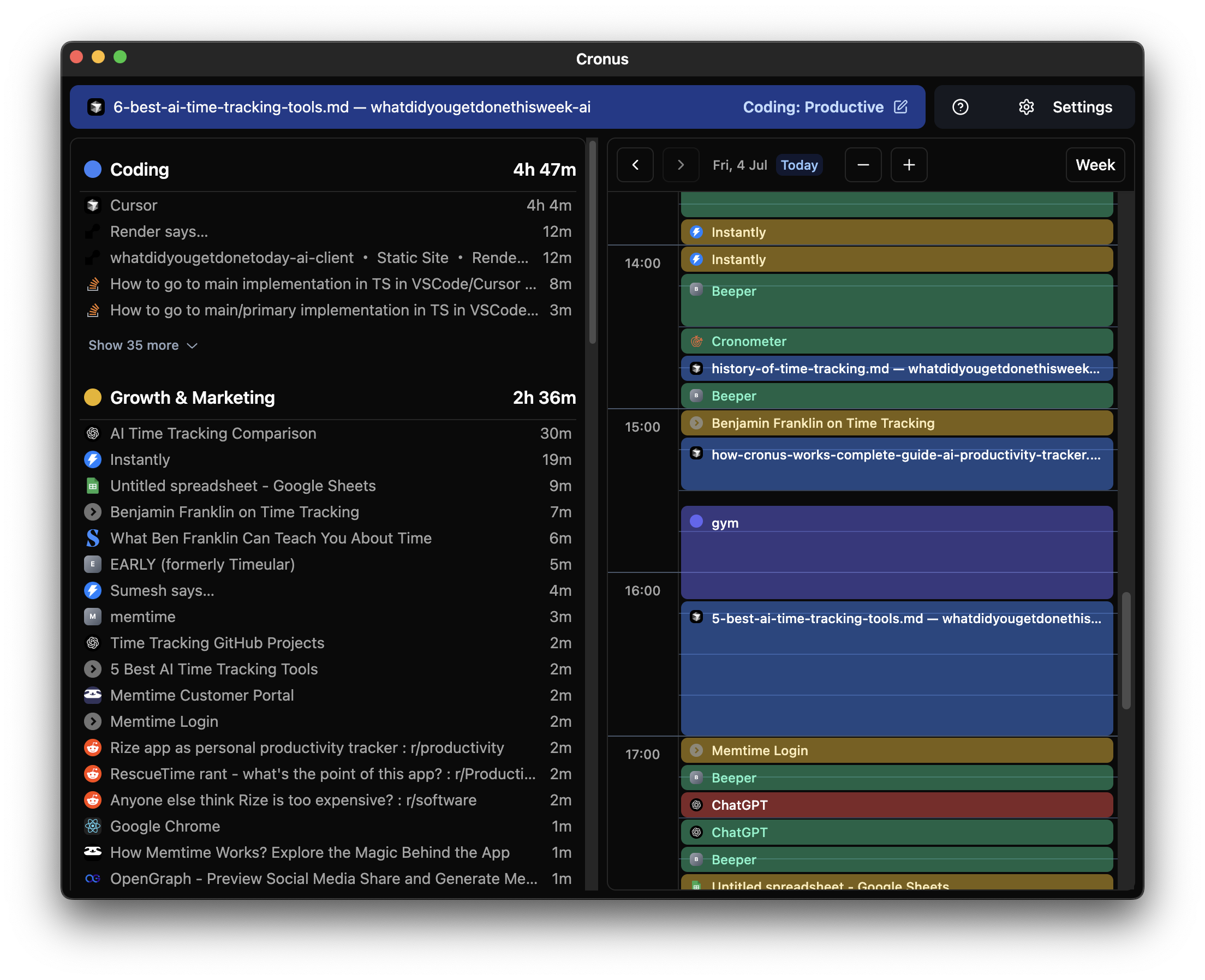
Cronus records where your time actually went, automatically. No timer to start. So the eleven hours spread across two weeks on a $40 decision shows up as eleven hours, instead of as a vague sense that you were busy.
People are usually wrong about this in one direction. The research always took longer than they thought.
The rule worth keeping
Match the analysis to the stakes and the reversibility. Not to how interesting the research is.
If you can undo it cheaply, decide now. If the options are close, that closeness is your answer: pick either.
Sources
- Iyengar, S. & Lepper, M. (2000), When Choice is Demotivating, Journal of Personality and Social Psychology — the jam study.
- METR randomized controlled trial on self-estimated productivity — on how badly people judge their own time.
Read next
- ADHD Paralysis — when you cannot start rather than cannot choose.
- Where Did My Day Go? — where the hours actually go.
Find out where your week actually goes
The 5-day time audit: one short email a day, walking you through the experiments in this post. You will end the week with a real answer instead of an impression. Free, no app required, and it ends after five days.