Motivation vs Discipline
The standard version of this argument goes: motivation is a feeling, feelings are unreliable, therefore build discipline.
Half right. Motivation genuinely is unreliable. But discipline is not the sturdy alternative it is sold as, and treating it as one is why the advice keeps failing.
What each one actually is
Motivation is wanting to do the thing. It arrives from novelty, interest, urgency, fear or inspiration, and it cannot be summoned on request. Its defining feature is that it is present or absent rather than something you allocate.
Discipline is doing the thing without wanting to. It is the capacity to override a preference, which makes it an act of inhibition rather than a character trait.
The crucial detail the discipline camp skips: inhibition is effortful, and effort draws from something finite. Discipline is not a permanent property you install through willpower. It is expenditure, and like any expenditure it runs out — reliably, near the end of the day, and faster when you are tired, hungry, stressed or ill.
Which means "just be more disciplined" is advice to spend more of a resource you are already short of.
What actually explains the people who seem to have it
Look closely at anyone consistently doing hard things and you rarely find heroic self-control. You find three other things.
They removed the decision. Same time, same place, same first action, every day. Nothing to override because nothing is being chosen. The gym clothes are already in the car.
They arranged for the thing to be hard to avoid. A training partner, a class booked and paid for, a client expecting a draft, a commitment made publicly. External structure doing the work internal effort would otherwise have to.
They lowered the bar until it was reliably clearable. Not an hour at the gym: showing up. Not a chapter: one paragraph. The consistency comes from the size of the ask, not from the strength of the person.
None of that is discipline in the sense the word is usually used. It is design.
The reframe that helps
The useful question is not "how do I get more motivated" or "how do I become more disciplined". It is:
How do I need less of both?
Every practical improvement comes from that question:
- Reduce the decisions. Every choice is a chance to choose wrong. Decide once, in advance, in writing.
- Reduce the friction to start. The gap between deciding and beginning is where most attempts die. Anything that shortens it — the file already open, the clothes already out, the first step already written down — is worth more than resolve.
- Add external accountability. Another person outperforms any internal technique. Body doubling is the strongest version.
- Shrink the unit. A commitment you can meet on your worst day is a commitment that survives. One that needs a good day is a streak waiting to break.
- Use motivation when it shows up. It is genuinely useful and genuinely unreliable, so treat it as weather. When it arrives, do the hard thing or set up the next week. Do not build a plan that requires it.
Where each is genuinely useful
Motivation is good for starting things. New projects, big changes, direction. Nothing else provides that initial push, and dismissing it as unreliable misses what it is for.
Discipline is good for short, defined pushes. A deadline week, a difficult conversation, a finish. Spending it deliberately on something bounded works well.
Neither is good for anything ongoing. Daily, indefinite commitments are exactly where both fail, and where structure is the only thing that holds.
If this has never worked for you
If you have tried repeatedly to build discipline and it has not held, that is worth taking as information rather than as a verdict on your character.
For some people the deficit is not effort at all. If you can hyperfocus for six hours on something interesting and cannot manage twenty minutes on something dull, that is not a discipline problem: it is an interest-driven attention system, and no amount of trying harder changes it. We wrote about that here.
The advice above still applies — it just becomes essential rather than optional.
The measurement problem
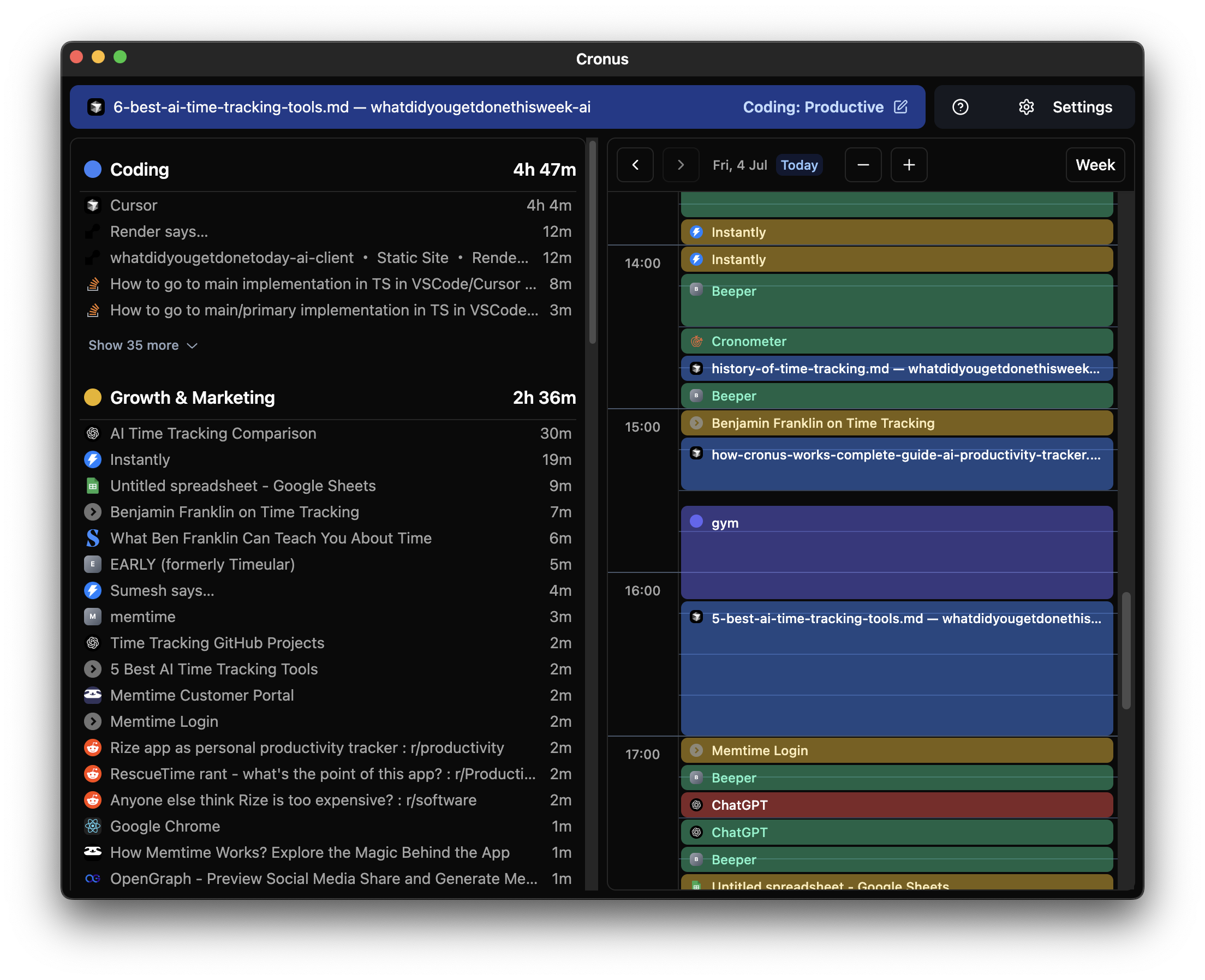
One reason this debate never resolves is that nobody checks.
People conclude they lack discipline from a feeling at the end of the day, and that feeling is unreliable. In a randomised controlled trial, experienced developers estimated a tool had made them 20% faster on real work; they were 19% slower — a forty point error about work they had just done. The study.
So "I have no discipline" is frequently a description of a bad memory of a fragmented day rather than an accurate account of it.
Cronus records what actually happened on your Mac, automatically, with no timer and nothing to log. The useful finding is normally not that you did too little, but that your longest unbroken block was 22 minutes — which is a structural problem with a structural fix, and a much more tractable thing than a character flaw.
$6 a month after a 21-day trial, and it never captures your screen.
Honest limit: a record does not make you do anything. It replaces a bad guess with a fact, and the fact is usually kinder and more actionable than the guess.
The short version
Motivation is weather: useful, unpredictable, not a plan. Discipline is expenditure: real, finite, and worth spending on short bounded pushes rather than on everything.
The people who look like they have both mostly built arrangements that require neither. Copy the arrangements.
Read next
- Body Doubling — external structure that beats internal effort.
- ADHD Routines — building structure when habits do not form.
- Monk Mode — discipline applied hard, and its failure mode.