Monk Mode: What It Actually Is
Monk mode is a fixed period where you cut everything non-essential and work on one thing.
No social media, minimal socialising, a fixed routine, one goal. Usually thirty, sixty or ninety days.
It works. It also has a failure mode that almost nobody writing about it mentions, so this post covers both.
Why it works
Three real mechanisms, none of them mystical.
Fewer decisions. Most of the drag in a normal week is deciding what to do next. Fix the routine and the deciding disappears. That is a genuine saving and it is the largest of the three.
One thing, so context switching drops. Switching costs more than people think. Removing the other five projects removes the re-entry cost that came with them.
A deadline exists. "Ninety days" gives an end. Open-ended effort has no shape, and effort without a shape decays.
Notice that none of these require monkishness. They are the same three levers behind time blocking, theme days and deep work. Monk mode is those levers applied hard, for a bounded period.
The failure mode
The version that fails looks like this: you cut everything, run at maximum intensity, feel superhuman for about two weeks, then collapse and undo most of the gains.
It happens because monk mode removes recovery along with the noise. Social contact, exercise, unstructured time and sleep are the first things cut, because they look optional. They are the things that make sustained work possible.
This is the same shape as burnout: compensation running above capacity, holding fine right up until it does not.
If you have done monk mode more than once and each attempt ended early, you are not failing at discipline. You are removing the wrong things.
The version that survives
Cut inputs, not maintenance. Social media, news, new projects, optional meetings: cut. Sleep, exercise, food, one or two people: keep. The rule is to cut what consumes attention, not what restores it.
Pick one goal, and make it specific. "Get fit" is not a monk mode goal. "Ship the app" is. You need to be able to tell, at the end, whether it happened.
Thirty days, not ninety. Almost everyone overestimates the duration they can sustain. Thirty is long enough to produce a result and short enough to finish. You can always run another one.
Keep one social anchor. One dinner a week, or a standing call. Isolation is the most common reason these end badly, and it does not help the work.
Define the exit. What happens on day 31? Without an answer, the day after either becomes an unplanned collapse or an accidental extension into something unsustainable.
The part everyone skips
Almost nobody measures whether monk mode worked.
The claim is always intensity: it felt extraordinarily focused. But feeling focused and being focused come apart badly, which is well established. In a randomised trial, experienced developers estimated a tool had made them 20% faster on real work. They were 19% slower — a forty percentage point error about work they had just finished.
So "that month felt incredibly productive" is not evidence, and the person best placed to assess it is the person least able to.
What to actually check, before and during:
- Longest unbroken block. If monk mode worked, this should go up. It is the most direct measure of what you were trying to buy.
- Number of distinct contexts per day. Should go down. If it did not, you removed activities but not switching.
- Where the recovered hours went. This is the one that surprises people. Cutting social media frees hours; they rarely land on the goal by themselves.
- Whether the goal moved. The only outcome that matters, and easy to lose sight of during a month of feeling busy.
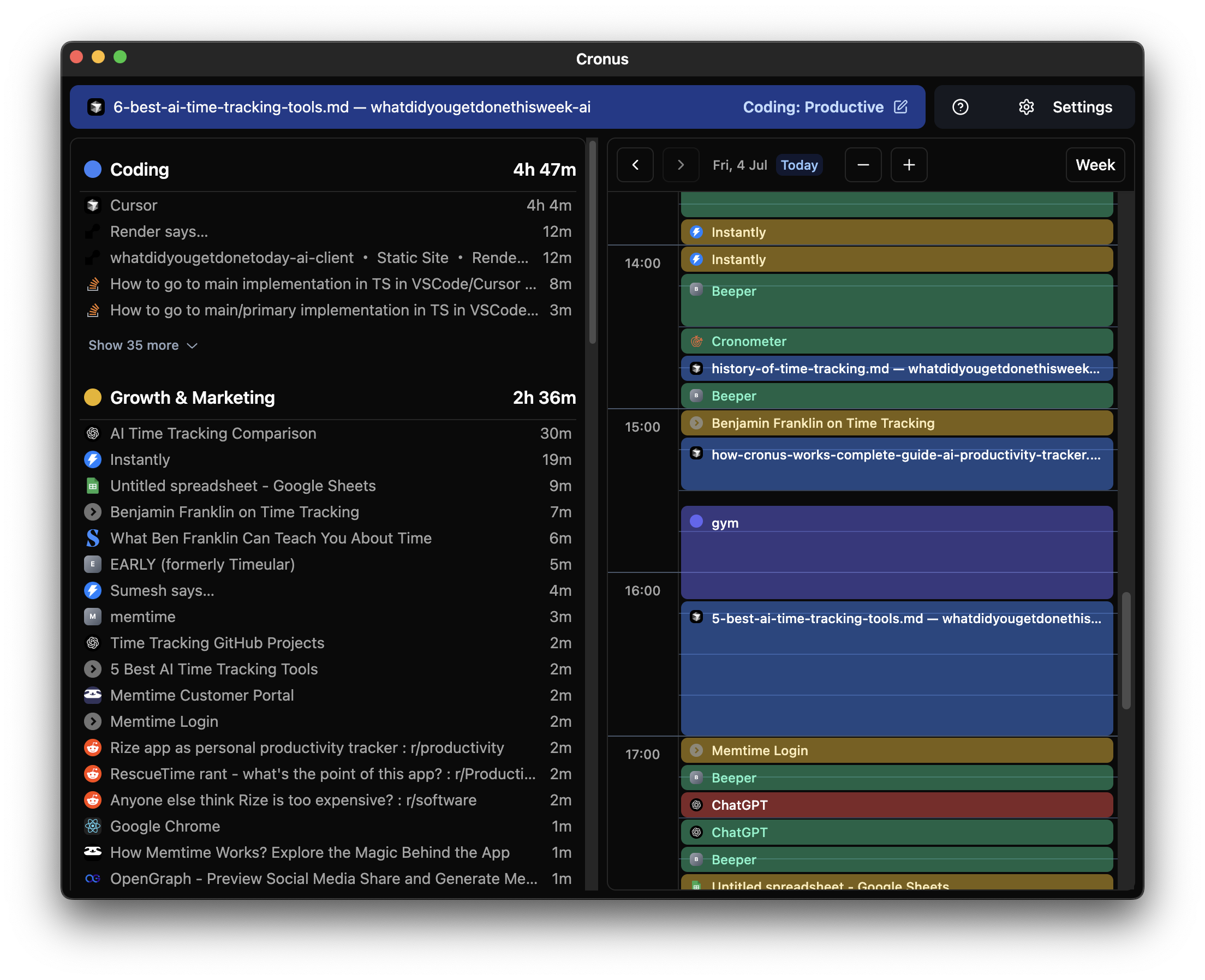
Measure for a normal week first, then run the month. Without a baseline you cannot tell whether anything changed, and a month is long enough that you will not remember what normal looked like.
Cronus records this automatically, with no timer to start and nothing to log, which matters because a monk-mode month is exactly when you will not maintain a logging habit. $6 a month after a 21-day trial.
Honest limit: it measures the shape of your work. It cannot tell you whether the ninety days were worth it, and it will not stop you cutting sleep.
When it is the wrong idea
If you cannot start, monk mode will not help. Removing distractions does not solve task initiation. You will sit in a quiet room, not starting, with fewer excuses and more guilt.
If your problem is direction, not focus. A month of intense work on the wrong thing is worse than a scattered month on the right one.
If you are already close to burnout. Monk mode removes recovery. That is the last thing to remove if you are running low.
The short version
Monk mode is time blocking, theme days and a deadline, applied hard for a bounded period. That is enough to explain the results, and it means you can get most of the benefit without the isolation.
Cut inputs, keep recovery, thirty days, one specific goal, and measure a normal week first so you can tell whether it did anything.
Read next
- Time Blocking: Why It Fails — the sustainable version of the same levers.
- How to Do a Time Audit — how to get the baseline before you start.
- ADHD Burnout — the failure mode, in detail.