ADHD Routines
There is a specific and demoralising experience that comes up constantly in ADHD communities: I cannot form a routine. Not "I struggle to stick to one" — the sense that the mechanism other people rely on simply does not engage.
That reading is closer to correct than most advice allows, and understanding why changes what you should try.
Why routines do not stick
Habit formation depends on repetition producing automaticity. Do a thing in the same context enough times and it stops requiring a decision. That is the entire premise of every habit book.
For ADHD, that process is less reliable. Attention and action are driven substantially by interest, novelty, challenge and urgency rather than by repetition. So the thirty-day streak that should have made something automatic often produces a thing that still costs full effort on day thirty-one.
Novelty wears off, and it was doing the work. A new routine is engaging because it is new. That engagement is what carried the first two weeks, and when it fades there is nothing underneath, which is why week three is where routines die.
One missed day breaks the whole structure. All-or-nothing thinking is common with ADHD, and a routine framed as a streak is fragile by design. Miss Tuesday and the sequence is broken, and a broken sequence often reads as a failed project rather than a missed day.
They rely on noticing time passing. A routine anchored to clock times requires you to feel 8am approaching. Time blindness means you often do not.
The routine gets designed for an ideal day. Built on a good morning, for a version of you with full capacity. It then fails on every ordinary day, which is most days.
What works instead
The shift that makes this tractable: stop trying to build habits, and start building structure that does not need you to remember.
Anchor to events, not to clock times. "After I pour coffee" beats "at 8am", because the coffee is a thing you will notice and 8am is not. Chain new behaviours onto things that already happen reliably.
Externalise it completely. A routine that lives in your head is not a routine. On the wall, on the mirror, on a card by the bed. Written down, where you cannot avoid it.
Reduce it until it is almost insultingly small. Not a twelve-step morning routine. Three things. A routine you complete builds momentum; one you abandon at step four costs you.
Design for the bad day, not the good one. The test is whether it works when you are tired, late and out of capacity. If it only works on good days it will fail exactly when you need it.
Allow gaps by design. Explicitly: missing a day is expected and means nothing. This single reframe keeps more routines alive than any other technique, because it removes the failure that triggers abandonment.
Rotate deliberately. Since novelty is doing real work, plan to change things every few weeks — the order, the music, the room. Most advice treats this as a lack of discipline. It is closer to fuel.
Use other people. A standing call, a gym class at a fixed time, someone expecting you. External accountability substitutes for internal automaticity, and it is the most reliable mechanism available. See body doubling.
Automate anything that can be automated. Recurring orders, autopay, prepared clothes, prepared food. Every removed decision is a decision that cannot fail.
The three that are worth it
If routines cost effort, spend it where the return is highest.
A shutdown routine. Five minutes at the end of the working day: what happened, what is next, close everything. It ends the day cleanly, which prevents work bleeding into the evening, and it means tomorrow starts with a decision already made.
A launch routine. Not a whole morning. The first fifteen minutes, decided in advance, so the hardest moment of the day — starting — needs no decisions. Same first task every day if possible.
A weekly reset. Thirty minutes: look at the week, look at the calendar, clear the surfaces. Weekly is achievable in a way daily is not, and it catches most of what falls through.
Three routines, all short, all anchored to events rather than times.
Building them on real data
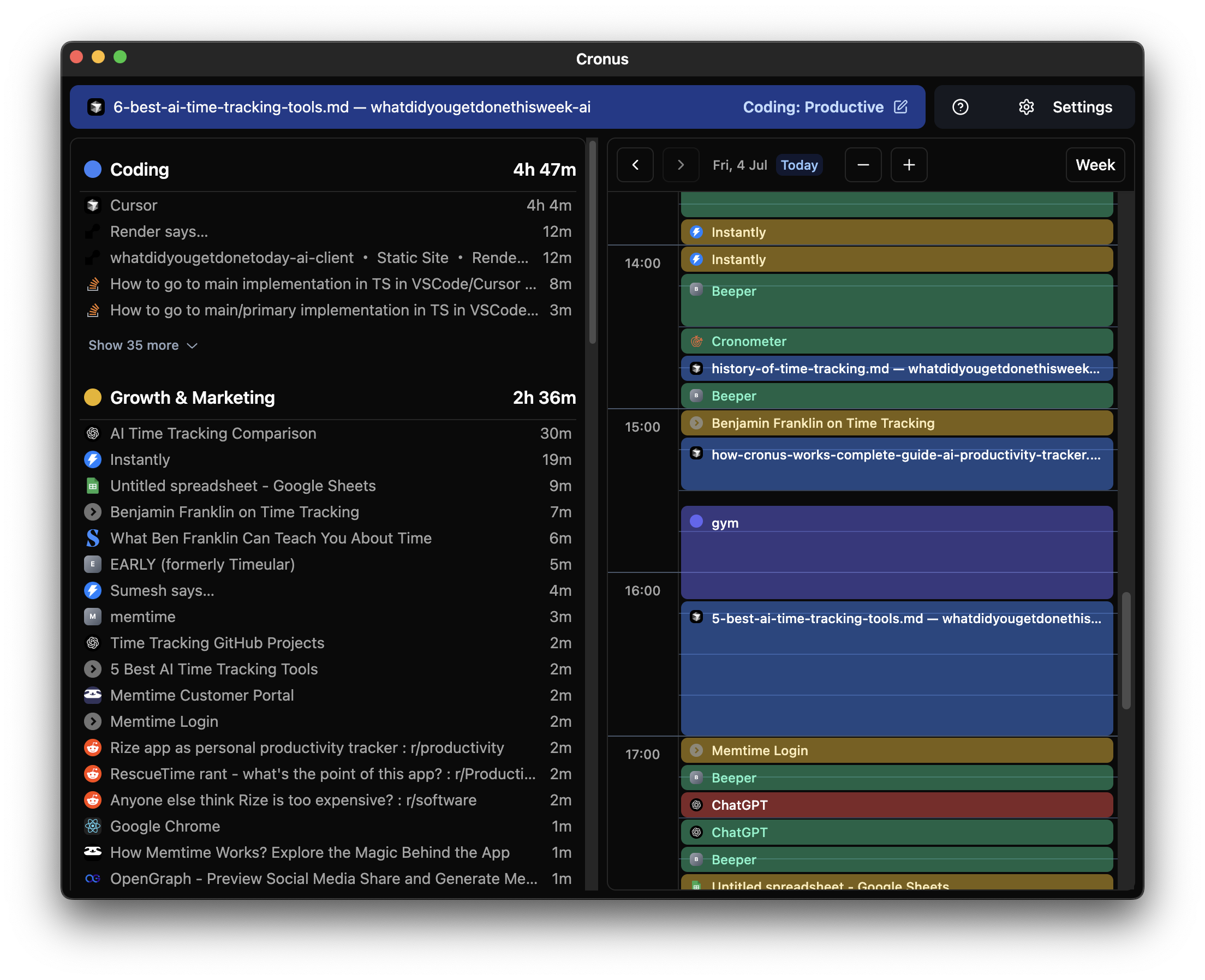
The reason routines get designed badly is that they are designed from an imagined day.
You believe you start at nine, do focused work in the morning, and fade after lunch — so you build the routine around that. If your actual pattern is a slow start, a genuinely good stretch from 11 to 1, and a second one at 4, the routine fights your day rather than supporting it.
Cronus records what actually happens on your Mac, automatically, with no timer and nothing to log. Two weeks of it tells you when your good hours really are, how long a realistic block is, and where the day reliably breaks.
Then build the routine around that. A routine matched to your real pattern needs far less discipline to sustain than one fighting it, which is the whole point, because discipline is the resource in short supply.
$6 a month after a 21-day trial, and it never captures your screen.
What it will not do: remind you, prompt you, or hold you accountable. It is a record. For the prompting, use event anchors and location-based reminders, which are free and better at that job.
If nothing has ever worked
Two things worth considering rather than trying a fourth system.
The problem may be starting rather than structure. If you know the routine, want to do it, and still cannot begin, that is task initiation and a better routine will not touch it.
Treatment moves this more than technique does. Medication and ADHD coaching have considerably better evidence behind them than any routine-building method, including everything on this page.
Read next
- ADHD Paralysis — if starting is the actual obstacle.
- Body Doubling — external structure that works when internal structure does not.
- Time Blocking: Why It Fails — the scheduling version of the same problem.