How to Slow Down Time
You cannot slow time down. You can change how much of it you remember, which is the same thing from the inside, and it is more achievable than it sounds.
Why it speeds up
Two mechanisms, and the second matters far more.
The proportional account. At five years old, a year is 20% of your life. At fifty it is 2%. Each year is a smaller fraction of what you have, so it feels shorter. This is the explanation everyone knows, usually credited to Paul Janet in the 1800s, and it is probably the smaller effect.
The memory density account. This is the one that gives you something to do.
Your sense of how long a period was is reconstructed afterwards from how many distinct memories it contains. A period rich in novel, distinguishable experiences reads as long. A period of repetition reads as short, because there is little to distinguish one day from another and your brain stores something closer to one composite memory than a hundred separate ones.
Childhood feels enormous because almost everything was new. Your thirties compress because the years are made of routine, and routine is efficient precisely by not being encoded in detail.
The uncomfortable implication: a life optimised for smoothness is a life that will feel short. Every routine you build to reduce friction also reduces the number of distinct memories the period will contain.
The prospective/retrospective split
Worth knowing, because it explains a confusion people often have about their own experience.
In the moment, boredom makes time drag and absorption makes it fly. A dull meeting is endless; a good conversation takes no time at all.
Afterwards, it inverts. The dull month you endured leaves almost nothing behind and reads as short. The absorbing week full of new things reads as long.
So the days that feel slow produce short years, and the days that fly produce long ones. Optimising for the in-the-moment feeling is exactly backwards if what you want is a life that feels full.
What actually works
Everything below follows from the memory density account.
Introduce novelty deliberately. New places, new routes, new people, new activities. Not necessarily large — the mechanism responds to distinguishable, not expensive. A different route to work, a restaurant you have not tried, a walk in an unfamiliar area. The point is producing something the week can be told apart by.
Take the first-time opportunities. First times are encoded disproportionately. The fiftieth time you do something is nearly free to store; the first is not.
Travel, if you can. The most reliable version of the above. A week somewhere new frequently occupies more retrospective space than the two ordinary months around it.
Break up long routines. If your weeks are indistinguishable, deliberately make some of them different. This is the single highest-return change for most people in a stable job with a stable home.
Pay attention on purpose. Attention is what encoding requires. Time spent absorbed in a phone is time that is barely encoded at all, which is a large part of why evenings vanish without trace. This is the practical case against doomscrolling that has nothing to do with productivity.
Write things down. A few lines a day, or a photo. Two effects: recording forces attention, and reviewing restores memories that would otherwise have blurred together. People who keep any kind of log consistently report their years feeling longer, and it is the cheapest intervention here.
Mark the boundaries. Do something to distinguish the start of a month or a season. Undifferentiated time blurs; boundaries give the year structure to hang memories on.
Learn something difficult. Skill acquisition generates a continuous stream of novel states, which is why periods of learning read as long afterwards.
What does not work
Being busy. Busyness is not novelty. A packed year of identical meetings compresses exactly like an empty one, and often worse, because you were not paying attention to any of it.
Slowing down in the sense of doing less. Doing less of the same thing does not add memories. It usually removes them.
Mindfulness alone, for this purpose. It genuinely helps you notice the present, which aids encoding. It does not by itself produce distinguishable experiences, and the evidence that meditation lengthens retrospective time is thin. Useful for other reasons.
The thing you are actually measuring
Here is the awkward part of this whole subject: you cannot trust your own account of where your time went, which makes it hard to know whether any of this is working.
In a randomised controlled trial, experienced developers estimated a tool had made them 20% faster on real tasks. Measured, they were 19% slower — a forty percentage point error about work they had just finished. The full study. If people are that wrong about the last hour, an impression of the last year is not evidence.
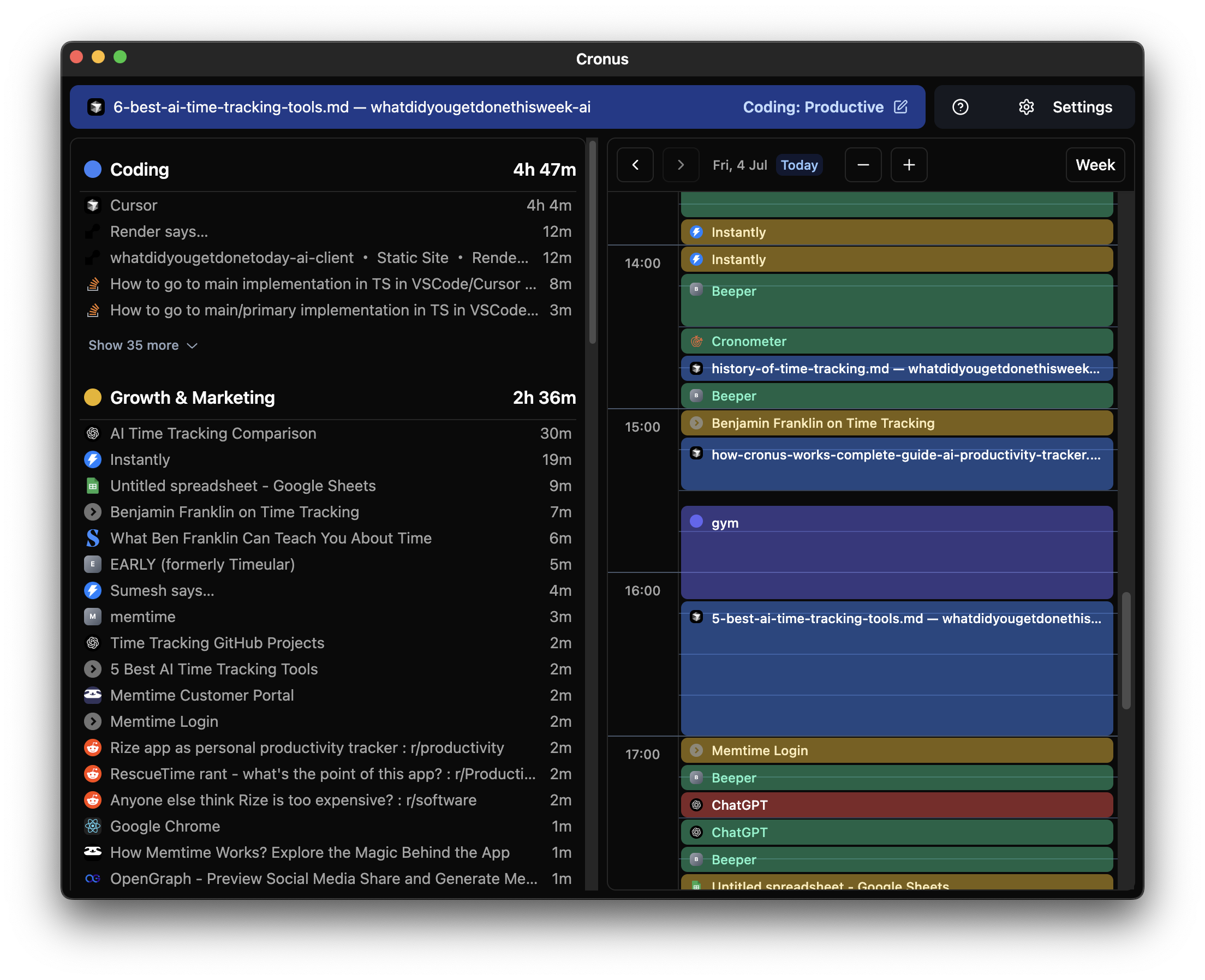
Cronus records what actually happened on your Mac, automatically, with no timer and nothing to log. Its relevance here is narrow but real: the hours that leave no memory are usually recorded somewhere. The evening that vanished was three hours of something specific, and seeing what tends to make people change it.
$6 a month after a 21-day trial, and it never captures your screen: window titles only, redacted on your device.
Being straight about the limits: a time tracker will not make your years feel longer. Novelty does that, and novelty mostly happens away from a laptop. What it can do is show you where the undifferentiated hours actually go, which is the raw material for deciding differently. For the retrospective part, a one-line daily note will do more than any software, including ours.
The short version
Time feels fast because repetition is not stored in detail. The fix is not to slow down, it is to make more of your life distinguishable from the rest of it.
Novelty, first times, attention, and writing it down. Those four cover almost all of it, and none requires more hours than you have.
Read next
- Why Childhood Summers Felt Infinite — the mechanism in detail.
- Why Novel Weeks Feel Longer — the research, and how to use it.
- Time Perception Experiments You Can Run on Yourself — testing it.