How to Stop Doomscrolling (When Blocking Apps Have Not Worked)
You have installed the blocker. You uninstalled it three days later. You set the app limit and learned to tap "ignore limit" without registering that you had. You turned the screen grayscale and got used to it.
If the standard advice had worked, you would not be reading this. So this post skips it.
What doomscrolling is actually doing for you
The framing that makes this tractable: doomscrolling is not a failure of willpower, it is a solution to a problem. A bad solution, but it is solving something, and if you remove it without addressing what it solved, it comes back.
It is usually solving one of four things.
1. It fills an unbearable gap. Waiting is genuinely aversive for some people, especially with ADHD, where a body of research treats delay aversion as central rather than incidental. A gap of three minutes has to be filled with something, and your phone is the nearest thing.
2. It defers a decision. Scrolling before a hard task is not really about the feed. It is the space between deciding and starting, and it is close kin to paralysis.
3. It is the cheapest available stimulation. Novelty on tap, no setup cost, infinite supply. Nothing else in reach competes on that.
4. It is a way of stopping without permission to stop. If you are tired but do not feel entitled to rest, scrolling is rest you can have without admitting you are resting. This one is underrated and worth sitting with.
Different causes, different fixes. That is why one piece of universal advice does not land.
Why blockers fail
Not because you are weak. Because of how they work.
They decide in advance, with information they do not have. A blocker cannot tell research from procrastination on the same site, so it blocks legitimate work. You disable it once for a real reason, and it never gets re-enabled.
They make you the adversary. Anything you can turn off, you will turn off — at the exact moment your judgment is worst. Every blocker is a negotiation with yourself at your least reasonable.
They do not address what the scrolling was for. Block the feed while the gap, the deferred decision, the understimulation or the unacknowledged tiredness is still there, and the behaviour relocates. Usually somewhere the blocker does not cover.
They fail loudest when you are most fragile. On a bad day the wall is one more thing fighting you, and that is the day it gets uninstalled.
The failure mode is consistent: a wall you can climb over gets climbed over once, and then removed.
What actually works
Ordered by how reliably it holds, not by how virtuous it sounds.
1. Raise friction instead of building walls
The aim is not to make it impossible. It is to insert a gap between impulse and feed, so the action requires a decision instead of happening.
What works, roughly in order:
- Phone in another room. Crude and by far the most effective thing on this list.
- Log out. Re-entering a password is enough friction to make it a choice.
- Delete the app, keep the browser. The mobile web is worse on purpose.
- Charge it outside the bedroom, which handles the worst session of the day.
None of these forbid anything. They add ten seconds, and ten seconds is often enough.
2. Give the gap something else to do
If scrolling is filling three minutes of waiting, taking the phone away leaves the three minutes. Something has to occupy it, and it needs to be as available as the phone was: a book left open on the desk, a walk to the window, a specific stretch.
The requirement is availability, not virtue. Anything needing setup will lose.
3. Name what you are avoiding, once
When you catch yourself starting, ask what you were about to do instead. You do not have to then do it. Naming it converts an automatic behaviour into a visible one, and visible behaviours are much easier to interrupt.
Frequently the honest answer is "I am tired and do not feel allowed to stop," in which case the fix is to stop, deliberately, which is more restful than scrolling and takes less time.
4. Get told during, not after
The useful moment is not the weekly screen-time summary. It is at minute eight of a session you thought was two minutes.
This is the one thing a tool can genuinely do, and it is the opposite of blocking: not preventing the behaviour, just supplying the fact you were missing. Almost nobody intends to scroll for forty minutes. They intend to scroll for two, and then lose track, which is a perception problem rather than a discipline one.
5. Fix the input, not just the output
If your feed is genuinely distressing, the volume matters as much as the duration. Unfollow, mute, curate. Doomscrolling is more compelling when the content is alarming, and you can lower the alarm.
The part you cannot see
Everyone underestimates this, and not by a little.
Sessions do not feel like their length. A forty-minute scroll registers as five, because your sense of duration runs on how occupied your attention is, and a feed is engineered to occupy it completely. Same mechanism as time blindness.
Screen-time reports help, but they answer the wrong question. They tell you how long you were in an app, not what it displaced. Twenty minutes of Reddit while a build runs is not the same as twenty minutes in the middle of the only clear block in your week, and no screen-time dashboard distinguishes them.
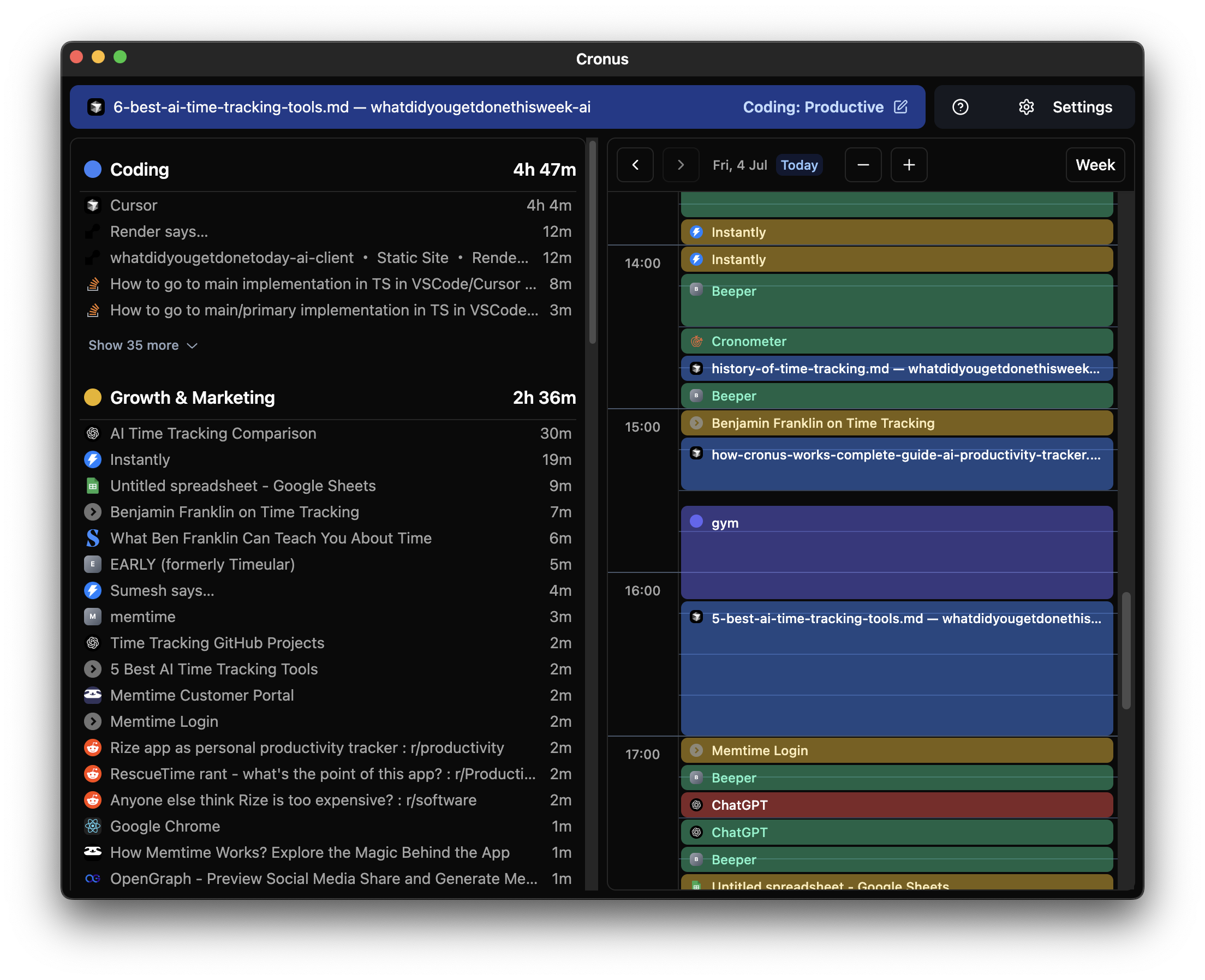
That is what Cronus does differently. It records what you were doing and judges it against what you told it you were working on, so the same twenty minutes reads differently depending on what it interrupted. And it nudges while it is happening rather than reporting on Sunday, because minute eight is when the information is worth something and Sunday is when the week is already gone.
It deliberately does not block. Partly because blockers get uninstalled, and partly because it cannot know that this particular video is the documentation you needed. Supplying the fact and leaving the judgment with you is a design choice, and on the days when the tool would have been wrong, it is the right one.
If you take one thing
Stop trying to make it impossible and start making it visible. The walls come down; the information does not.
And find out what the scrolling was solving. A gap, a deferred decision, understimulation, or tiredness you have not given yourself permission to act on. Remove the behaviour without answering that, and it simply moves.
Read next
- ADHD Time Blindness — why forty minutes reads as five.
- ADHD Paralysis — when the scrolling is really deferred initiation.
- Where Did My Day Go? — and why distraction is usually the smallest of the four culprits.
The newsletter below is a five-day audit of your own time, one short email a day, with nothing to install and nothing to log.
Find out where your week actually goes
The 5-day time audit: one short email a day, walking you through the experiments in this post. You will end the week with a real answer instead of an impression. Free, no app required, and it ends after five days.