Why Childhood Summers Felt Infinite
Everyone remembers this and almost nobody can explain it.
A single summer holiday at nine years old was an era. It had chapters. Things happened in July that felt distant by late August. The same eight weeks at thirty-five is a period you refer to as "this summer" and describe in one sentence.
The days were the same length. Something else changed.
The usual explanation is the proportional one, which goes back to Paul Janet in the 1870s: at nine, a year is about eleven percent of your life; at thirty-five it is under three. That is real and we have written about it in more depth. But it is not the whole story, and it is the least actionable part, since you cannot get younger.
There is also a physical component nobody can do much about. The medial temporal lobe, and the hippocampus in particular, does a lot of the work in both memory and time perception, and it changes with age: grey matter volume declines and new information is encoded with less fidelity. Some of the compression is structural.
Which makes the parts you can influence worth more, not less.
Four other things changed, and unlike your age, three of them are still yours to influence.
1. Everything was a first time
At nine, an enormous share of your experiences were novel. First time swimming in that lake. First time staying up that late. First time a friendship went wrong.
Your brain stores first times separately by default. It has no compressed template to file them under. So a childhood summer generated an enormous number of distinguishable memories, and the felt length of a period in retrospect is close to a function of how many separable memories it produced.
The scale of the difference is measurable. In routine adult life we commit roughly six to nine experiences per fortnight to long-term memory. Somewhere genuinely unfamiliar, that becomes six to nine per day. A child's summer runs closer to the second number than the first, all the way through.
By thirty-five, most of a given week matches an existing template. Not because life got worse, but because you have done most of it before, and the brain handles a familiar stimulus with progressively less effort each time it meets one. That efficiency is useful and it shortens the subjective duration of whatever you are efficient at. The four hundredth similar Tuesday gets merged into the pile, and nothing new is stored.
This is the biggest factor after age, and it is the one people give up on too easily.
2. The days had no fixed shape
A child's summer day had a rough structure and enormous internal variance. What happened at 2pm was not determined by what happened at 2pm the day before.
An adult week has a shape that repeats with high fidelity. Same start, same standup, same rhythm, same tools, same evening. The variance is not zero but it is small, and low variance is exactly the condition under which memory merges instances.
The irony is that this shape is something we build on purpose. Routine is genuinely useful. It reduces decision fatigue and makes hard things repeatable. It also costs you felt duration, and almost nobody accounts for that in the trade.
3. Attention was undivided
This is the one that has changed most in the last twenty years, and it may now be the dominant factor.
A nine-year-old doing something is doing that thing. There is no second stream. No notification, no partial monitoring of an ambient channel, no phone in the other hand.
Undivided attention is not just pleasant, it is a storage condition. Experiences you are only half present for do not get encoded well, which means they do not contribute to felt duration. A fragmented week can be full of genuinely novel events and still compress like a blur, because you were not sufficiently there for any of them.
This is why a holiday spent on your phone feels shorter in memory than a holiday that was not, despite identical itineraries.
4. Time was not instrumental
A child's summer afternoon was not for anything. It was not a means to a later end.
Adult time is almost entirely instrumental. This hour is for shipping the thing, which is for the launch, which is for the quarter. Instrumental time is experienced as transit, and we do not encode transit well. Nobody remembers the corridor between two rooms.
This is not an argument for abandoning goals. It is an observation that a life composed entirely of means, with no hours that are simply themselves, will compress badly no matter how successful it is.
What you can actually do
Age is fixed. The other four are not, and they respond to the same lever.
Increase the share of hours at the edge of your ability. Not novelty as decoration, but work that requires you to be different at the end than at the start. This is the closest adult equivalent to a first time, and it reliably creates markers.
Break the shape deliberately. Not every week, but often enough that instances stop merging. Different problem, different environment, different collaborators.
Defend undivided attention as if it mattered more than the hours themselves. Because for this purpose it does. Four hours of genuine focus store more than eight fragmented ones, both in output and in memory.
Keep some hours that are not instrumental. Some part of the week that is not in service of a later thing.
The measurement problem underneath all of this
Every one of those requires knowing your current ratio, and here is the awkward fact: you do not.
People misestimate where their working hours went by margins around forty percentage points. You almost certainly believe you spend more time on hard, novel, focused work than you do, and less on the familiar and the fragmented. Everyone believes this. It is one of the most consistent findings in the area.
And the failure mode is self-concealing. The weeks that compress leave no evidence of having compressed. That is what compression means. By the time you notice a year went by in a blur, the year is gone and there is no record to examine.
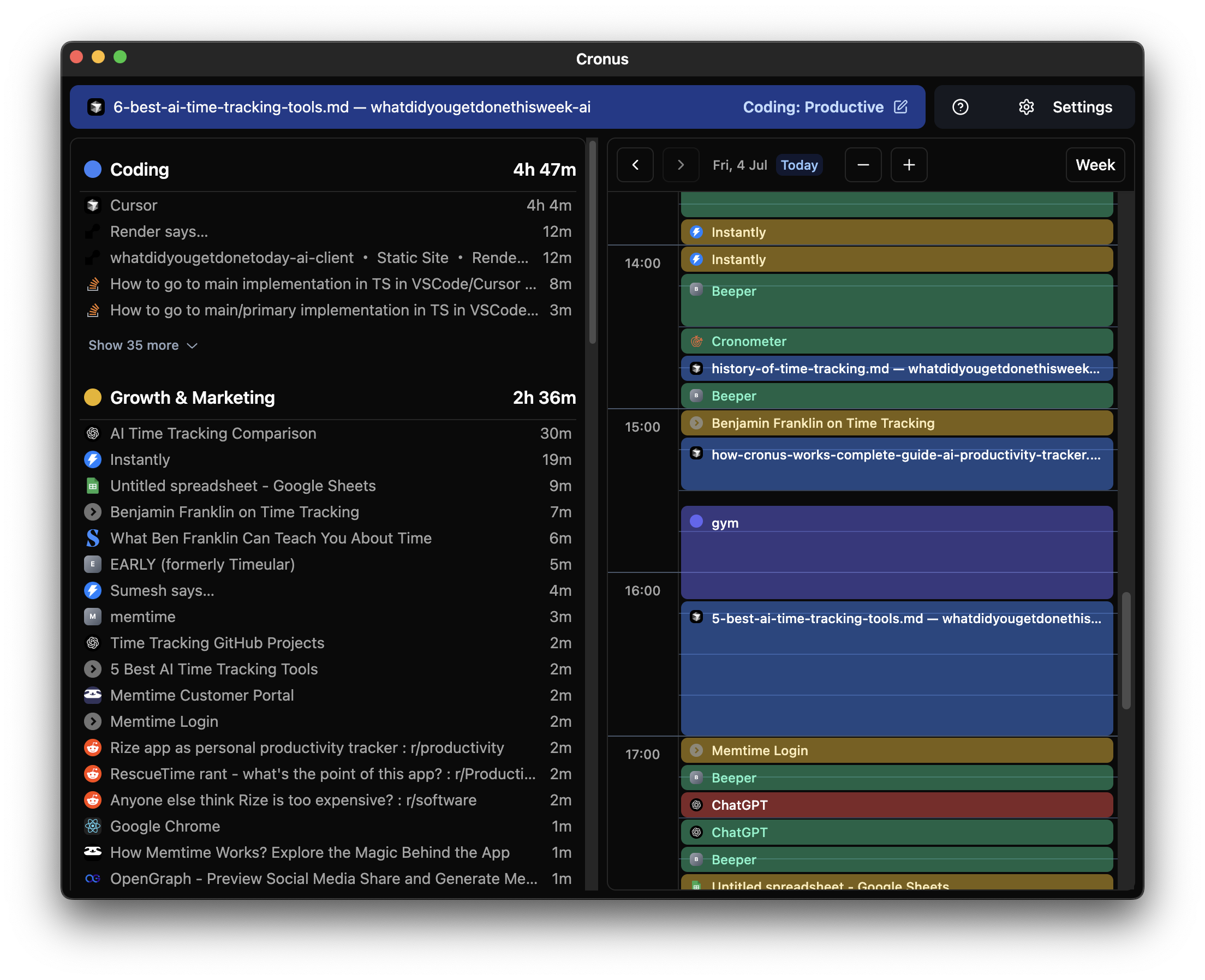
This is why the answer has to be automatic. A journal works, right up until the weeks you most need to see, the fragmented ones, are the weeks you are least likely to write anything down.
Cronus records where your hours went and what they meant relative to what you were trying to do, with no timers to start. A month later you can look at an actual record instead of an impression, and see how much of it was at the edge of your ability and how much was the four hundredth similar Tuesday.
The consolation
Childhood summers were not magic. They were novel, unstructured, undivided and non-instrumental, and they felt infinite for those reasons rather than because you were young.
Adult life is short on all four, mostly by choice and mostly for good reasons.
But the reason a year disappears is not that you got older. It is that fifty of its weeks were interchangeable, and that is a fact about how the weeks were spent rather than a fact about you.
Try Cronus. Start with finding out how interchangeable yours currently are.
Sources
- Claudia Hammond, Time Warped: Unlocking the Mysteries of Time Perception (2012), for the holiday paradox and the memory-encoding figures.
- Why Does Time Seem to Speed Up with Age?, Scientific American, on encoding efficiency, the proportional account and age-related changes in the medial temporal lobe.
- METR, "Measuring the Impact of Early-2025 AI on Experienced Open-Source Developer Productivity", for the self-report gap.
Find out where your week actually goes
The 5-day time audit: one short email a day, walking you through the experiments in this post. You will end the week with a real answer instead of an impression. Free, no app required, and it ends after five days.