Why a Week of Travel Feels Longer Than a Month at Your Desk
You have probably noticed this. A ten-day trip somewhere unfamiliar occupies more space in memory than the three months that followed it. Ask someone what they did last February and you may get nothing at all. Ask about a week in a country they had never visited and you will get an itinerary.
Both were real time. One left almost no trace.
This is the same mechanism behind the more famous observation that time seems to accelerate as you get older, and understanding it in this smaller, more controllable form is more useful, because unlike your age, this one you can do something about on a Tuesday.
Two different clocks
The confusion comes from using one word, "time," for two things that behave completely differently.
Time as you live it. Governed by attention. An hour of something demanding feels short while you are inside it. An hour of waiting feels long.
Time as you remember it. Governed by how much distinguishable material got stored. A period that produced many separable memories reads as long in retrospect. A period that produced few reads as short, no matter how many days were on the calendar.
These two clocks routinely disagree, and the disagreement has a name. The psychology writer Claudia Hammond called it the holiday paradox in her book Time Warped: the trip flew by while you were on it and feels enormous afterwards, while the month of routine dragged daily and has now collapsed into nothing.
Novelty is what drives the second clock, and the size of the effect is larger than most people expect. In ordinary routine life, we commit roughly six to nine experiences per fortnight to long-term memory. On holiday somewhere unfamiliar, that jumps to six to nine per day.
Read those two numbers next to each other. A week away can lay down more separable memories than a month at your desk, which is precisely why it occupies more space in retrospect. You did not imagine it.
Routine compresses, and it does it silently
Here is the part that matters for ordinary working life.
Repeated experience does not just fail to create new memories. It actively merges. Two hundred commutes become one generic commute. Forty similar meetings become a vague sense of having been in meetings. The individual instances are gone, and with them the felt duration.
There is a mechanism underneath this rather than just a metaphor. When the brain meets a stimulus it has processed many times before, it handles it with increasing efficiency, spending less neural effort encoding it each time. That efficiency is a good thing for getting through a day, and it has a direct cost: repeated exposure measurably shortens the subjective duration of what you are experiencing. Getting better at your job makes your job take up less of your life, in the only sense that you will remember.
So a working life optimized for consistency, the same desk, the same tools, the same meetings, the same rhythm, is a working life optimized for memory compression. You are not losing the time. You are losing the record of it, which in retrospect amounts to the same thing.
This is why people describe a year as having "gone by in a blur" when they can, in fact, account for every working hour of it. Nothing was wasted. Nothing was distinguishable either.
What actually generates a distinguishable memory
Not novelty for its own sake. Rearranging your furniture will not lengthen your year.
The reliable ingredients are:
First times. The first time doing anything is stored separately by default. The tenth is not.
Difficulty at the edge of your ability. Work that required you to be different at the end than at the start creates a marker. Comfortable competence does not.
Emotional weight. Fear, delight, embarrassment, relief. These are storage instructions.
Genuine attention. This is the one people underrate. An experience you were not present for does not get stored regardless of how novel it was. A trip spent on your phone compresses like a commute.
Notice how much of this is available inside ordinary work. A hard problem at the edge of your ability, given real attention, generates a marker. A day of familiar tasks with divided attention does not, and most weeks contain far more of the second than anyone intends.
The measurement problem
Here is where this stops being philosophy.
Almost nobody can tell you how many hours last week went into something genuinely new or difficult versus something familiar and automatic. Not roughly. The estimate is not merely imprecise, it is systematically wrong: people misjudge where their working hours went by margins around forty percentage points.
So the situation is:
- The felt length of your life depends heavily on the ratio of distinguishable to repeated experience.
- That ratio is set almost entirely by how you spend working hours, since that is where most waking time goes.
- You have no idea what your ratio currently is.
- The drift is always in one direction, because routine is efficient and efficiency is rewarded.
You cannot manage what you cannot see, and this particular thing is invisible by construction: the weeks that compress are exactly the ones that leave no evidence of having compressed.
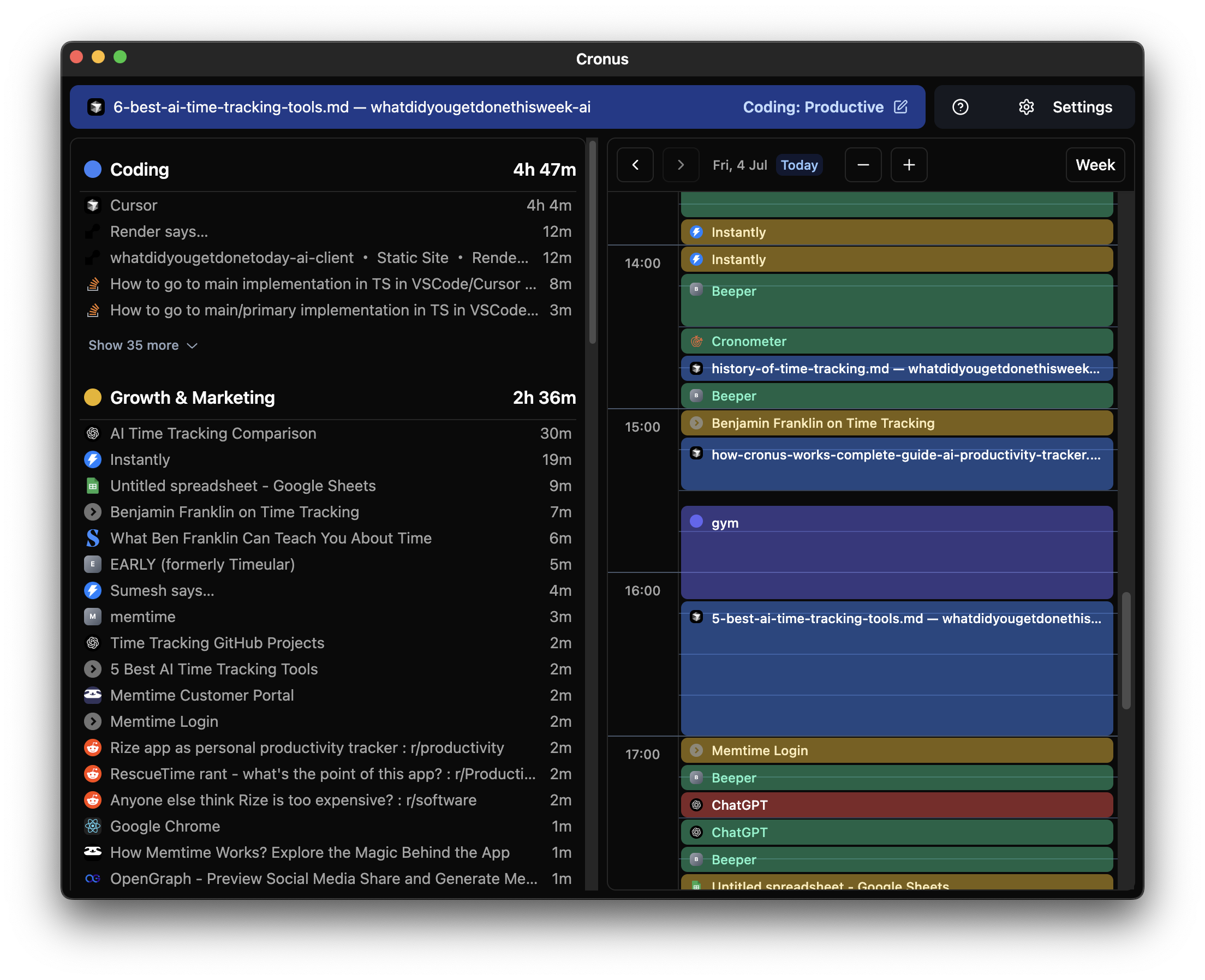
This is a large part of why we built Cronus. It records where your hours actually went, categorized by what the work meant rather than which app was open, so the ratio stops being a matter of impression. A month later you can look at the record and see whether the hours went into things that changed you or things that merely occurred.
What to do with this
Four things, in descending order of how much they matter.
1. Protect the hard hours. The work at the edge of your ability is what creates markers. It is also the first casualty of a fragmented day, because it needs a block and fragmentation kills blocks. Guard that time above everything.
2. Vary the container, not just the content. Different problem, different environment, different collaborators. A new project in the same seat with the same rhythm compresses more than you would expect.
3. Attend to what you are doing. Divided attention is memory suppression. A week of interesting work done while half-monitoring Slack stores like a week of nothing.
4. Keep a record. Even a rough one. The reason a two-week trip feels enormous is partly that you can enumerate it. Enumerability is most of felt duration, and a record supplies it for weeks that would otherwise merge.
The real conclusion
The advice usually given here is "travel more, seek novelty." That is fine and it will not fix a compressed year, because it addresses three weeks out of fifty-two.
The bulk of your life is working hours. Whether those hours are distinguishable from one another is the single biggest lever on how long your life feels from the inside, and it is a lever most people never touch because they have no readout on it.
Getting that readout is not complicated. It just has to be automatic, because the weeks you most need to see are the ones you are least likely to write down.
Try Cronus. Find out what your ratio actually is.
Sources
- Claudia Hammond, Time Warped: Unlocking the Mysteries of Time Perception (2012), which named the holiday paradox and reported the encoding figures above.
- Why Does Time Seem to Speed Up with Age?, Scientific American, on repetition, encoding efficiency and the proportional account.
- METR, "Measuring the Impact of Early-2025 AI on Experienced Open-Source Developer Productivity", for the self-report gap.
Find out where your week actually goes
The 5-day time audit: one short email a day, walking you through the experiments in this post. You will end the week with a real answer instead of an impression. Free, no app required, and it ends after five days.