The Dopamine Menu
A dopamine menu is a pre-written list of things that reliably feel good to you, organised like a restaurant menu, so that when your brain wants stimulation you pick from the list instead of reaching for whatever is nearest.
Whatever is nearest is almost always your phone.
The term dopamenu was coined in May 2020 by Jessica McCabe of How to ADHD and ADHD coach Eric Tivers, looking for a deliberate alternative to pandemic doomscrolling. It went viral on TikTok from 2023 and is now firmly in mainstream wellness territory, which has blurred what it was actually for.
Why it exists
The ADHD brain is underserved by dopamine, and it will go get some. That part is not optional and not a character flaw.
What is changeable is what it grabs. In the moment of wanting stimulation you have almost no capacity to generate options, so you take the one requiring zero decisions: the phone in your hand, already unlocked, algorithmically optimised to be the easiest thing in the room.
The menu is a decision made in advance, when you had the capacity to make it. That is the entire mechanism. It is not about willpower at the moment of craving, because there is none available at the moment of craving.
The five sections
Appetizers — quick hits, roughly 2 to 5 minutes, usable mid-work without derailing anything. One song. Stepping outside. Cold water on your face. Ten push-ups. Texting one specific person.
Mains — the genuinely satisfying, longer things, 30 minutes or more, that leave you better than they found you. An instrument. A real walk. Cooking. A project you like. These are the ones that actually refill the tank, and the ones you reliably forget exist.
Sides — things layered onto boring work to make it tolerable, rather than instead of it. Music. A good coffee. A podcast during admin. Working somewhere else. Someone else in the room (body doubling is the strongest side dish there is).
Desserts — the high-dopamine, low-nutrition ones. Social media, games, YouTube, shopping. Not banned. A menu that pretends you do not want dessert is a menu you will not use.
Specials — rare, need planning, worth having on the list to look forward to. A concert, a trip, a day of something you love.
Write the actual list. On paper, on a whiteboard, anywhere you will see it. A dopamine menu that lives in your head is not a dopamine menu, it is an intention, and the entire point is having something external at the moment your working memory has nothing in it.
The failure mode
Here is the part most articles skip.
Desserts eat the menu. Slowly, and without any single decision you would recognise as a decision.
You build the menu. The first week you use the appetizers. Then a hard day comes and dessert is easier, and dessert is on the list, so it feels sanctioned. Within a month the appetizers and mains are decorative and you are choosing from a dessert-only menu, with the added sting of having a system that says you are doing it right.
Some ADHD coaches call this dessert drift, and it is not a discipline failure. It is the predictable outcome of putting a cheap, engineered option on the same list as an expensive one and expecting a depleted brain to choose the expensive one.
The second failure mode is quieter: the mains never get chosen. They require setup, and the moment you want dopamine is the moment you have the least capacity for setup. So the section that would genuinely help sits untouched while you rotate through appetizers.
The thing you cannot see
Both failure modes have the same root: you cannot tell it is happening.
Dessert drift does not arrive as an hour of Instagram. It arrives as forty separate ninety-second checks that leave no memory behind. Asked at the end of the day, you would honestly report "a few minutes here and there", and you would be wrong by an order of magnitude.
This is well documented and it is not about phones. In a randomised trial, experienced developers estimated a tool had made them 20% faster on real tasks. It had made them 19% slower — a forty percentage point error about work they had just finished. If people misjudge work they were concentrating on, self-report about a habit designed to be unmemorable is not going to be better.
So the honest position is: a dopamine menu without any measurement is a system whose main failure mode is invisible to its user.
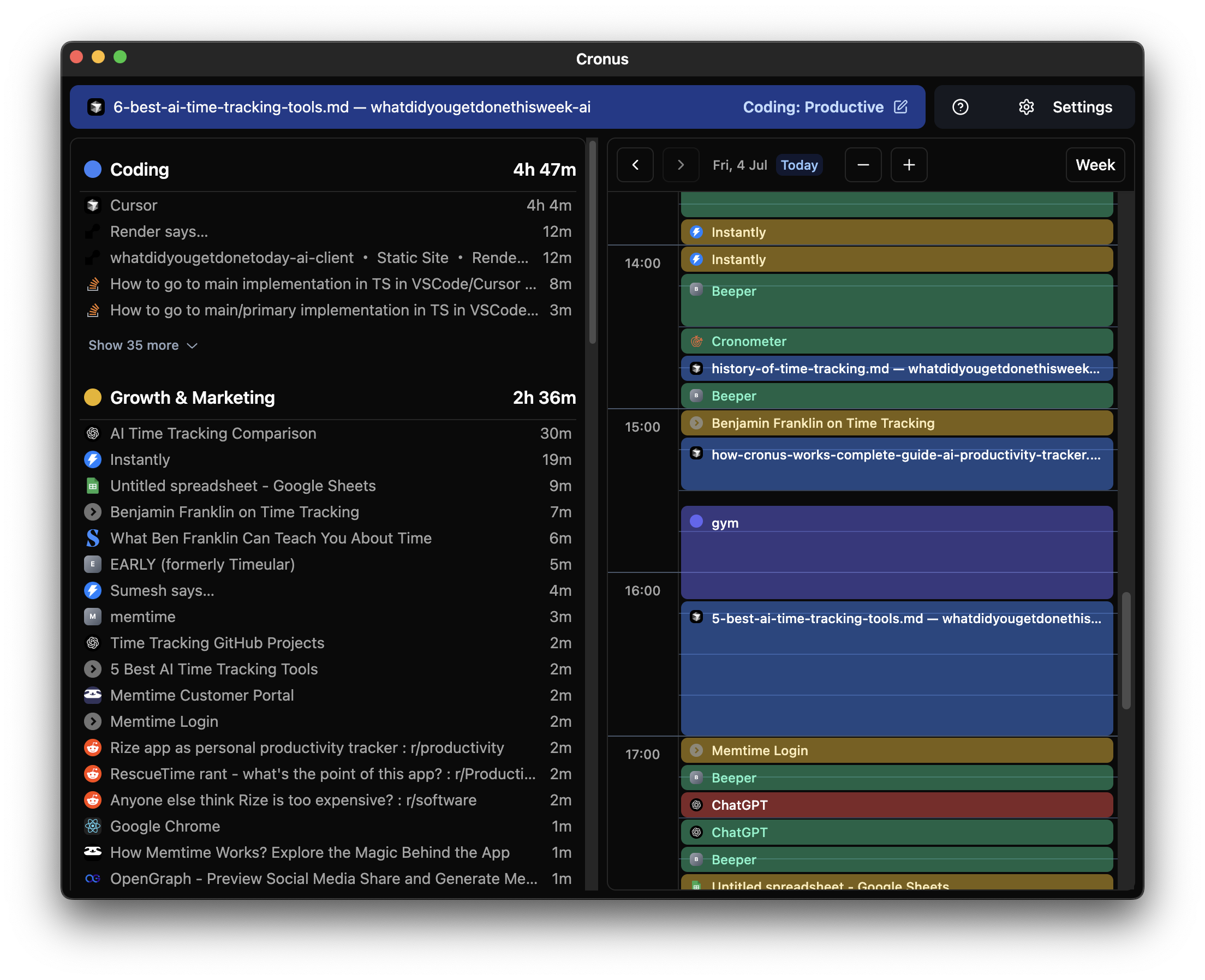
This is the one place a time tracker genuinely helps, and it is a narrow claim. Cronus runs in the background on your Mac and records what you were actually in, with no timer to start and nothing to log, which matters here because remembering to log a dessert is exactly the thing that will not happen.
What it gives you is one number per week: how much time went to the dessert section. Not a judgement, just the number you could not otherwise have. If it went from 40 minutes to three hours, the menu drifted, and you can rebuild it before it collapses entirely.
$6 a month after a 21-day trial. It never captures your screen: window titles only, with sensitive information redacted on your device.
If you would rather not install anything, iOS Screen Time and macOS Screen Time will give you a rough version of the same number for free. Coarser, and much better than guessing.
Building one that survives
Put the desserts in a separate place. Same menu is fine, different page or a different colour. The physical separation does real work, because "choose from the list" and "choose from the dessert list" should not feel like the same action.
Make the mains require no setup. If the guitar is in its case in a cupboard, it is not on the menu. Whatever is on the mains list should be reachable in under a minute or it will lose to dessert every time.
Cap the desserts on the menu itself. Write the portion next to it. "Instagram — 10 min." Weak on its own, and it converts an unbounded choice into a bounded one, which is the only thing that ever helps.
Include the boring physical ones. Water, food, outside, movement. Roughly half of what reads as "I need dopamine" is dehydration, hunger or four hours in a chair. These are the highest-hit-rate items on any menu and everyone leaves them off because they are not fun to write down.
Rewrite it monthly. Menus go stale. What worked in January is background noise by March, which is a dopamine problem and not a motivation problem.
Check the number. Once a week, thirty seconds. This is the step that keeps the other five honest.
When it is not the right tool
If you cannot start work at all, the problem is task initiation, and a dopamine menu is aimed at what happens during work. See ADHD paralysis.
If you cannot stop once started, that is hyperfocus, which is nearly the opposite problem, and a menu will not help.
If everything on the list feels flat, including the mains, that is worth taking seriously rather than optimising around. Persistent anhedonia is a symptom, not a scheduling issue, and it is a reasonable thing to raise with a doctor.
Read next
- What ADHD Communities Actually Say About Time — what people report, in their own words.
- How to Stop Doomscrolling — the specific dessert most menus lose to.
- ADHD and Time Tracking — why manual systems fail on exactly the days they are needed.
Sources: ADDitude: Your ADHD Dopamenu · Mayo Clinic: Dopamine menus · Psychology Today: Creating a Dopa-menu