Busywork
Busywork is activity that consumes time and produces nothing anyone would miss.
The reason it survives is not that people cannot recognise it in the abstract. It is that busywork feels good. It has clear steps, visible completion and no risk of failure, which are exactly the properties that make real work difficult. Reorganising a spreadsheet gives you everything the hard task withholds.
Four tests
The absence test. If you stopped doing this permanently, who would notice and when? If the answer is nobody, or "in about six months, mildly", you have your answer. This is the most useful single question here.
The decision test. Does anything change as a result of it? A report that informs no decision is a report nobody needs. A meeting where no decision is made is a meeting that could have been notes.
The comfort test. Do you reach for it specifically when facing something hard? Busywork is often avoidance wearing a work costume, and the timing gives it away. If you tidy your inbox exclusively before difficult tasks, the inbox was never the point.
The delegation test. Would you pay someone the equivalent of your hourly rate to do this? If not, it is not worth your doing either.
Two useful cautions. Some genuine work fails these tests — maintenance, documentation, and relationship-building often show no visible result and matter enormously. And some busywork is required, which is a different problem addressed below.
The usual suspects
- Status reporting nobody reads. Especially anything duplicating what a tool already shows.
- Meetings without a decision. The largest category by hours. See too many meetings.
- Perfecting internal documents. Formatting a deck three people will glance at.
- Tool maintenance. Reorganising the task manager, migrating notes, refining the system. Enormously satisfying and almost always avoidance.
- Inbox management as an activity. Sorting, labelling, achieving zero. Reading and replying is work; the filing is usually not.
- Duplicate data entry. Same information in three systems because nobody integrated them.
- Approval chains with no judgement in them. Rubber stamps that exist to distribute blame rather than to catch mistakes.
Cutting your own
Do the absence test on your recurring calendar. Recurring items are where busywork accumulates, because nobody revisits a decision made eighteen months ago. Go through them once a quarter.
Stop doing one thing and see what happens. Genuinely: pick something you suspect, stop, and wait. This is far more informative than asking permission, and the answer is frequently silence. If someone notices, you have learned it mattered, at a cost of one cycle.
Batch what you cannot cut. Admin scattered through the day costs more than the same admin in one block, because each switch has a re-entry cost. Give it one slot.
Lower the standard on anything internal. Internal documents need to be clear, not good. The polish is invisible to everyone but you.
Cut attendees before cutting meetings, since that is politically easier and recovers most of the hours.
Automate the duplicate entry. This is usually the largest single win available and it is nearly always technically trivial.
When it is imposed on you
Most advice assumes you can simply stop, which is not most people's situation.
Find out what it is actually for. Some busywork serves a purpose nobody stated: reassuring a nervous stakeholder, creating an audit trail, providing cover. If that is the real function, a cheaper mechanism usually exists, and proposing one works far better than arguing the task is pointless.
Never argue that it is pointless. Whoever asked for it is unlikely to agree, and now it is personal. Argue about frequency and format instead — monthly rather than weekly, a dashboard rather than a document. Nobody defends a cadence the way they defend a decision.
Bring the cost, not the complaint. "This is 90 minutes a week, about 75 hours a year" is a fact that invites a conversation. "This is a waste of time" invites a defence.
Offer the replacement. People rarely agree to lose a thing. They frequently agree to swap it for something cheaper.
Getting the number
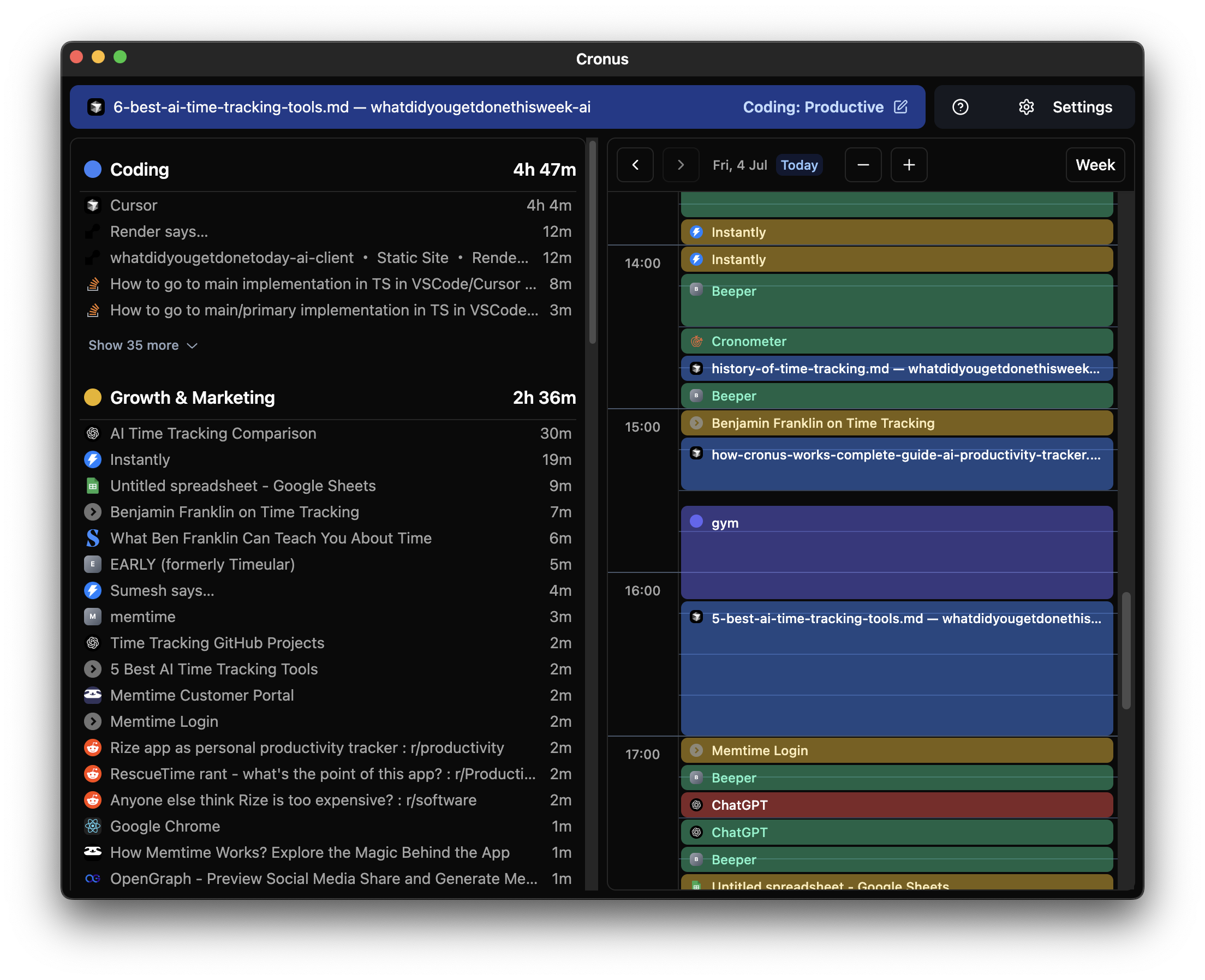
The obstacle to cutting busywork is that its cost is invisible. Nobody feels the 75 hours; they feel the 90 minutes, and 90 minutes sounds reasonable.
Reconstructing it from memory does not work either, because busywork is unmemorable by nature — it leaves no result to remember.
Cronus records where the time actually goes on your Mac, automatically, with no timer and nothing to log, so the small recurring things show up at the same fidelity as the big ones.
The number that changes minds is annual hours on a recurring task. Multiply the weekly figure by 48 and the conversation shifts from preference to arithmetic. The meeting cost calculator does the money version for anything recurring, and the money version is usually the one that lands.
$6 a month after a 21-day trial, and it never captures your screen: window titles only, redacted on your device.
One important caution: bring a conclusion, never a log. Handing raw personal tracking data to a manager creates a performance record you did not consent to, and it will be read in ways you cannot control. More on that here.
The uncomfortable part
Some of your busywork is not imposed. You chose it, because it is easier than the work that matters and it produces the feeling of a day well spent.
That is worth noticing without self-flagellation, because the fix is not discipline. It is usually that the real task has no clear first step, and busywork does. Defining the first step of the hard thing removes most of the pull. See ADHD paralysis, which describes the mechanism even if the label does not apply to you.
Read next
- Too Many Meetings — the largest category of it.
- How to Do a Time Audit — finding it systematically.
- Productivity Guilt — why a busy day still feels empty.