Too Many Meetings: The Cost Is Not the Hours
Twelve hours of meetings in a forty-hour week sounds like 30% of your time.
It is not. It is most of your week, and the gap between those two readings is why every conversation about meeting load goes nowhere.
Two tools for the practical end of this: the meeting cost calculator prices one in salary, and the time zone converter settles what time it is for everyone before it gets scheduled.
Why the hours understate it
A meeting costs its own length plus the block it destroys.
An hour at 11am does not remove one hour from a morning. It removes the morning, because 9:00–11:00 and 12:00–13:00 are rarely long enough for anything demanding, and you spend the first stretch knowing an interruption is coming.
That anticipation is real and rarely counted. Work you cannot finish before an interruption tends not to get started.
Two thirty-minute meetings placed badly can eliminate a whole day of deep work while appearing on the calendar as one hour. That is the entire problem in one sentence, and it is why "we only have 12 hours of meetings" is a misleading defence.
The three costs, in order of size
1. Fragmentation. The largest by a distance. What matters is not how many hours are booked but how many usable blocks survive. A day with meetings at 10 and 3 has no long block in it at all.
2. Re-entry. After an interruption you are working but not yet at depth, and that ramp is invisible. It does not appear on a calendar and nobody schedules around it.
3. The hours themselves. The thing everyone argues about, and the smallest of the three.
Most attempts to fix meeting load attack the third. Shorter meetings, fewer attendees, a stricter agenda. All fine, all attacking the smallest cost.
What actually helps
Move meetings to the edges before cutting them. A recurring meeting at 9am or 4pm costs a fraction of the same meeting at 11am. This is the single highest-leverage change available and it requires nobody to give anything up.
Cluster, do not spread. Three meetings in a row is one interruption. Three meetings spread through a day is three, and it leaves no usable block. Most calendars accidentally do the second.
Protect one block, not the whole day. Blocking your entire calendar fails. Defending 9:00–11:00, every day, is achievable and captures most of the benefit.
Meeting-free days. They work, and they work because of clustering rather than volume: pushing meetings onto other days produces long blocks somewhere.
Cut attendees before cutting length. Cost scales linearly with people, and most large meetings have several people who could read the notes.
Making the argument
The reason meeting load persists is that the cost is invisible to whoever is scheduling. Their hour looks like an hour.
Two things make the case concretely.
The money. Multiply attendees by duration by their hourly cost, then by 50 for anything recurring. The annual number is the one that changes minds, and almost nobody computes it. We built a meeting cost calculator because it takes ten seconds and the result is usually startling.
The fragmentation. More persuasive than the money, and harder to get. Show your longest unbroken block on days with meetings versus days without.
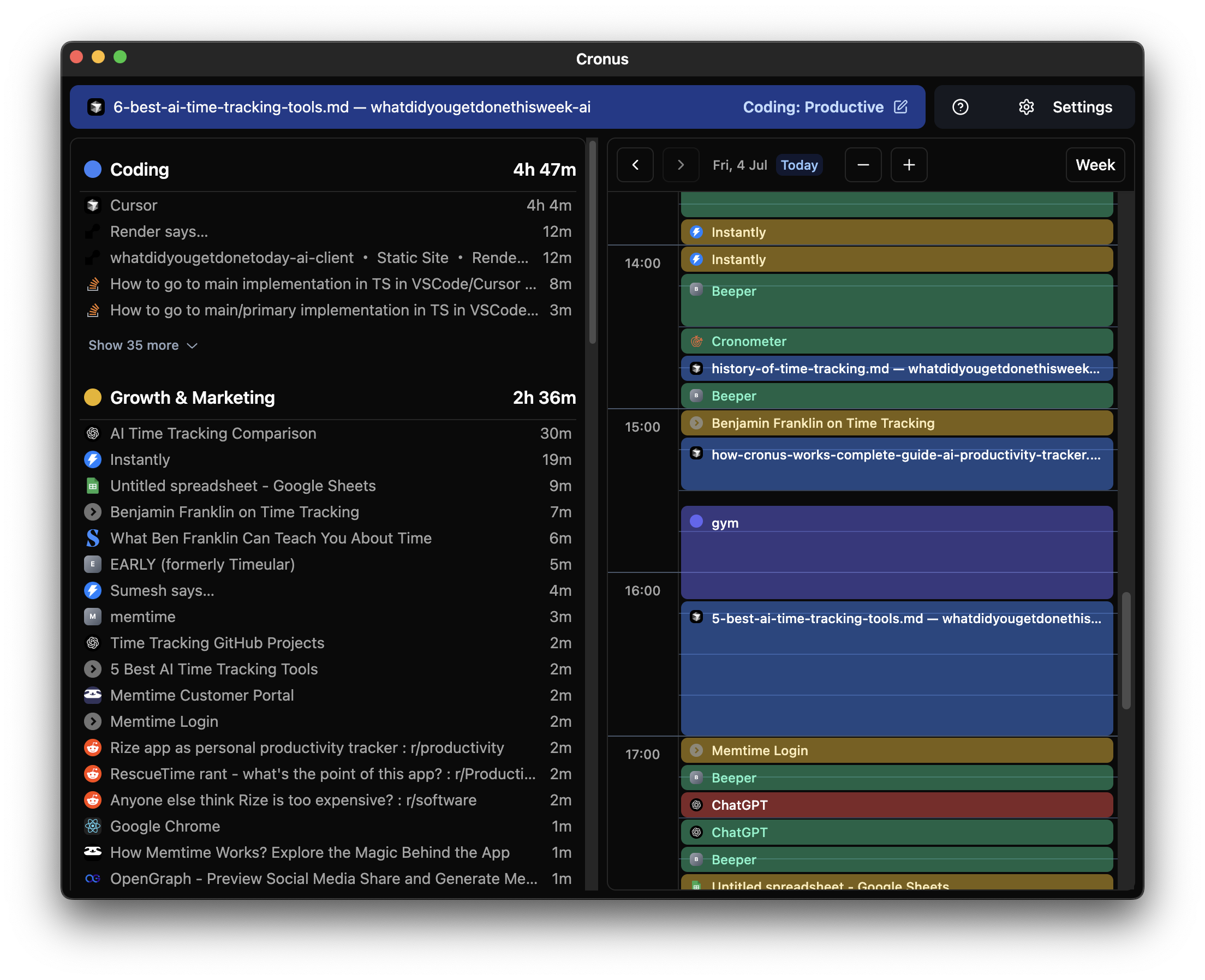
That second number is the argument, and you cannot produce it from memory. Cronus records it automatically, with no timer to start, so "meetings are wrecking my week" becomes "my longest block is 2h10m on clear days and 34 minutes on meeting days".
That is a scheduling conversation rather than a complaint, and it tends to go better.
One caution: bring the conclusion, not a log of your activity. Nobody should be handing detailed tracking data to a manager, and we wrote about why in the accommodations post.
What not to bother with
Arguing about whether the meeting was useful. Unwinnable and it makes it personal. Argue about placement instead, which nobody is defensive about.
Declining without a counter-offer. "Can we move this to 4pm" succeeds far more often than "do I need to be here".
Shortening 60 to 45. Better than nothing, and it does not fix the fragmentation, which is where the cost is.
Read next
- Meeting cost calculator — the annual number for anything recurring.
- Time Blocking: Why It Fails — protecting the blocks that survive.
- Where Did My Day Go? — fragmentation as the usual culprit.