Autistic Masking
Masking, or camouflaging, is the suppression of autistic traits in order to pass as neurotypical.
It is not politeness and it is not adapting to your audience, which everyone does. It is a continuous, effortful performance running underneath everything else you are doing, and the defining feature is that it consumes the same resources the actual task needs.
What it is actually made of
Described abstractly it sounds vague. In practice it is a specific and exhausting list.
Suppression. Not stimming when you need to. Sitting still. Keeping your face neutral when it wants to do something else. Tolerating light, noise or texture that is genuinely painful rather than saying so.
Compensation. Rehearsing conversations in advance. Preparing answers to questions that have not been asked. Scripting small talk. Consciously running the rules for eye contact — how long, how often, when to break — that other people never think about.
Assimilation. Copying other people's phrasing, posture and humour. Forcing interest in topics you do not care about. Not mentioning the thing you actually want to talk about because you have learned it makes people's expressions change.
Every one of these runs while you are also doing your job. That is the whole cost: it is not an occasional effort, it is a background process that never terminates during the working day.
Why it matters more than it sounds
Masking is one of the more consistently replicated findings in autism research, and the associations are not mild.
It is associated with worse mental health. Higher camouflaging scores correlate with depression, anxiety and, in several studies, suicidality. Hull and colleagues' work developing the CAT-Q — the standard camouflaging questionnaire — and subsequent studies have repeatedly found these relationships.
It delays diagnosis, particularly for women. People who mask well look, to a clinician using an observational checklist, like people who are not autistic. This is a substantial part of why so many women and girls are diagnosed late or not at all, and why late diagnosis in adulthood is so often accompanied by the feeling of a life explained retrospectively. Our post on ADHD symptoms in women covers the parallel problem.
It produces a specific kind of loneliness. If the version of you that people know is a construct, their acceptance does not land. Being liked for the mask is not experienced as being liked.
It is strongly linked to autistic burnout. This is the most practically important consequence, and it gets its own post.
One thing worth being clear about: masking is usually not a free choice. It is a response to environments where being visibly autistic carries real costs — social, professional, sometimes physical. Telling someone to simply stop is not advice, it is a request that they absorb those costs.
The time cost, specifically
Here is the part relevant to a site about time.
Masking does not appear on any calendar, and it is not a task, so it never gets budgeted for. But it changes what a day can hold in three measurable ways.
Recovery time is real time. A day of heavy masking is followed by a stretch where you cannot do much of anything. That stretch is not laziness and it is not optional; it is the cost of the day arriving late. Most people schedule as though it does not exist, which is why the evening after a conference or a full day of meetings disappears.
The capacity is spent, not the hours. Two hours of meetings can cost more than five hours of solo work, because the meetings ran the performance and the solo work did not. Planning by hours rather than by cost is why "I only had two meetings, why did I get nothing done" is such a common experience.
It hides its own accumulation. Because none of it is logged anywhere, you cannot see the pattern building until the crash.
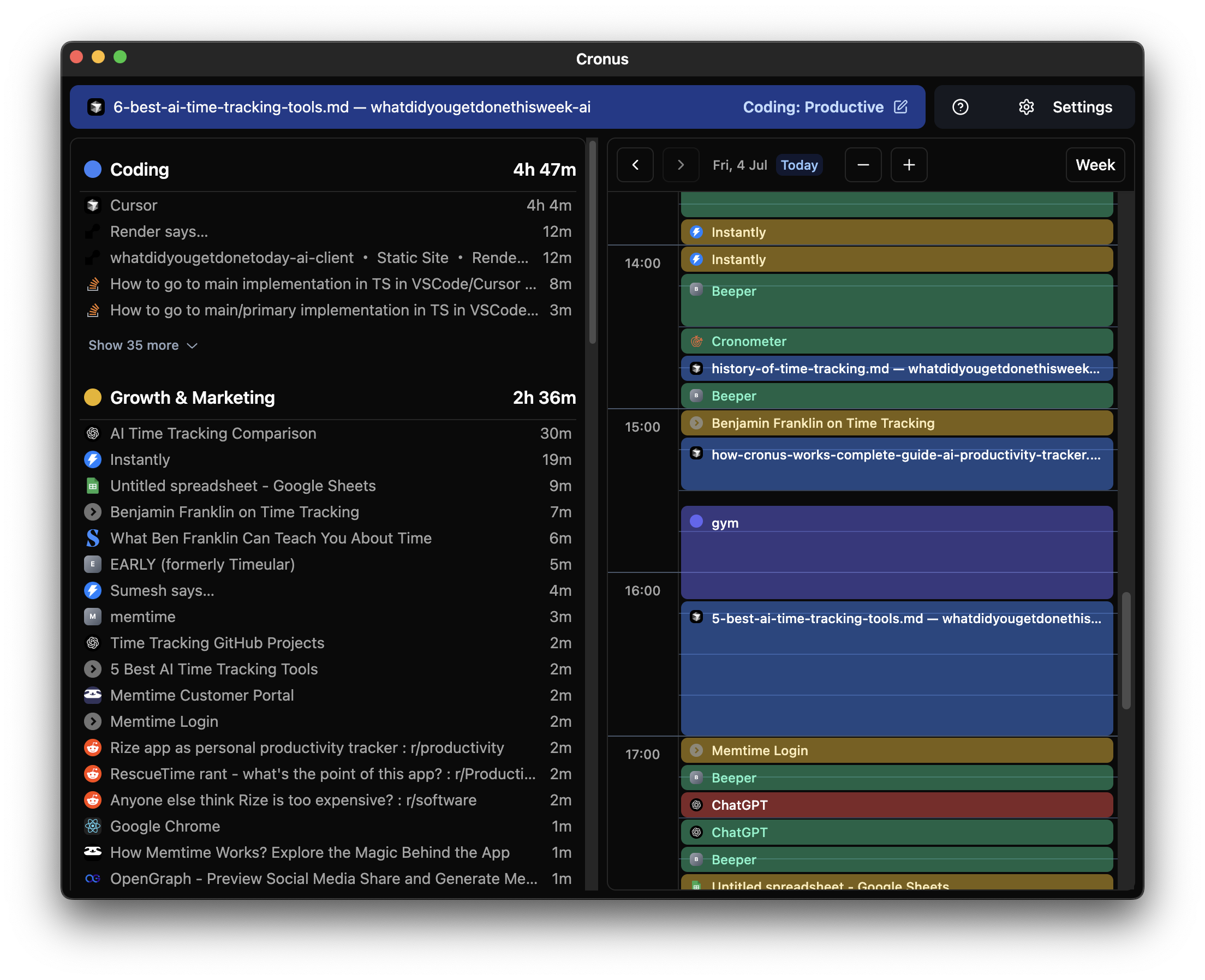
This is the narrow, honest thing a time tracker can do here. Cronus records what happened on your Mac automatically, with no timer and nothing to log. It cannot see masking — nothing can, it is internal — but it can show you the shape it leaves behind: what a heavy social day does to the hours afterwards, and how the days after those days actually go.
That converts "I'm exhausted and I don't know why" into a pattern with dates on it. Which is what you need if you are going to ask for anything to change.
$6 a month after a 21-day trial, and it never captures your screen: window titles only, with sensitive information redacted on your device.
Two limits, stated plainly. It measures activity, not effort, so a brutal day and an easy day of the same length look identical. And if you are already inclined to judge yourself by output, a dashboard can make that worse rather than better. Look weekly, not daily.
What unmasking realistically looks like
The framing of "unmasking" as liberation is common online and sets people up badly. It is more accurate to think of it as choosing where you spend it, because the total is finite either way.
Start where it is safe, not where it is hardest. Alone, then with one trusted person, then a low-stakes setting. Not at work first.
Drop the invisible ones first. Let yourself stim where nobody can see. Stop forcing eye contact with your screen. These cost you nothing socially and return real capacity.
Pick your accommodations to reduce the demand, not to announce anything. Camera off. Written instructions instead of verbal. Fewer, longer meetings instead of many short ones. Noise-cancelling headphones. None of this requires disclosing anything, and all of it reduces the load. Our accommodations post covers how to ask, and why you should never hand over raw personal data as evidence.
Budget recovery deliberately. Put it in the calendar as a real block. Recovery that is not scheduled gets colonised.
Be realistic about disclosure. Whether unmasking at work is safe depends entirely on your workplace, and you are the only one who can assess that. Nobody writing a blog post knows your situation, and advice that assumes a supportive employer is useless if you do not have one.
When to get support
If masking is costing you your mental health rather than just your energy — persistent low mood, anxiety that does not lift, or thoughts of self-harm — that is worth professional support, ideally from someone who works with autistic adults specifically. A neurotypical-default therapist can sometimes make masking worse by treating the performance as the goal.
Read next
- Neurodivergent Burnout — where sustained masking usually ends.
- Monotropism — why social interaction is expensive in a specific, structural way.
- ADHD Symptoms in Women — the parallel late-diagnosis problem.
Sources: Hull et al. (2019), Development and validation of the CAT-Q, Journal of Autism and Developmental Disorders · Cassidy et al. (2020), camouflaging and suicidality, Molecular Autism · National Autistic Society