Neurodivergent Burnout
The most useful thing to know about neurodivergent burnout is that it is not caused by the amount of work.
Occupational burnout, as the WHO defines it, comes from chronic unmanaged workplace stress. Reduce the workload and it improves. That is why the standard advice — take leave, delegate, set boundaries at work — works reasonably well for it.
Autistic and ADHD burnout is caused by sustained masking, compensation and sensory load running above capacity for a long time. The workload is often not the problem. Which is why people take two weeks off, come back, and collapse again within a month, then conclude something is wrong with them.
What it actually looks like
The presentation is different from occupational burnout in ways that matter for recognising it.
Skills regress. This is the most distinctive feature and the most frightening. Things you could reliably do stop working: speech gets harder, executive function drops, driving or cooking becomes unmanageable, previously fine sensory environments become intolerable. Autistic communities describe this as regression, and it is real rather than imagined.
Sensory tolerance collapses. Noise, light and touch that were manageable are suddenly not. Often the earliest warning sign, and usually dismissed.
Masking stops being possible. Not a choice. The capacity that ran it is gone, which is why people often become visibly more autistic during burnout, sometimes for the first time in adult life.
Executive function drops further than usual. Tasks that were already hard become impossible, including the ones that would help.
Rest does not restore it. A weekend does nothing. A two-week holiday helps slightly and does not resolve it. Recovery is measured in months.
The exhaustion is not fixed by sleep. People sleep enormously and wake up unchanged.
If you recognise most of that list, generic burnout advice is going to fail you, and it will not be your fault when it does.
Why a holiday does not fix it
Because the load is not the job. The load is the continuous, unpaid work of operating in an environment that was not built for you.
That work does not stop on holiday. It runs during travel, at the family gathering, in the unfamiliar accommodation with the wrong lighting. Some holidays cost more capacity than the working week does, which is why people return worse and cannot explain it.
This is also why the advice to "do less" is imprecise. The relevant variable is not hours. It is how much of your day requires suppression, performance, unpredictability and sensory tolerance.
Two jobs of identical hours can differ by a factor of several on that axis. A quiet solo role with predictable structure and a client-facing open-plan role are not the same job, and no timesheet will ever show the difference.
The compensation trap
Here is the mechanism that produces the collapse, and it is worth naming because it is so easy to miss from the inside.
Difficulty in one area gets compensated for by effort elsewhere. Poor working memory gets compensated with elaborate lists. Difficult transitions get compensated with rigid routines. Social confusion gets compensated with scripting and rehearsal.
The compensation works. That is the trap. From outside, and often from inside, everything looks fine. The person is coping, so nothing is adjusted, so the compensation keeps running.
But compensation costs capacity continuously, and capacity is finite. The system holds right up until it doesn't, and because the visible performance was fine the whole time, the collapse looks sudden and inexplicable to everyone including you.
Most people arrive at burnout after a long period of doing well. That is not irony. It is the mechanism.
What actually helps
Recovery is slower and less satisfying than the internet suggests, and the honest version is worth more than an encouraging one.
Reduce sensory and social load before reducing hours. This is the highest-leverage change and it is not what anyone tries first. Fewer meetings beats fewer working hours. Camera off beats a shorter day. A quiet room beats a long weekend.
Drop the invisible masking first. Stimming in private, no forced eye contact on calls, headphones. Costs nothing socially, returns real capacity.
Let the routines get boring and rigid. During burnout, novelty is expensive. This is the wrong time to fix your life, start a system, or take on a project.
Expect months. Autistic communities consistently describe recovery in months, not weeks. Planning for two weeks and then failing to be better sets up a second collapse.
Reduce the demand permanently, not temporarily. Burnout that resolves and recurs is almost always burnout where the underlying load never changed. This is the part people skip, and it is the only part that prevents the next one.
Get support if you can. Ideally from someone who works with autistic or ADHD adults. Standard burnout treatment aimed at workload will miss the cause.
Seeing it before it arrives
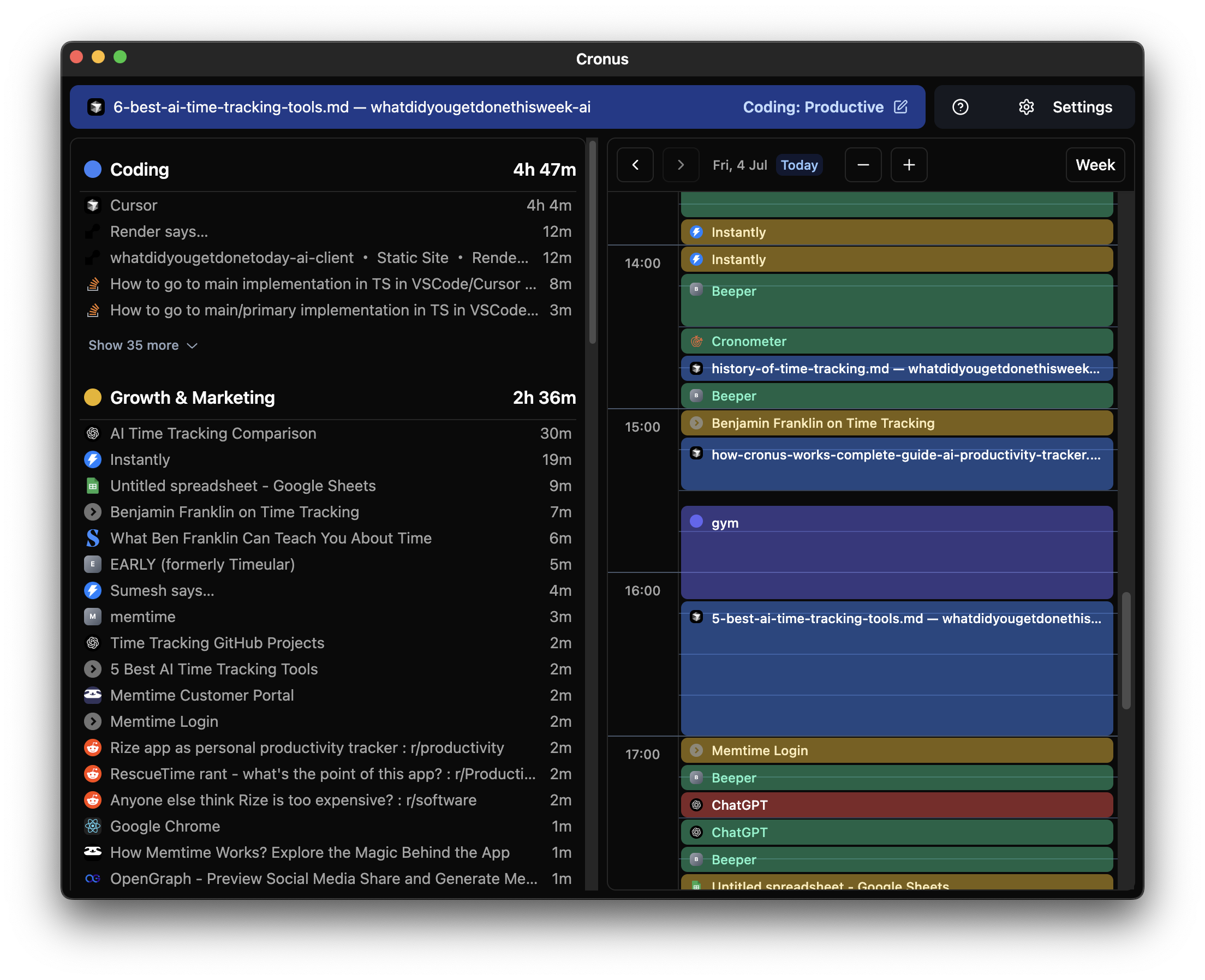
The reason burnout blindsides people is that the compensation hides the load until the failure. There is no gauge.
You cannot measure masking directly. Nothing can; it is internal. But you can measure the things that reliably drive it, and those leave a trace.
Cronus records automatically on your Mac, with no timer and nothing to log — which matters here, because during a bad stretch you will not maintain a manual log, and that is precisely the stretch worth having data on.
The two things worth watching, weekly and not daily:
Meeting and social load. Not total hours, but how much of the week was performance. This is the number that predicts a crash, and it is usually creeping upward for months beforehand.
Recovery days. The days after heavy ones. When those start producing nothing, capacity is already spent, and that shows up before the collapse does.
$6 a month after a 21-day trial, and it never captures your screen: window titles only, redacted on your device before anything is sent.
Where this genuinely does not help: it will not measure sensory load, home life, or anything away from the laptop, and those are often the larger share. It is one input, not a diagnosis. And if you are already in burnout, adding a tracking habit is the wrong project — do it on the way out, not at the bottom.
Please read this part
Neurodivergent burnout involves genuinely elevated risk. If you are experiencing persistent hopelessness, or thoughts of suicide or self-harm, please talk to a doctor or a crisis line rather than working through a productivity article. In the US you can call or text 988. In the UK, Samaritans is 116 123.
That is not a disclaimer. Burnout in this population has been repeatedly associated with serious outcomes, and it is worth taking seriously well before it feels like an emergency.
Read next
- Autistic Masking — the load that causes it.
- ADHD Burnout — the ADHD-specific version.
- Monotropism — why transitions and interruptions cost what they do.
Sources: Raymaker et al. (2020), Having All of Your Internal Resources Exhausted Beyond Measure: Defining Autistic Burnout, Autism in Adulthood · Higgins et al. (2021), defining autistic burnout, Autism · WHO, ICD-11: Burnout as an occupational phenomenon