Agency Time Tracking
Two things up front, because they will save you time.
We do not build a team product. No seats, no utilisation dashboard, no client reports, no manager view. Cronus is a single-user tool. If you are here to equip an agency, the recommendations below are the useful part of this page. The free time card and timesheet calculators are useful whichever product you land on.
We are not going to help you monitor staff, and the section at the end explains why that is a practical position rather than a moral one.
What agencies actually need
Time attached to client, project and task, because agency profitability lives at the project level and nowhere else.
Utilisation reporting — billable against available hours — per person and per team.
Budget burn against estimate, visible while the project is running rather than after it has lost money.
Rate cards, since a strategist hour and a junior designer hour are not the same unit.
Approval before invoicing. Someone signs off.
What to use
Harvest is the default for a reason. Time, expenses, budgets and invoicing in one place, straightforward enough that people actually fill it in, and priced sanely for small teams.
Toggl Track for the best manual tracking experience, with strong reporting and project budgets. Free up to five users, then $9–$18 a seat.
Clockify is the cheapest credible option, free for unlimited users on the basic tier and from $3.99 a seat for the rest. More detail here.
Timely if entry compliance is your actual problem. Its Memory app records in the background and drafts timesheets people approve rather than compose, which is a much lower ask. Around $11 a seat.
Productive, Scoro or Teamwork if you have outgrown time tracking and need resourcing, pipeline and profitability in one system. Heavier, and the right answer past roughly twenty people.
Choose on compliance, not features. An agency time tracking tool nobody fills in is worth less than a worse tool everybody does.
Why the timesheet understates scope creep
Here is the part worth knowing regardless of which tool you buy.
Scope creep does not arrive as a task. It arrives as a fifteen-minute call, a "quick look" at a deck, a Slack thread, a revision nobody logged because it felt too small to log. Individually beneath the threshold anyone would open a timer for. Collectively, the difference between a profitable retainer and an unprofitable one.
Timesheets systematically miss exactly the work that causes scope creep, because they capture what people remember to record, and the increments that matter here are precisely the ones that feel too small to record.
The second gap is switching. Someone across four accounts in a day is not doing four blocks of work; they are doing four blocks plus three rebuilds. That cost is real, unbillable and absent from every utilisation report, which is why a team at 85% utilisation can feel underwater.
Where a single-user tool is still useful
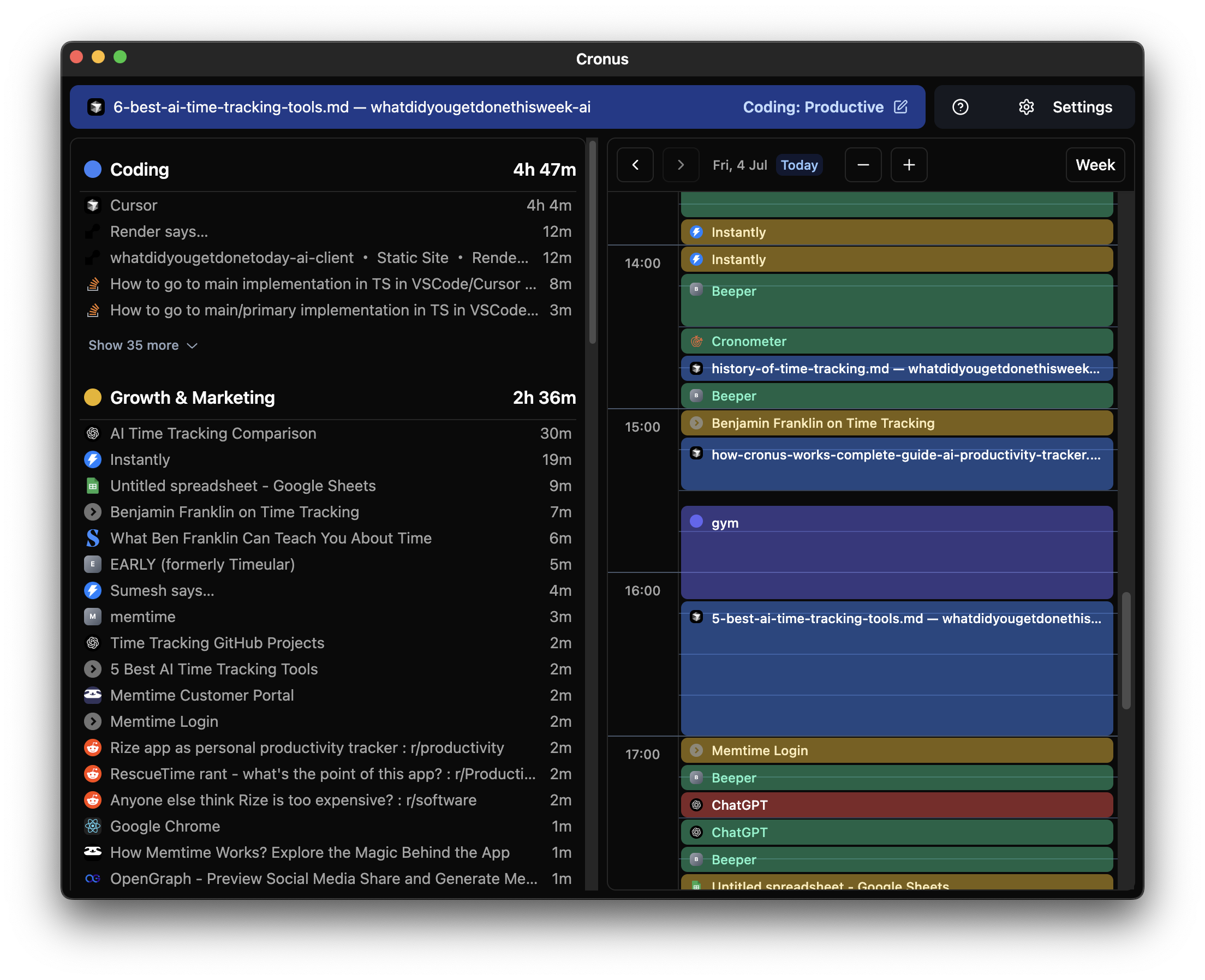
One narrow case: an individual at an agency who wants to know where their own week went, alongside whatever the agency runs for billing.
Cronus records automatically on your Mac, with no timer and nothing to log, so the small unlogged increments show up. For a founder or account lead, the useful findings are usually how much of the week went to one account versus what it pays, and how many context switches a day contains.
That is a personal tool for your own decisions, not an agency system. $6 a month after a 21-day trial, and it never captures your screen.
On monitoring staff
If what you want is oversight of employees, we are the wrong vendor, and this is worth saying plainly rather than pretending we are merely unsuited.
Automatic tracking on someone else's machine is a different product with different ethics. It changes behaviour, and mostly not in the direction intended: people optimise for looking busy, stop taking the thinking time that produces good work, and stop reporting problems early. The data also tends to be used to answer questions it cannot answer, since hours at a keyboard and value delivered are only loosely related in creative work.
If you have a performance problem with someone, tracking software will not tell you what it is. If you have a profitability problem with an account, project-level time in Harvest will.
Never ask individuals to hand over raw personal tracking data, and if you are on the other side of that request, we wrote about how to share a conclusion instead of a log.
The short version
Under 20 people: Harvest, or Clockify if budget is tight, or Timely if nobody fills anything in.
Over 20: Productive or Scoro.
For yourself: something automatic, because the increments that sink retainers are the ones nobody logs.
Read next
- Time Tracking for Consultants — the solo version of the same problem.
- Too Many Meetings — where agency weeks usually go.
- Best Timely Alternatives — if drafts-to-approve is the model you want.