ADHD Procrastination: Why Deadlines Work and Nothing Else Does
Three weeks before the deadline: nothing. The night before: four hours of excellent work.
Everyone treats that as a discipline problem. It is more useful to treat it as information about how your motivation system is wired.
Written by people who build a time tracker, not clinicians. About mechanism and practical fixes, not diagnosis.
Now and not now
The most useful model here is simple. Many ADHD brains have two settings for time: now and not now.
Something due tomorrow is now. Something due in three weeks is not now. Not now is not "less urgent". It is functionally invisible.
That explains the shape of the pattern. Nothing happens for weeks, then everything happens at once. Not because you left it late, but because until it was near, it did not register as a thing that existed.
Why deadlines work
Because urgency supplies what the system otherwise lacks.
A pressing deadline creates enough pressure to overcome the gap between deciding and starting. That is why the night before is productive and the fortnight before is not.
It also explains something people find confusing: you are not lazy, you are under-stimulated. The same person who cannot start a three-week task will work for six hours straight on something urgent, or interesting, or novel.
Interest and urgency both function as fuel. Importance, on its own, often does not.
Why the standard advice fails
"Start earlier." The instruction assumes the task is visible early. It is not. There is nothing to act on.
"Break it into smaller pieces." Good advice that needs sequencing, which is frequently the jammed function. See ADHD paralysis.
"Just do a bit each day." Requires daily initiation with no urgency present. That is the hardest possible version.
"Think about the consequences." You already know them. Knowing has never been the missing piece.
Each one assumes the problem is that you have not realised you should start.
What actually works
The strategies that work do one of two things: make it now, or make it interesting.
Manufacture proximity
Use somebody else's deadline. Tell a person you will send it Thursday. External commitments have a weight that self-imposed ones do not.
Make intermediate deadlines real. "Draft by Tuesday" only works if someone sees the draft on Tuesday.
Shrink the horizon. Do not plan the month. Plan today. Anything beyond the visible horizon is not motivating, so planning it is wasted effort.
Add stimulation
Body doubling. Another person working alongside you, in person or on a call. It is the most reliable intervention in this whole area and it costs nothing. We build software and will still say it outperforms ours.
Change the setting. A different room, a café, anywhere with mild novelty.
Make the first step trivially small. Not "write the report". "Open the document and write one bad sentence."
Stop optimising for a system you do not have
Most productivity systems assume steady effort over time. Yours is not steady, and no amount of setup changes that.
Planning around bursts works better than planning against them: keep big blocks free rather than spreading work thinly, and expect the fortnight before to be quiet.
The thing to be careful about
Deadline-driven work has a real cost, even when it produces good output.
It is stressful. It burns recovery. It leaves no margin when something goes wrong. And it feeds directly into burnout, because it runs on adrenaline rather than on capacity.
"It works, so it is fine" holds until the week something breaks.
What you cannot see
Two weeks of "not working on it" are not blank. They usually contain a background hum of dread, plus a large amount of avoidance activity that never gets counted.
That is invisible afterwards. What you remember is "I did it the night before", which reads like efficiency.
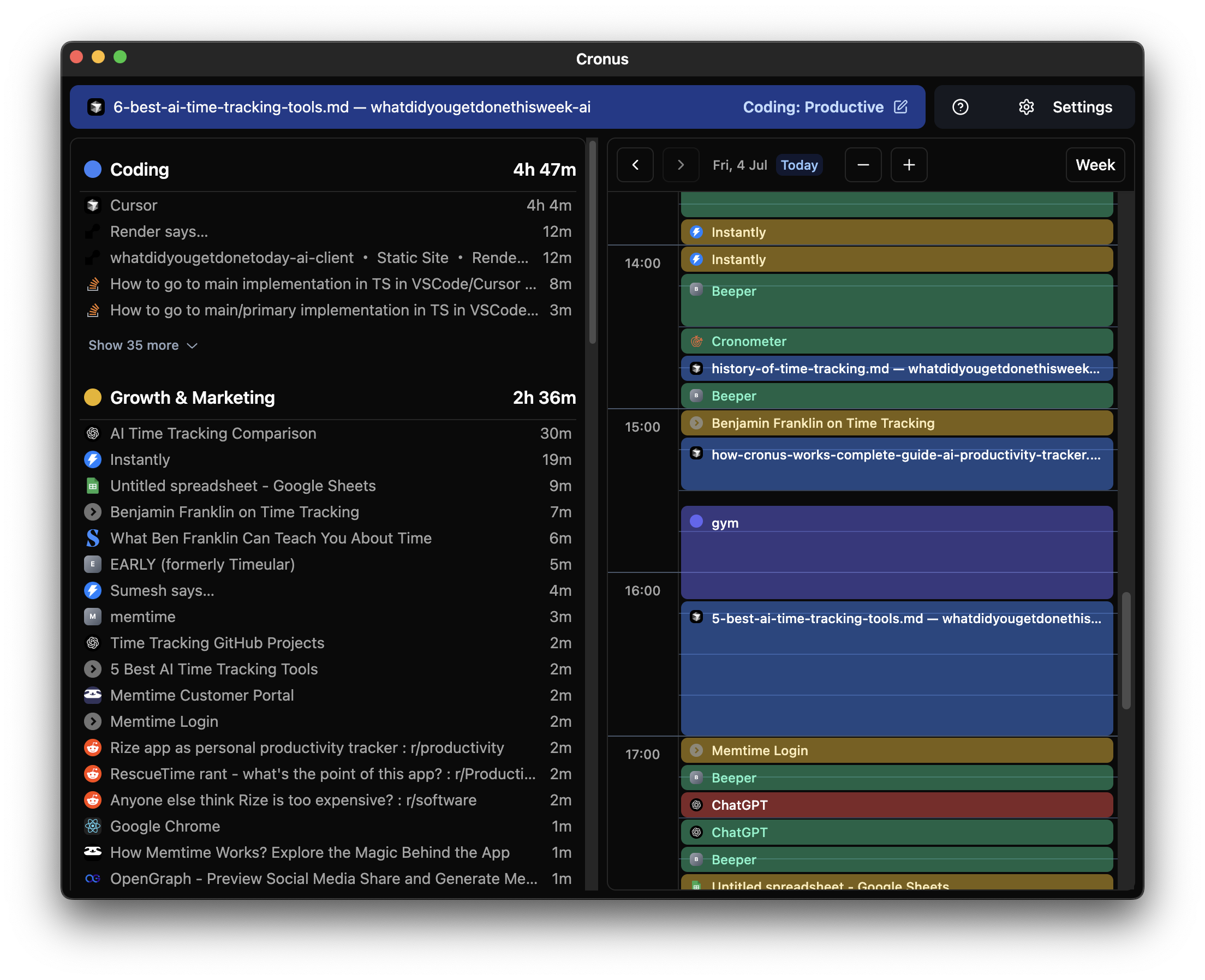
Cronus records where the time actually went, automatically, with nothing to start or log. So the fortnight before a deadline is a record rather than a blur, and the avoidance shows up as what it is.
Two things usually surprise people. The avoidance is more expensive than the task. And the burst is shorter than remembered — the legendary all-nighter was often three hours.
Where it will not help: it will not create urgency and will not start anything. For that, a person expecting something on Thursday beats every app.
The reframe worth keeping
You are not bad at starting things. You are bad at starting things that are not now, which is a different problem with different fixes.
So stop trying to want it earlier. Make it nearer, make it more interesting, or put a person on the other end of it.
Read next
- ADHD Paralysis — when even an urgent task will not start.
- ADHD Burnout — the cost of running on deadlines for years.
- ADHD Time Blindness — why three weeks away is invisible.
- Body Doubling and Accountability Partners — the intervention that beats every app.
Find out where your week actually goes
The 5-day time audit: one short email a day, walking you through the experiments in this post. You will end the week with a real answer instead of an impression. Free, no app required, and it ends after five days.