ADHD Executive Dysfunction: What It Is, in Plain Language
Most explanations of executive function are written for clinicians and read like it. This one is written for someone who wants to know why they can hold a complicated job and still be unable to reply to a two-line email for nine days.
Written by people who build a time tracker, not clinicians. It is about mechanism and practical consequence, not diagnosis or treatment.
The short version
Executive functions are the brain's management layer. Not the skills that do the work, the ones that decide which work happens, in what order, starting when, and whether to keep going.
You can have every underlying ability intact and still not produce anything, if the management layer is not dispatching. That gap is the whole of executive dysfunction, and it explains the thing that confuses everyone around you: how someone this capable can be this stuck.
It is also why "you're so smart, why can't you just…" is a question with an answer. Intelligence is not the layer that is struggling.
The seven functions, and what it feels like when each one slips
You do not need the taxonomy to function, but you do need it to stop misdiagnosing yourself. Most people blame "laziness" for six different problems that need six different fixes.
1. Task initiation — getting from decided to started. When it slips: you sit in front of the thing, knowing exactly what to do, not doing it. See ADHD paralysis.
2. Working memory — holding information live while you use it. When it slips: you walk into the room and forget why, or lose the thread of a sentence mid-sentence.
3. Planning and sequencing — turning a goal into ordered steps. When it slips: the task feels like an undifferentiated mass rather than a list, so there is no obvious place to grab it.
4. Prioritisation — deciding what matters most. When it slips: everything feels equally urgent, which is functionally the same as nothing being urgent.
5. Time management — sensing duration and planning around it. When it slips: time blindness, chronically underestimating tasks, "five more minutes" becoming two hours.
6. Emotional regulation — keeping feeling proportionate to event. When it slips: a small piece of criticism eats the whole afternoon.
7. Self-monitoring — noticing what you are doing while you do it. When it slips: forty minutes into the wrong task with no memory of switching.
Two of these — time management and self-monitoring — are the reason this is so hard to fix by trying harder. They are the functions that would notice the problem.
Why this makes advice fail
Almost all productivity advice assumes an intact management layer and offers better instructions for it. Which is why it works fine for people who did not need it.
- "Make a list" assumes prioritisation. If everything feels equally urgent, you have written down the problem, not solved it.
- "Break it into steps" assumes sequencing, which is often the function that jammed.
- "Check the clock" assumes self-monitoring, the thing that is not running.
- "Just start" assumes initiation, which is the actual failure.
Every one of them hands the task back to the part that is struggling. That is not bad advice, it is advice for a different problem.
What helps, by function
The pattern across all of these: move the load off the management layer and onto something external.
Initiation — shrink to a physical first action ("open the document", not "write the report"). Body doubling, which is the most effective intervention in this entire space and is free.
Working memory — write everything down immediately, in one place you always check. The goal is not organisation, it is not having to hold it.
Planning — get the sequence out of your head and onto paper before starting. Or borrow a template rather than deriving one each time.
Prioritisation — reduce the options to two, then pick either. Almost always better than ranking twelve things correctly.
Time management — make time external. An analogue clock in your eyeline, and an automatic record so you are not relying on a sense that is not reporting accurately.
Emotional regulation — put distance between event and response. Draft the reply, send it in an hour.
Self-monitoring — this is the one you cannot do from the inside, by definition. It has to be an interrupt from outside: a person, an alarm, or software that notices you have drifted.
The two you cannot self-assess
Worth its own section, because it is the trap.
Five of the seven functions announce themselves. You know you forgot the thing. You know you could not start.
Time management and self-monitoring do not. Their failure mode is silence. You do not experience "I have lost track of time," you experience nothing, and then it is 4pm.
Which means introspection cannot fix them, and worse, introspection feels like it is working. You reflect on your week, arrive at a confident account, and that account is wrong in ways you have no way of detecting.
The research on this is stark, and not specific to ADHD. In a 2025 randomized controlled trial, experienced developers estimated AI tools had made them 20% faster on real tasks from their own backlogs. They were 19% slower — an error of roughly forty percentage points about work they had personally just finished. To find out what actually happened, researchers had to record screens and hand-review 143 hours of video.
If that is the error on ordinary self-assessment, the estimate you form on a hard day is not evidence of anything.
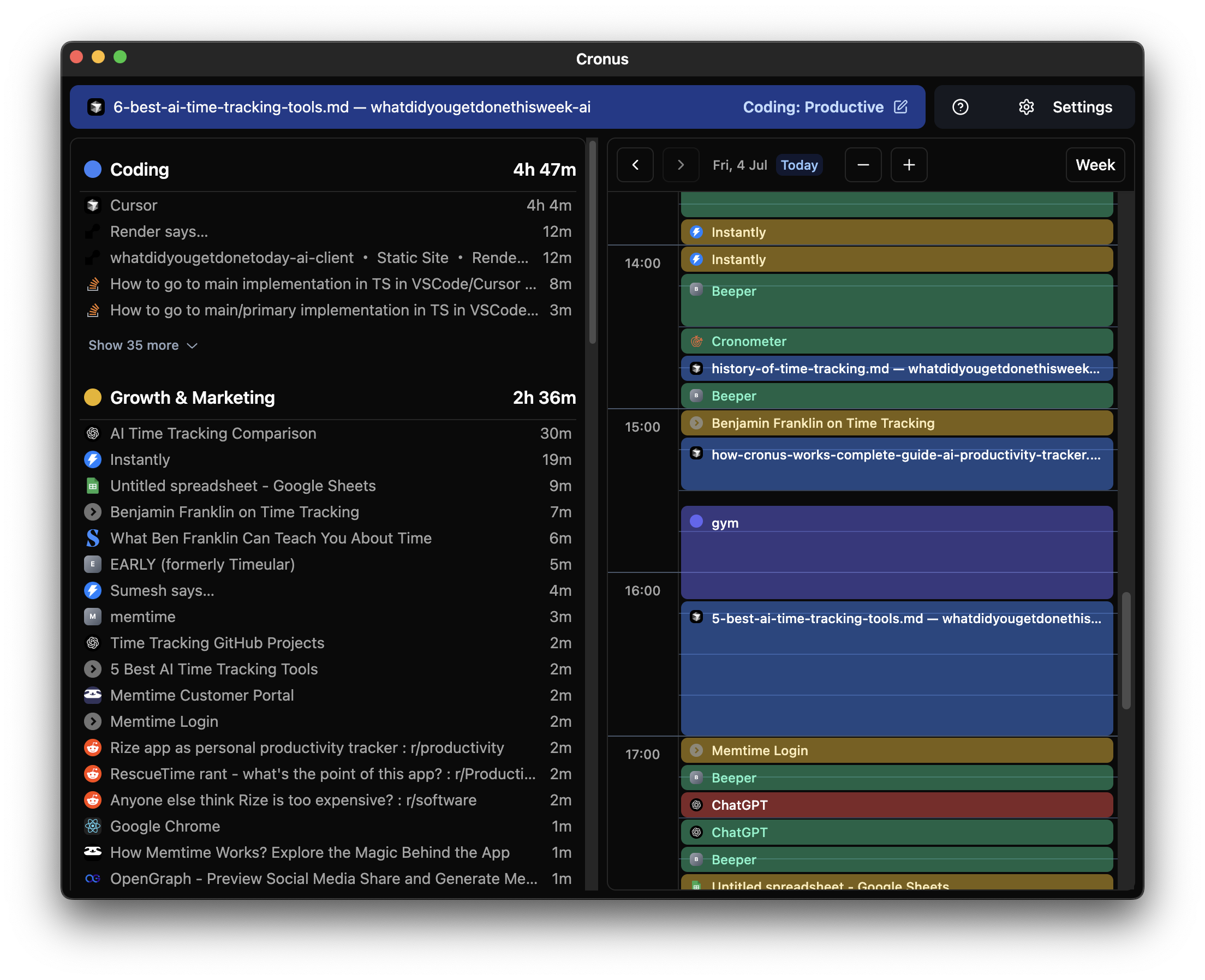
That gap is the specific thing Cronus exists to close. It records which app and window you were in and works out what the time was in service of, automatically, so the two functions that go quiet get an external record instead of your recollection. No timer to start and nothing to log, which matters because logging is itself an initiation task and stops happening on the days worth seeing.
And it does nothing for the other five. It will not start tasks, hold your working memory, sequence your plan, prioritise, or regulate anything. For those, the list above is more use than we are.
What to stop doing
Stop treating it as one problem. "I'm bad at productivity" is seven different problems wearing one coat, and they need different responses.
Stop using intelligence as the yardstick. Executive function is a separate system. Being good at your job predicts nothing about whether you can start an email.
Stop relying on the two silent ones. Anything whose first step is "notice that…" is building on the part that does not report.
Read next
- ADHD Paralysis: Why You Freeze — the initiation failure in depth.
- ADHD Time Blindness — the time-management one.
- ADHD and Time Tracking: Why Manual Trackers Fail You Specifically — why tools built on self-monitoring do not survive contact with a bad week.
- ADHD Forgetfulness — the working memory one, in depth.
- ADHD Symptoms in Women — why this gets missed for decades.
The newsletter below is a five-day audit of your own time. One short email a day, nothing to log.
Find out where your week actually goes
The 5-day time audit: one short email a day, walking you through the experiments in this post. You will end the week with a real answer instead of an impression. Free, no app required, and it ends after five days.